
Description
1. Product Overview
Zirconium n-propoxide is a high-purity organometallic precursor, essential for the synthesis of advanced zirconia-based ceramics, optical coatings, and catalytic materials. Its primary industrial use lies in chemical vapor deposition (CVD) and sol-gel processing for producing high-refractive-index films and nano-structured zirconia powders. The key value proposition is exceptional hydrolytic reactivity combined with a low carbon residue profile, enabling superior film uniformity and densification at lower processing temperatures. Strategically, this product is critical for manufacturers in aerospace, solid-state batteries, and precision optics seeking to reduce defects and improve thermal barrier performance in next-generation components.
2. Key Specifications & Technical Characteristics
-
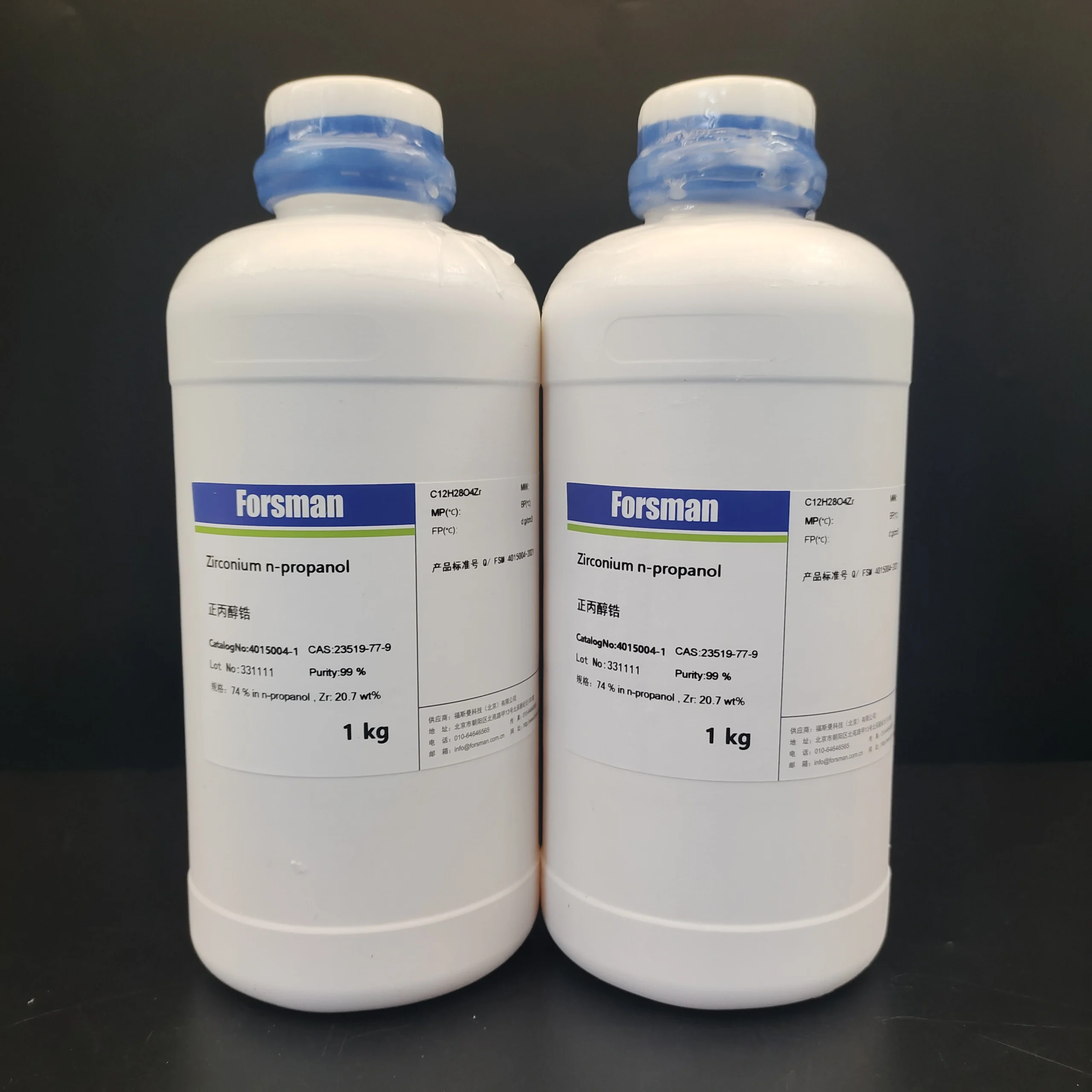
Chemical composition: Zr(OC₃H₇)₄ (Zirconium tetra-n-propoxide)
-
Purity level: ≥99.9% (trace metals basis); standard industrial grade ≥99.5%
-
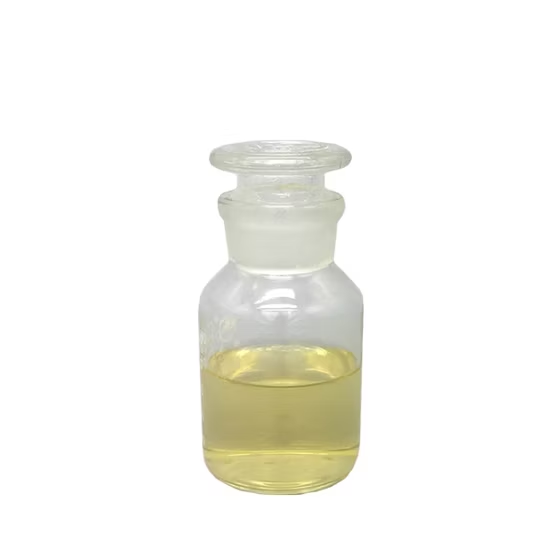
Physical characteristics: Pale yellow to amber liquid; density ~1.05 g/cm³ at 20°C; viscosity 5–15 cP; boiling point 117–120°C at reduced pressure (1 mmHg)
-
Reactivity: Highly moisture-sensitive; supplied under inert gas blanket
-
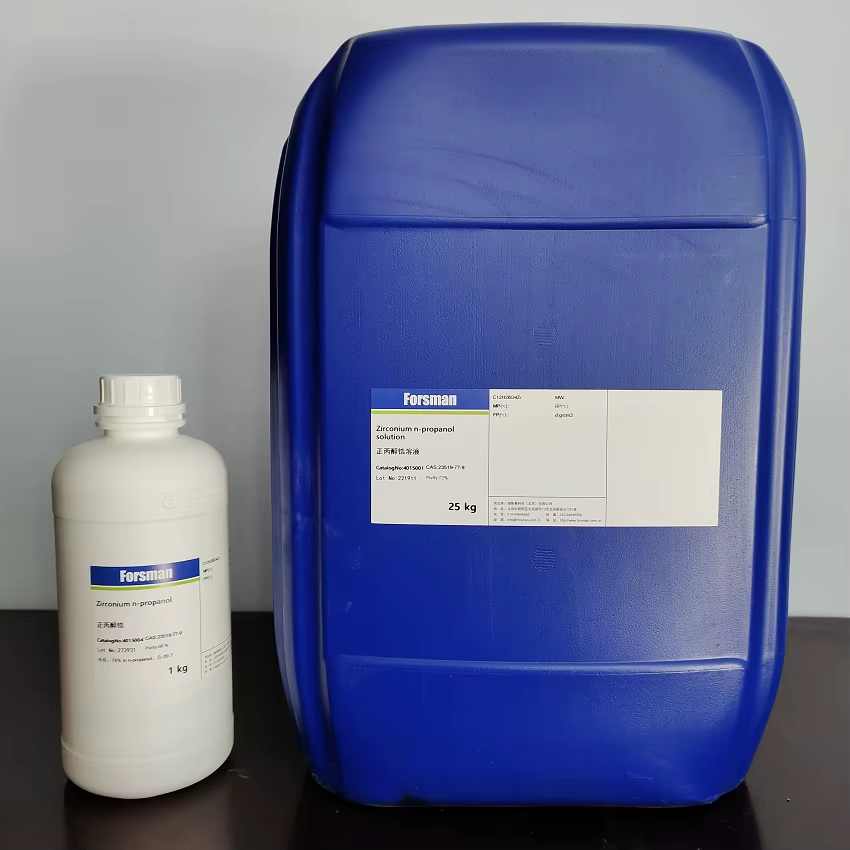
Packaging options: 1L, 5L, 20L stainless steel canisters with PTFE liners; 200L drum; IBC totes (800L)
-
Shelf life: 12 months when stored below 30°C in original sealed container under dry nitrogen
3. Core Industrial Applications
-
Aerospace & gas turbines: As a precursor for yttria-stabilized zirconia (YSZ) thermal barrier coatings (TBCs) – delivers columnar grain structures with 40% longer thermal cycling life than powder-based alternatives.
-
Solid-state battery electrolytes: Enables dense, crack-free lithium lanthanum zirconium oxide (LLZO) thin films at 600°C (vs. 800°C for alkoxide-free routes), reducing interfacial resistance by >50%.
-
Precision optics: Anti-reflective and high-index layers for AR/VR waveguides – achieves refractive index n=2.1 with sub-10 nm roughness, outperforming sol-gel titania.
-
Catalysis: Supports zirconia-based acid-base catalysts for ketonization and methanol-to-olefins processes, providing 30% higher selectivity due to controlled mesoporosity.
4. Competitive Advantages
-
Quality consistency: Batch-to-batch variability <0.1% via in-line FTIR and ICP-MS; each shipment includes Certificates of Analysis traceable to NIST standards.
-
Supply reliability: Dual-sourced zirconium feedstock from certified mines in Australia and South Africa; three redundant filling lines ensure 99.5% on-time delivery even during spot market shortages.
-
Logistics capability: Temperature-controlled hazardous logistics network (UN 3180, Class 3 PG II) with real-time GPS and humidity monitoring.
-
Price competitiveness: Direct propoxide synthesis eliminates broker margins – typical pricing 15–20% below European and Chinese equivalents at equivalent purity.
-
Sustainability: Closed-loop solvent recovery during manufacturing reduces VOC emissions by 70%; packaging return/reuse program available for IBCs and drums.
5. Commercial & Supply Information
-
Minimum Order Quantity (MOQ): 20 kg (standard packaging); 5 kg for qualification samples
-
BULK 20MT loading capacity: One flexitank or 80 x 250kg drums per 20FT container (net weight 20 metric tons)
-
Loading capacity per container: 20FT standard container – 20 MT net; 40FT HC – 40 MT net (16 pallets, 100 drums total)


Reviews
There are no reviews yet.