
Description
-
Product Overview
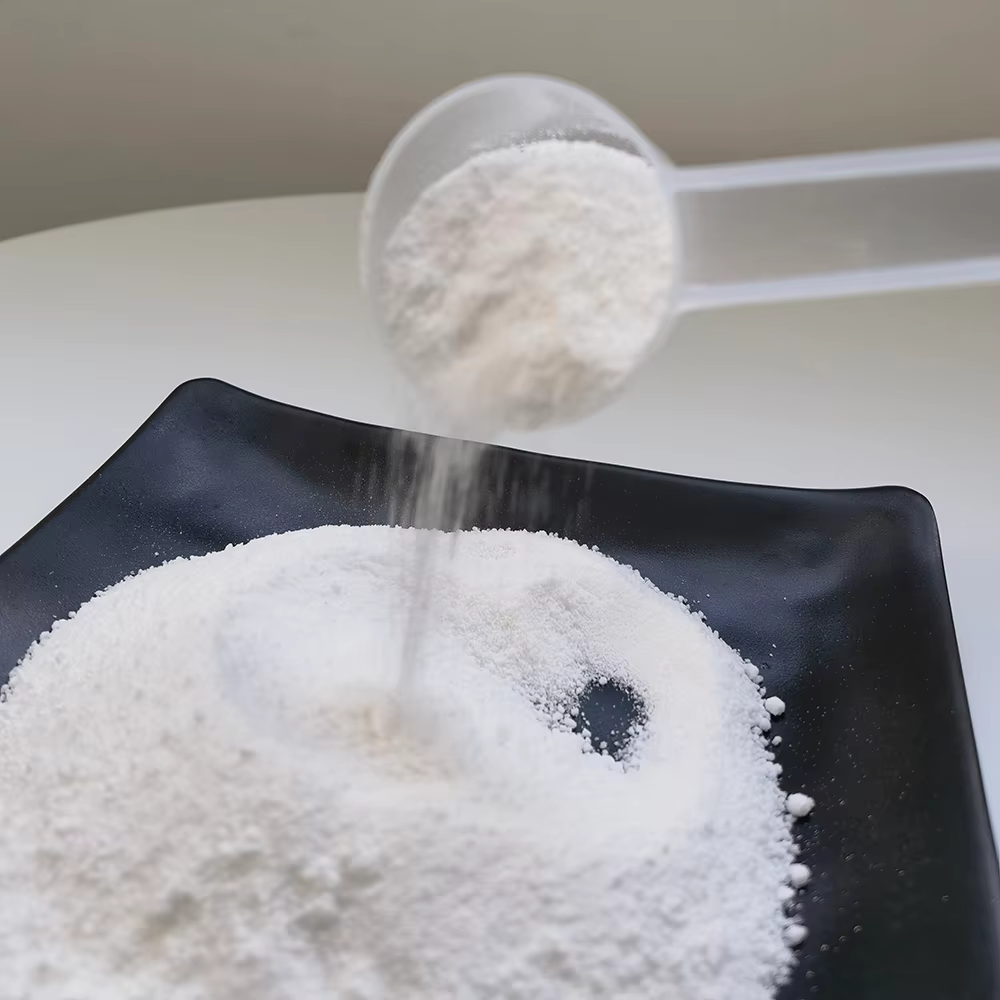
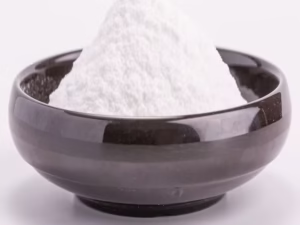
Calcium Carbonate (E170) is a high-purity inorganic mineral powder widely used as a filler, pigment, pH regulator and functional additive across industrial value chains. Primarily deployed in plastics, paints & coatings, paper, rubber, adhesives, and food-grade formulations (where E170 designation applies), it delivers predictable rheology control, opacity/brightness enhancement and cost-in-place reduction versus specialty mineral alternatives. The product’s key value proposition is stable, specification-driven performance that lowers formulation costs while improving processing consistency and finished-product quality. For strategic sourcing teams, reliable access to standardized Calcium Carbonate (E170) reduces production variability, simplifies supplier qualification, and supports scale-up across multiple end markets.
-
Key Specifications & Technical Characteristics
-
Chemical composition: Primarily calcium carbonate, CaCO3, with trace levels of associated minerals (as delivered).
-
Grade / purity: E170 food/industrial grade; typical assay ≥ 98.0% CaCO3 (insoluble basis).
-
Loss on ignition (LOI): Typical range consistent with CaCO3 specification, ≤ 44% (as applicable to assay method).
-
Heavy metals: Meets industry limits for lead, cadmium, mercury and arsenic per applicable regulatory specifications (spec sheets provided on request).
-
Physical form: Dry, free-flowing powder.
-
Color/brightness: Off-white to white; brightness optimized for pigment/filler applications.
-
Particle size distribution: Available ground and precipitated variants; typical D50 range 1–10 µm for ground grades; custom-milled sizes available on request.
-
Specific gravity / bulk density: True density ~2.7–2.8 g/cm³; bulk density variable by grade and packing (typically 500–900 kg/m³ for loose powder).
-
Surface treatment: Untreated and surface-treated options (stearate/coating) available for improved dispersibility in non-polar matrices.
-
Moisture content: Controlled for stable handling; typical ≤ 1.5% (grade dependent).
-
Packaging options: 25 kg multi-wall kraft bags, 1,000 kg FIBCs (big bags), bulk loose in lined hopper trucks, and ISO tank/blown-in bulk for selected micronized grades.
-
Shelf life: Stable indefinitely if stored dry; recommended storage under dry, covered conditions to maintain free-flowing properties.
-
Core Industrial Applications
-
Plastics & Polymers: Used as a cost-effective filler for PVC, PP, PE and engineering polymers to increase stiffness, dimensional stability and thermal conductivity while reducing resin costs. Delivers consistent dispersion and predictable rheology versus inconsistent natural fillers.
-
Paints & Coatings: Provides opacity, brightness, gloss control and anti-settling properties; improves hiding power and rheology control while lowering pigment costs compared with higher-priced extenders.
-
Paper & Board: Functions as a filler and coating pigment to enhance brightness, opacity and printability, improving paper formation and reducing fibre usage.
-
Rubber & Tires: Improves reinforcement, processing stability and cost efficiency in non-critical rubber compounds.
-
Adhesives & Sealants: Acts as thixotropic agent and cost reducer, improving gap-filling and workability.
-
Food & Pharma Excipients (E170): Where certified for food use, serves as a permitted food additive and acidity regulator, subject to regulatory and supplier documentation.
Why it outperforms alternatives: consistent particle-size control and availability of surface-treated grades enable superior dispersibility, reduced dusting, and optimized loading levels—driving lower total material costs and higher throughput compared with less-controlled mineral sources.
-
Competitive Advantages
-
Quality consistency: Tight in-house QC with batch certificates and traceable analytical data to ensure batch-to-batch uniformity for critical manufacturing specifications.
-
Supply reliability: Industrial-scale production capacity and regional distribution channels reduce single-supplier risk and support continuous supply for large-volume manufacturers.
-
Logistics capability: Flexible packaging (bagged, FIBC, bulk) and container loading options optimized for port and overland transport; capability to coordinate FOB, CIF, and DDP logistics for global buyers.
-
Price competitiveness: Economies of scale and multiple grade options allow optimized cost-in-use outcomes versus specialty fillers.
-
Sustainability benefits: Inert, non-toxic mineral with low embodied energy for ground grades; options for locally sourced feedstock to reduce transport emissions and support circular procurement strategies.
-
Technical support & documentation: Full technical data sheets (TDS), safety data sheets (SDS), certificates of analysis (CoA), and regulatory documentation (food-grade declarations) available to support supplier qualification, regulatory compliance and formulation trials.
-
Commercial & Supply Information
-
Minimum order quantity (MOQ): BULK 20 MT.
-
Loading capacity (MT per container):
-
20 ft container (loose-bulk/liner): up to ~20–22 MT depending on packing and bulk density.
-
20 ft container (FIBCs/palletized 1,000 kg bags): up to ~20 MT (20 FIBCs typical).
-
40 ft container (FIBCs/palletized 1,000 kg bags): up to ~24–26 MT (subject to pallet configuration and port/rail constraints).
-
Custom configurations available for road tanker/hopper delivery for regional distribution.
-
Reviews
There are no reviews yet.