
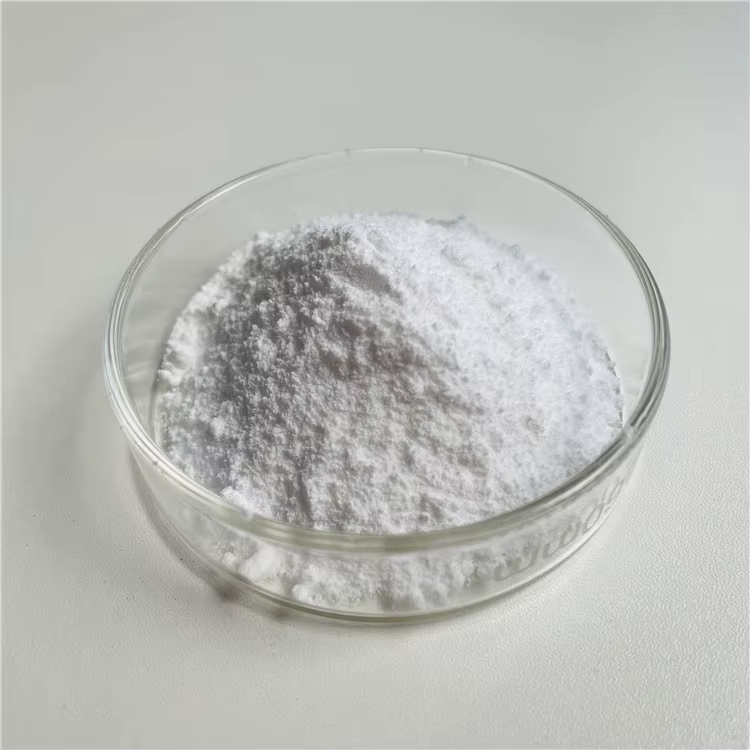
Description
-
Product Overview
Mono & Diglycerides (E471) are food‑grade emulsifier blends composed primarily of mono- and diglycerides of fatty acids, manufactured to industrial standards for consistent functionality in large‑scale processing. They enable stable oil–water dispersion, improve batter and dough handling, control crystallization in fats, and enhance texture and shelf life across food and non‑food formulations. The product delivers predictable emulsification performance, batch-to-batch purity, and handling properties that reduce processing variability and waste. Strategically, E471 is a high‑utility processing aid and ingredient that supports formulation stability, cost-efficient production, and regulatory compliance for global food, bakery, confectionery, and industrial lubricant markets.
-
Key Specifications & Technical Characteristics
-
Chemical composition: Mono- and diglycerides of fatty acids derived from vegetable (palm/soy/sunflower) or specified feedstock; typical blend ratio proprietary per SKU.
-
Functional group: Glycerol esters of long‑chain fatty acids (C16–C18 predominating).
-
Purity / grade: Food‑grade, complies with E‑number E471 specifications; free fatty acid (FFA) ≤ 2.0% (typical 0.5–1.5%).
-
Acid value: ≤ 3.0 mg KOH/g (typical 1.0–2.5).
-
Peroxide value: ≤ 5.0 meq O2/kg (typical ≤ 2.0).
-
Moisture content: ≤ 0.5% (typical 0.1–0.3%).
-
Iodine value (indicative unsaturation): product‑dependent, supplied on certificate of analysis.
-
Physical form: Viscous liquid to soft paste at ambient, pourable at 30–60°C; homogenous, non‑separating.
-
Color: Pale yellow to amber, visually clear to slightly turbid depending on batch.
-
Density: Approx. 0.92–0.95 g/cm³ at 20°C.
-
Solubility / miscibility: Lipophilic with partial water dispersibility when heated or in presence of high‑shear; excellent oil‑in‑water emulsification capacity.
-
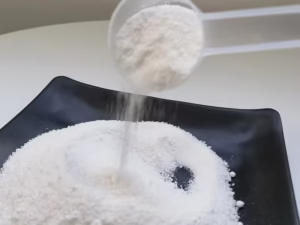
Particle size: Not applicable for liquid grades; solid flake/powder grades available on request with defined mesh spec.
-
Packaging options: 20 kg poly drums, 25 kg composite drums, 200 kg drums, 1,000 kg IBCs, or bulk tank truck; export‑grade palletization and fumigation available.
-
Shelf life: 12–24 months when stored sealed, in cool, dry, and dark conditions (actual shelf life and storage instructions provided on COA and SDS).
-
Certification & compliance: Manufactured under GMP; HACCP compatible; certificates of analysis (CoA), material safety data sheet (SDS), and origin available; compliance with EU, FSANZ, and CODEX limits on request.
-
Core Industrial Applications
-
Bakery & Confectionery: Used as dough conditioners, crumb softeners, and emulsifiers in breads, cakes, and fillings; improves dough machinability, increases volume and crumb uniformity, and stabilizes fat phases versus competing single‑component emulsifiers.
-
Margarine & Spreads: Controls fat crystallization and plasticity, enabling spreadable texture across temperature ranges and reducing syneresis; provides more predictable mouthfeel and longer shelf stability than unmodified fats.
-
Dairy & Ice‑cream: Enhances fat dispersion and air cell stabilization, improving creaminess, meltdown profile, and heat shock resistance relative to native milk fat alone.
-
Chocolate & Confectionery coatings: Lowers viscosity, improves flow and mould release, and reduces tempering variability—delivering processing throughput gains and reduced energy consumption.
-
Emulsion polymers & lubricants (industrial): Acts as anti‑wear emollient and dispersion aid in certain non‑food formulations where glyceride esters are suitable; increases compatibility between hydrophobic additives and aqueous systems.
-
Nutraceutical & Pharmaceutical Excipients: Enables stable oil‑in‑water emulsions for soft‑gel fills, topical creams, and oral suspensions with predictable release profiles.
Why it outperforms alternatives: Mono & diglycerides offer a balanced HLB (hydrophilic–lipophilic balance) for versatile emulsification, stronger interfacial film formation, and thermal/crystallization control—reducing dosages, processing time, and product rejects compared with single‑function surfactants or native fats.
-
Competitive Advantages
-
Quality consistency: Tight in‑house QC with batch CoA ensures reproducible acid/peroxide values and functional performance critical to scalable production.
-
Supply reliability: Global sourcing network with multiple feedstock options and safety stocks reduces single‑source risk and ensures continuous supply to industrial buyers.
-
Logistics capability: Flexible packaging and containerized bulk loading; partner shipments with temperature management and export documentation (CoO, phytosanitary where required).
-
Price competitiveness: Economies of scale and feedstock diversification allow competitive unit pricing and multi‑year contract structures to stabilize procurement costs.
-
Sustainability: Vegetable feedstock traceability options (RSPO segregated/MB, non‑GMO, or certified sustainable on request) and low‑waste manufacturing practices.
-
Technical support: Dedicated technical dossiers, application trials, formulation guidance, sensory and rheology support, and full SDS/CoA documentation to accelerate qualification and regulatory acceptance.
-
Commercial & Supply Information
-
Minimum order quantity (MOQ): BULK 20 MT.
-
Loading capacity (MT per container): Standard 20 ft container (flexitank/bulk liquid) up to 20–24 MT depending on packaging and temperature; 40 ft container flexitank up to 24–26 MT; 20 ft OT/box loading variable by drum size (approx. 8–10 MT for 200 kg drums).
-
Lead times: Standard lead time 4–6 weeks for bulk orders; expedited production/air shipments available subject to surcharge.
-
Incoterms & payment: FOB/CIF/EXW negotiable; payment terms and volume discounts available under contract.
-
Documentation: CoA, SDS, specification sheet, and origin documentation provided with shipment; regulatory dossiers and allergen statements available on request.
Reviews
There are no reviews yet.