
Description
-
Product Overview
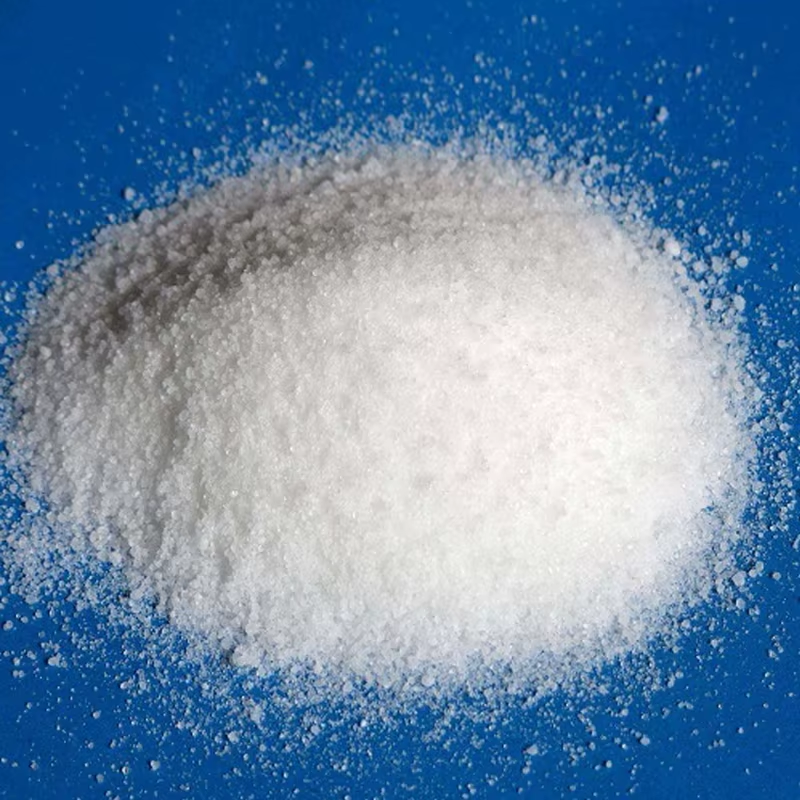
Sodium Citrate (E331) is the trisodium salt of citric acid supplied as a high-purity, industrial-grade buffering and chelating agent. It is primarily used across food processing, pharmaceutical formulation, water treatment, and industrial cleaning applications to control pH, sequester metal ions, and stabilize formulations. The product delivers consistent chemical performance, reliable lot-to-lot purity, and easy integration into continuous and batch manufacturing processes—reducing process variability and downstream waste. For strategic buyers, Sodium Citrate (E331) is a low-risk, high-impact ingredient that supports regulatory compliance, product quality, and operational efficiency at scale.
-
Key Specifications & Technical Characteristics
-
Chemical name: Trisodium citrate, dihydrate or anhydrous (as specified per lot).
-
Chemical formula: C6H5Na3O7 (detailed on COA per batch).
-
Purity / Grade: Industrial / Food- & Pharma-compatible grades available; typical assay ≥ 99.0% (per specification).
-
Impurities: Heavy metals (Pb, As, Cd, Hg) within regulatory limits; residual solvents nil; detailed limits on Certificate of Analysis (COA).
-
Physical form: Free-flowing crystalline powder.
-
Color: White to off-white.
-
Particle size: Median particle size and distribution provided on request; suitable for dissolution and powder handling systems.
-
Bulk density: Typical bulk density reported on COA; suitable for hopper/feeder design.
-
Solubility: Highly soluble in water; solubility increases with temperature—data provided for process engineering.
-
pH (1% solution): Typically mildly alkaline (specification value on COA).
-
Moisture content: Controlled to specification (dihydrate/anhydrous variants specified).
-
Packaging options: 25 kg multiwall paper sacks, 500 kg FIBCs (big bags), 1–1.2 MT bulk bags, or ISO tank/bulk tanker for liquid solutions. Palletized and heat/shrink-wrapped per export standard.
-
Shelf life: 24 months when stored dry, sealed, and below 25°C; COA and storage recommendations included.
-
Core Industrial Applications
-
Food & Beverage: Buffering and acidity regulation in beverages, dairy, confectionery and processed foods; ensures flavor stability and shelf-life extension while meeting E-number compliance.
-
Pharmaceuticals & Nutraceuticals: pH control and excipient use in oral and parenteral formulations; acts as a stabilizer and chelating agent in active pharmaceutical ingredient (API) processes.
-
Water Treatment & Cooling Systems: Sequestration of divalent metal ions and scale control in boiler water and cooling circuits; improves corrosion control and extends equipment life.
-
Cleaning & Detergent Formulations: Enhances cleaning efficacy by chelating hard-water ions and stabilizing enzymes in industrial and institutional cleaners.
-
Chemical Manufacturing & Laboratory Use: Reagent for synthesis routes, buffer preparation, and analytical standards.
Why it outperforms alternatives: Sodium Citrate provides predictable buffering capacity across a useful pH range, superior metal-chelating efficiency versus many inorganic sequestrants, excellent solubility for rapid process integration, and regulatory familiarity that simplifies approval and supply-chain qualifications. These features translate into fewer batch rejections, lower additive usage, and lower total cost of ownership.
-
Competitive Advantages
-
Quality consistency: Each lot accompanied by Certificate of Analysis (COA) and batch traceability; in-house QC and third-party testing available.
-
Supply reliability: Regular production scheduling with safety stock, multi-source raw material strategy, and capacity planning to support continuous supply for large industrial customers.
-
Logistics capability: Export-ready packaging, palletization, and coordination with global freight forwarders; options for DAP, CIF, or EXW Incoterms.
-
Price competitiveness: Bulk pricing tiers and contractual pricing available for annual offtake agreements to stabilize costs.
-
Sustainability: Manufactured under controlled emissions processes, with options for reduced-packaging and recyclable FIBC liners; waste and effluent management compliant with local regulations.
-
Technical support: Dedicated technical datasheets (TDS), handling & safety data sheets (SDS), dissolution and dosing guidance, and formulation support from application specialists to accelerate scale-up and troubleshooting.
-
Commercial & Supply Information
-
Minimum order quantity (MOQ): BULK 20 MT.
-
Loading capacity (per container): Standard 20-foot container up to 20 MT (bagged/palletized), 40-foot container up to ~24–26 MT depending on bag configuration; FIBC/ISO big-bag and bulk tanker options available—confirm packaging to optimize loading.


Reviews
There are no reviews yet.