
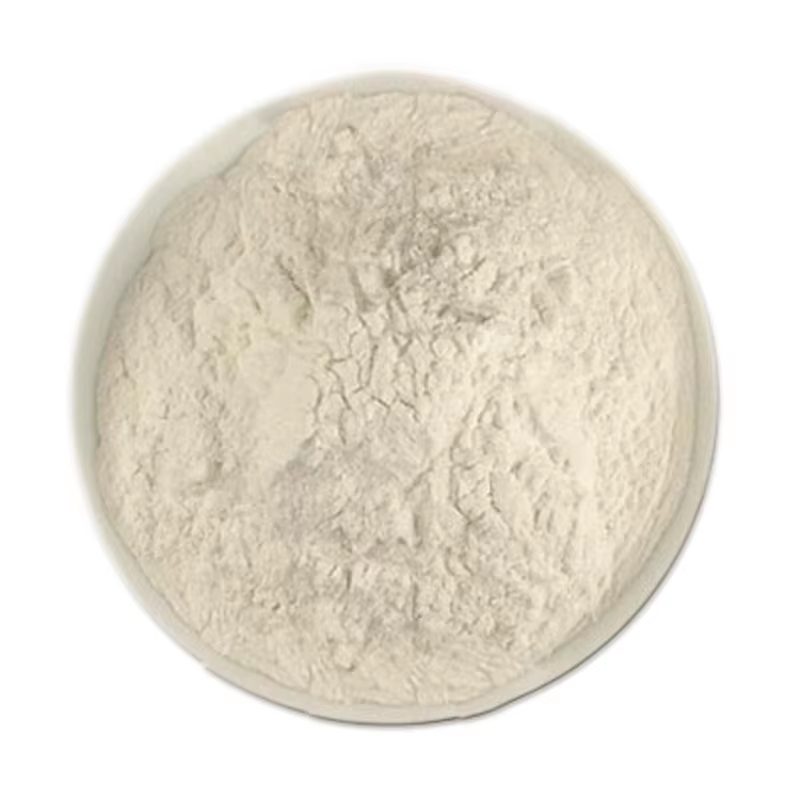
Description
-
Product Overview
Sodium Alginate (E401) is a high-quality, food- and industry-grade sodium salt of alginic acid extracted from brown seaweed. It serves as a versatile rheology modifier, gelling and stabilizing agent across multiple industrial processes—most notably in food production, pharmaceuticals, textile printing, and water treatment. The key value proposition is predictable, reproducible viscosity control and gel formation that enables process standardization, product consistency, and downstream cost reductions. Strategically, Sodium Alginate is a critical natural polymer for manufacturers seeking scalable, regulatory-compliant functional additives that replace synthetic thickeners while supporting cleaner-label and sustainability objectives. -
Key Specifications & Technical Characteristics
-
Chemical composition: Sodium alginate (sodium salt of alginic acid), extracted from brown seaweed (Phaeophyceae).
-
Functional group profile: Mannuronic acid (M) and guluronic acid (G) block composition specified on certificate of analysis.
-
Purity / grade: Food/Pharma-grade available; typical purity ≥ 90% (manufacturer certificate required for exact batch).
-
Viscosity (2% solution, Brookfield, 25°C): typically 200–2000 mPa·s (product subgrades available by viscosity range).
-
M/G ratio: supplied with batch-specific M/G ratio to match application (low M for strong gels; high M for elasticity).
-
Moisture content: typically ≤ 12% (batch variation reported).
-
Ash content: ≤ specified limit per grade (refer to CoA for exact value).
-
Physical form: off-white to light tan powder.
-
Particle size: standard mesh sizing (e.g., 80–200 mesh); custom milling options available.
-
Bulk density: typical 300–600 kg/m³ (packed density varies by grade and compaction).
-
Solubility: dispersible in cold water with controlled hydration; soluble in hot water for rapid dissolution.
-
pH (1% aqueous): typically 6.5–8.0.
-
Packaging options: multi-wall paper bags with PE liner (25 kg), FIBC/tonne bags (1,000 kg), and bulk tanker loading for slurry by arrangement.
-
Shelf life: recommended 24 months from manufacture when stored dry, sealed, and below 25°C away from direct sunlight.
-
Documentation: full Certificate of Analysis (CoA), Safety Data Sheet (SDS), and traceability documentation provided with each shipment.
-
Core Industrial Applications
-
Food & Beverage: Used as a gelling agent, stabilizer, and thickener in dairy analogues, sauces, dressings, confectionery (e.g., fruit gels), and meat analogs. Offers clean-label positioning versus synthetic hydrocolloids.
-
Pharmaceuticals & Nutraceuticals: Excipient for controlled-release matrices, tablet binders, and microencapsulation (e.g., probiotic encapsulation) due to biocompatibility and predictable gelation with divalent cations.
-
Textile & Printing: Employed as a printing paste, thickener for reactive dyes and pigment inks, providing excellent screen recovery and film formation with reliable viscosity control.
-
Oil & Gas / Drilling Fluids: Functions as a rheology modifier and fluid-loss reducer in water-based drilling fluids where biodegradability and environmental profile are prioritized.
-
Water Treatment & Metallurgy: Used for flocculation, suspension stabilization, and as a binder in pelletizing processes.
Why it outperforms alternatives: -
Natural polymer with superior film-forming and gel-strength properties compared with many synthetic thickeners.
-
Tunable performance via controlled M/G ratio and viscosity grades, enabling precise match to process requirements.
-
Superior stability across pH and temperature ranges used in industrial processing, reducing rework and waste.
-
Competitive Advantages
-
Quality consistency: Batch traceability, tight specification control, and CoA for each shipment ensure repeatable performance in large-scale production.
-
Supply reliability: Secured raw-material sourcing and contracted production capacity reduce risk of supply disruption for enterprise customers.
-
Logistics capability: Flexible packaging (25 kg bags to FIBCs) and CIF/FOB shipping options, with capability for containerized and bulk loading.
-
Price competitiveness: Multiple grade offerings and scalable supply enable cost-optimized sourcing strategies for high-volume buyers.
-
Sustainability: Derived from renewable seaweed, biodegradable, and suitable for clean-label formulations; supplier commitment to responsible harvesting and compliance documentation available on request.
-
Technical support: Application guidance, CoA interpretation, and formulation assistance provided by technical service teams; stability and compatibility testing available as a paid service.
-
Commercial & Supply Information
-
Minimum order quantity (MOQ): BULK 20 MT.
-
Loading capacity (MT per container):
-
20 ft container (FCL, palletized 25 kg bags): ~18–20 MT depending on pallet configuration.
-
40 ft container (FCL, palletized 25 kg bags): ~22–24 MT depending on pallet configuration.
-
FIBC/tonne bags: loading optimized per container and stowage plan; typical 20 ft container: ~18–20 MT; 40 ft high-cube: ~24–26 MT.
-
-
Lead times: subject to order size and current inventory; standard lead time for bulk orders typically 4–8 weeks from purchase order and confirmation.
-
Incoterms: FOB, CIF, and DAP options available; supplier can coordinate export documentation and compliance.
-
Quality & compliance: Supplied with CoA, SDS, and traceability; certifications and additional testing available on request.

Reviews
There are no reviews yet.