
Description
-
Product Overview
Carrageenan Refined is a high-purity polysaccharide extracted from red seaweed (kappaphycus/ eucheuma species) and delivered as a refined, food-/industrial-grade hydrocolloid. Its primary industrial use is as a rheology modifier and stabilizer—providing gelling, thickening, suspension and water-binding functionality across food, pharmaceutical, personal care, and industrial formulations. The key value proposition is predictable, reproducible performance (gel strength, viscosity and syneresis control) that enables formulation simplification, extended product stability and reduced downstream waste. Strategically, refined carrageenan is a globally recognized functional ingredient that de-risks product development timelines and secures supply chains for manufacturers seeking scalable, cost-effective texture and stabilization solutions.
-
Key Specifications & Technical Characteristics
-
Chemical composition: Predominantly sulfated galactans (kappa-, iota-, lambda-carrageenan profile specified on certificate of analysis).
-
Active content / purity: Refined grade, minimum 90–98% carrageenan (depending on grade variant), residual salts and moisture controlled per specification.
-
Ash content: Typically ≤ 10% (grade-dependent; exact value provided on CoA).
-
Sulfate content: Reported on CoA; typical ranges depend on type (kappa, iota, lambda).
-
Moisture content: ≤ 12% (standard); low-moisture grades available on request.
-
Physical form: Free-flowing powder or fine granular flakes.
-
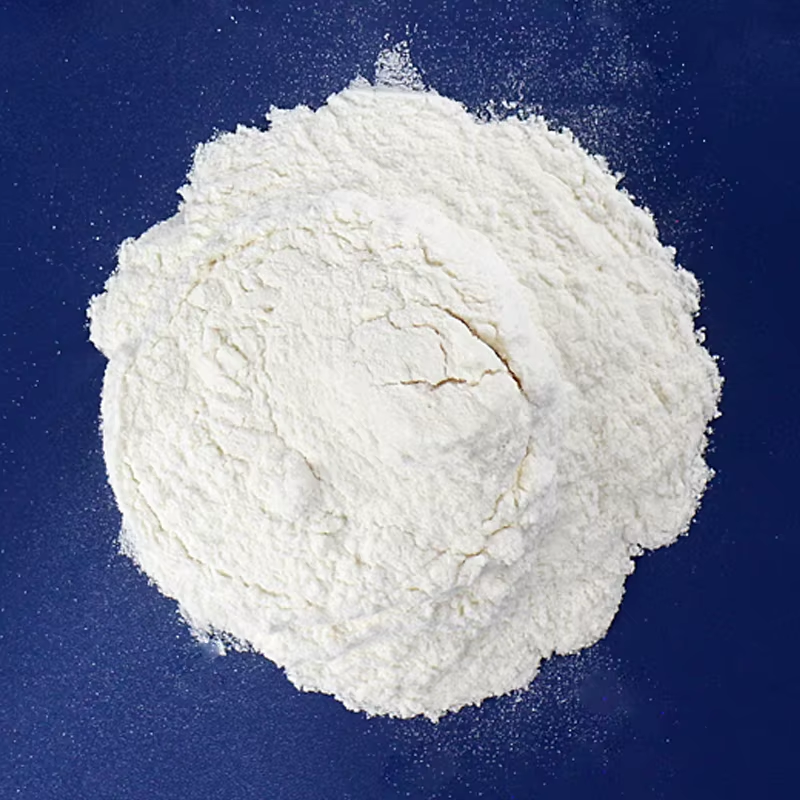
Color/appearance: Off-white to light beige, homogeneous, free from visible extraneous matter.
-
Particle size: Typical distribution 100–500 µm (custom milling available).
-
Bulk density: Approx. 300–500 kg/m3 (subject to packing and grade).
-
Solubility & handling: Dispersible in cold water with controlled hydration and heating profiles; forms gels/viscous solutions depending on salt and process conditions.
-
Microbial limits: Manufactured under GMP with Total Plate Count and yeast/mold limits per industrial/food grade standards; CoA provided per batch.
-
Heavy metals: Compliant with relevant industrial/food safety limits; batch CoA includes Pb, As, Cd, Hg.
-
Packaging options: 25 kg multi-wall paper bags with PE liner; 500–1,000 kg FIBC (big bag); bulk tanker or silo-loading for palletless bulk.
-
Shelf life: Standard 24 months from manufacture when stored dry, cool (<25°C) and in original sealed packaging; longer-term storage protocols available.
-
Core Industrial Applications
-
Food & Beverage manufacturing: Employed as a gelling agent, stabilizer and mouthfeel modifier in dairy analogues, processed meats, desserts, sauces and beverages. Improves yield, prevents syneresis and delivers consistent texture across batches.
-
Pharmaceutical & nutraceuticals: Used for controlled-release matrices, suspension stabilization and as an excipient in tablets, syrups and topical gels where biocompatibility and predictable rheology are required.
-
Personal care & cosmetics: Provides thickening, stabilization, and film-forming properties in creams, lotions, shampoos and masks, enabling reduced surfactant usage and improved product aesthetics.
-
Industrial & technical products: Functions as a rheology modifier and binder in paints, adhesives, drilling fluids and paper coatings where shear-thinning and suspension stability are critical.
-
Why it outperforms alternatives: Refined carrageenan offers tunable gelation (kappa for firm gels, iota for elastic gels, lambda for viscosity without gelation), high water-binding capacity, and superior batch-to-batch consistency compared with crude seaweed extracts or synthetic thickeners. This reduces formulation iterations, lowers overall additive loading, and can deliver cost-in-use advantages through improved yield, reduced segregation, and longer shelf life.
-
Competitive Advantages
-
Quality consistency: Produced under controlled extraction and refining processes with batch-specific Certificate of Analysis (CoA) ensuring reproducible gel strength, viscosity and impurity profile.
-
Supply reliability: Secured raw-material sourcing networks in major seaweed-producing regions and logistics partnerships to manage seasonal supply variation; forward stock and contract allocation options available.
-
Logistics capability: Flexible packaging (bags, FIBC, bulk), containerized export readiness, and support for direct-to-silo or toll-blending operations to minimize handling steps and cost.
-
Price competitiveness: Multiple grade options and scalable supply volumes enable competitive FOB/CIF pricing and cost-in-use optimization across industries.
-
Sustainability: Traceable sourcing programs, options for third-party sustainability certifications, and low-energy refining routes available to reduce carbon and water footprint compared with alternative chemically synthesized thickeners.
-
Technical support & documentation: Full technical dossier, application guidelines, stability and compatibility data, regulatory declarations (where applicable), and on-request formulation support from experienced technical service teams.
-
Commercial & Supply Information
-
Minimum order quantity (MOQ): BULK 20MT.
-
Standard loading configurations: 20 ft container: up to 20 MT (FIBC/bag-stuffed, subject to bulk density and packing), 40 ft container: up to 24–25 MT (optimized pallet/ FIBC loading); bulk tanker/silo options available for larger shipments.
-
Lead times: Typical production lead time 4–8 weeks depending on quantity and grade; expedited allocation available for recurring contracts.
-
Incoterms & pricing: FOB, CIF and DDP pricing available; volume-based pricing tiers and long-term contract pricing on request.
-
Regulatory & compliance: Batch CoA, SDS, and regulatory declarations provided; suitable grades available to meet food-grade, cosmetic or pharmaceutical requirements per destination market.




Reviews
There are no reviews yet.