
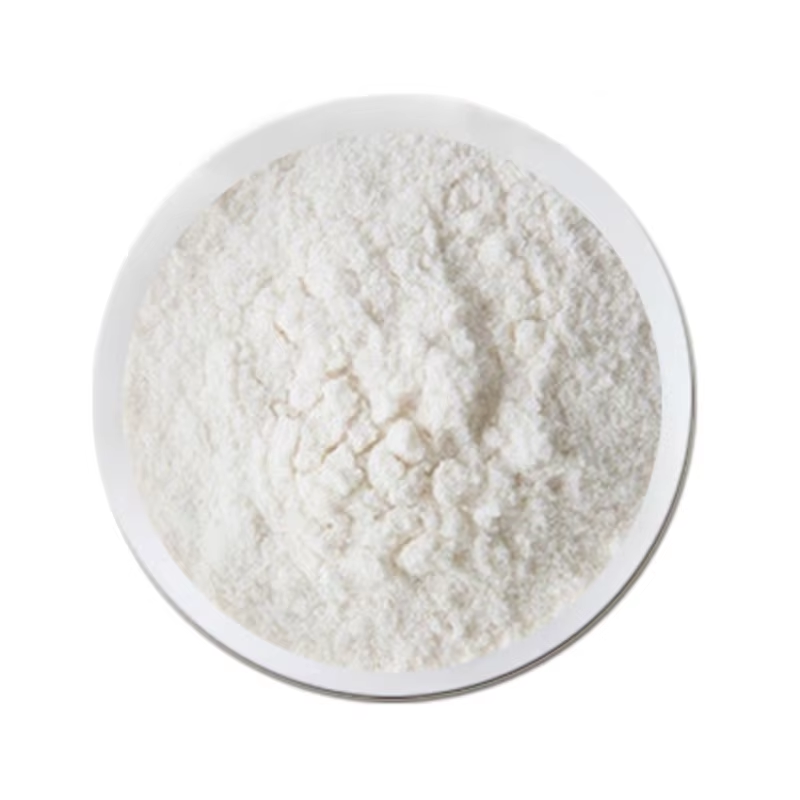
Description
-
Product Overview
Gellan Gum (E418) is a high-performance anionic polysaccharide produced by microbial fermentation and refined for industrial applications. It functions as a reliable gelling, thickening, stabilizing, and film-forming agent across food, pharmaceutical, personal care, and technical formulations. Its primary value proposition is predictable rheology and superior gel strength at low usage levels, enabling formulation cost reductions, improved texture control, and enhanced process yield. Strategically, Gellan Gum is critical where formulation precision, thermal stability, and clean-label or biodegradable functionality drive product differentiation and regulatory compliance.
-
Key Specifications & Technical Characteristics
-
Chemical composition: Microbial polysaccharide — linear tetrasaccharide repeating units of rhamnose, glucose, and glucuronic acid (sodium/calcium salt form depending on grade).
-
E-number: E418 (food-grade designation).
-
Grade / Purity: Industrial/food-grade available; typical assay ≥ 95% dry matter of active polysaccharide.
-
Form: Fine powder.
-
Color: Off-white to pale yellow.
-
Particle size: Typical D50 50–200 µm (custom milling available on request).
-
Moisture content: ≤ 10% (typical 6–8%).
-
Bulk density: 350–650 kg/m³ (packed density varies by milling and compaction).
-
pH (1% aqueous solution): typically 5.5–7.5 depending on counter-ion.
-
Solubility: Dispersible in hot water; requires shear for full hydration; forms gels on cooling in presence of cations.
-
Thermal stability: Stable under pasteurization conditions; gel strength retained after heating/cooling cycles.
-
Packaging options: 25 kg multiwall paper sacks with inner PE liner, 500 kg and 1,000 kg FIBCs (bulk bags), or ISO tank-suitable transfer for liquid slurry forms.
-
Shelf life: 24 months when stored dry, cool (<25°C), away from direct sunlight and moisture.
-
Core Industrial Applications
-
Food & Beverage: Low-level gelling and texturizing in confectionery (jellies, gummies), dairy analogs, plant-based gels, and beverage stabilization. Key use: consistent gel strength, clarity, and mouthfeel at reduced dosages versus agar/gelatin.
-
Pharmaceuticals & Nutraceuticals: Controlled-release matrices, tablet binding, suspension stabilization, and oral/enteric formulations. Key use: predictable rheology for manufacturing reproducibility and regulatory-grade specifications.
-
Personal Care & Cosmetics: Stabilizer and film former in lotions, gels, and facial masks; delivers clean-label, biodegradable binding and viscosity control.
-
Technical & Industrial: Bio-based adhesives, encapsulation matrices, and emulsion stabilization in coatings and specialty lubricants. Key use: thermal and shear resilience, and compatibility with ionic crosslinking for tunable mechanical properties.
Why it outperforms alternatives: Gellan delivers high gel strength at low concentrations, excellent clarity, and stable performance under thermal cycling and shear, reducing raw-material usage and improving throughput. It often replaces or reduces reliance on gelatin, agar, or synthetic stabilizers when clean-label or vegan credentials are needed.
-
Competitive Advantages
-
Quality consistency: Tight in-house QC with batch-to-batch rheological and compositional testing to ensure predictable gel strength and viscosity.
-
Supply reliability: Contract manufacturing and multi-sourced fermentation capacity reduce single-point risk; maintained safety stocks for industrial MOQs.
-
Logistics capability: Pack formats optimized for bulk handling, containerized loading plans, and export documentation support for global shipping from Cameroon (Buea origin) or designated export hubs.
-
Price competitiveness: Low effective usage rates and economies of scale in bulk packings lower landed cost per functional unit versus many alternatives.
-
Sustainability: Microbial fermentation feedstocks and biodegradable end-of-life profile; opportunities for traceable sourcing and reduced reliance on animal-derived gels.
-
Technical support: Comprehensive documentation (spec sheets, SDS, application notes), formulation guidance, and on-request lab samples and scale-up trials.
-
Commercial & Supply Information
-
Minimum order quantity (MOQ): BULK 20 MT.
-
Standard loading capacity: 20–22 MT per 20’ container (bagged, depending on packing type); up to 24 MT per 20’ container with optimized FIBC packing subject to local loading constraints.
-
Lead times: Confirmed on order; typical production-to-shipment lead time 4–8 weeks depending on order size and scheduling.
-
Incoterms, payment, and certification: Available on request (examples: FOB, CIF, third-party inspection, HACCP/ISO/Food-grade certificates as applicable).


Reviews
There are no reviews yet.