
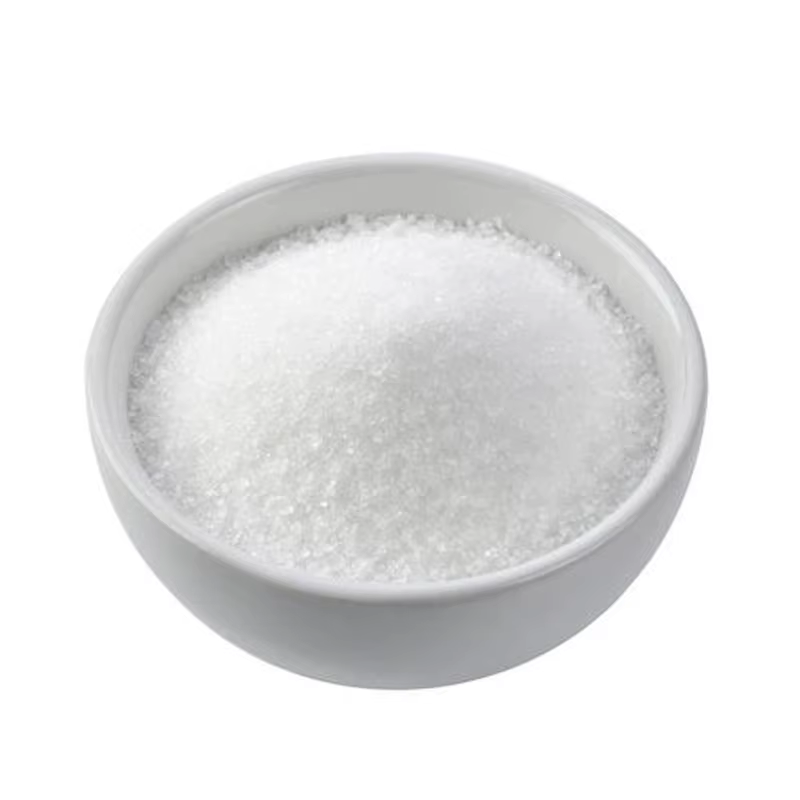
Description
-
Product Overview
Maltitol (E965) is a high-purity sugar alcohol (polyol) used as a low-calorie sweetening agent and functional excipient across food, pharmaceutical, and specialty chemical industries. Its primary industrial use is as a bulk sweetener and humectant—providing sugar-like sweetness, stability, and moisture control while reducing calorie content and glycemic impact compared with sucrose. The key value proposition is consistent food-grade performance at scale: sugar-like organoleptic properties, thermal stability in processing, and reliable physical handling for high-throughput production lines. Strategically, Maltitol (E965) enables product differentiation (reduced-sugar formulations, pharmaceutical syrups and chewables, confectionery with reduced stickiness) and supports compliance with rising regulatory and market demand for lower-calorie, label-friendly ingredients.
-
Key Specifications & Technical Characteristics
-
Chemical name: 4-O-α-D-Glucopyranosyl-D-sorbitol (Maltitol)
-
INCI / additive code: E965
-
Chemical formula: C12H24O11 (typical technical reference)
-
Grade / purity: Food-grade / Pharmaceutical-excipient grade available; typical purity ≥ 98.0% (specify batch certificate)
-
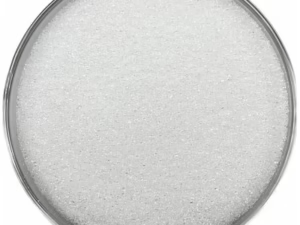
Appearance: White to off-white crystalline powder or granules
-
Physical form & particle profile: Granular/crystalline; particle size distribution customizable (standard 150–800 µm; fine powder options on request)
-
Moisture content: ≤ 0.5–1.5% (depending on grade; confirm on COA)
-
Bulk density: Typical 0.8–1.0 g/cm³ (tapped density provided on COA)
-
Solubility: Highly soluble in water; forms clear solutions at standard process concentrations
-
Sweetness relative to sucrose: ~75–90% (organoleptic dependent)
-
Hygroscopicity: Low-to-moderate; behaves as a humectant in formulations
-
Melting/softening behavior: Thermally stable in typical confectionery and baking ranges; specific thermal properties supplied per batch
-
Impurities & heavy metals: Compliant with relevant specifications (EU, FCC, USP where applicable); heavy metals below regulatory limits, per COA
-
Microbiological: Meets food-grade microbiological criteria; pathogen-free (reportable on COA)
-
Packaging options: 25 kg multi-wall paper bags with PE liner, 500 kg flexible intermediate bulk containers (FIBCs), 20 MT bulk containerized loading, or customer-specific packaging under contract
-
Shelf life & storage: Recommended shelf life 24 months when stored in a cool, dry place (≤ 25°C, relative humidity controlled), away from direct sunlight; unopened packages retain specified quality under recommended conditions
-
Core Industrial Applications
-
Confectionery & Chocolate: Replaces or partially replaces sucrose in sugar-free and reduced‑sugar hard candies, fondants, gummies, and sugar‑free chocolate, delivering comparable texture and mouthfeel with reduced crystallization issues. Better for product stability and reduced stickiness versus some alternative polyols.
-
Baked Goods & Fillings: Used where bulk sweetness and humectancy are required—improves shelf life by retaining moisture and soft texture in reduced-sugar baked products and fillings. Outperforms high-intensity sweeteners for bulk functionality and mouthfeel.
-
Pharmaceuticals: Serves as an excipient in syrups, chewable tablets, lozenges, and oral suspensions—provides palatability, bulking, and stability while maintaining low hygroscopic instability compared with pure sorbitol in some formats. Available in pharmaceutical-excipient grade with COA and compliance documentation.
-
Nutraceuticals & Supplements: Formulations requiring reduced sugar profile and pleasant taste—capsule fillings, chewables, and powder blends.
-
Food Processing & Beverage Applications: Used as a partial sugar replacer in ready-to-eat products and low-calorie beverage concentrates where bulk sweetness and freezing point depression are relevant.
-
Specialty Chemical Uses: Humectant and stabilizer in personal care formulations where non-cariogenic, low-to-moderate sweetness polyols are acceptable.
Why it performs better: Maltitol balances sweetness, bulk, and functional properties (hygroscopic control, thermal stability) better than intense sweeteners (which lack bulking properties) and often yields fewer digestive tolerance issues and better organoleptic profiles than some other polyols in equivalent usage levels. Its crystalline form enables predictable dosing and flow characteristics for automation.
-
Competitive Advantages
-
Quality consistency: Manufactured under controlled processes with full batch Certificates of Analysis (COA), lot traceability, and specification conformity (food/pharma grades).
-
Supply reliability: Industrial-scale production and strategic inventory allocation to support continuous supply for high-volume customers; contingency sourcing and scheduled production planning available for contractual customers.
-
Logistics capability: Flexible packaging and container loading (20 MT bulk per container), export-ready documentation (commercial invoice, packing list, COA, health certificates where required), and experience with global cold-chain-free distribution routes.
-
Price competitiveness: Economies of scale for bulk (20 MT) orders and contract pricing options for multi-month purchase agreements; competitive landed cost modeling available on request.
-
Sustainability: Sourcing transparency and process-efficiency programs to reduce waste and energy per tonne; availability of sustainability disclosures and supplier-assurance documentation upon request.
-
Technical support: Application guidance, stability and compatibility data, and formulation troubleshooting from technical specialists; sample and pilot-lot support available for process qualification.
-
Commercial & Supply Information
-
Minimum order quantity (MOQ): BULK 20 MT
-
Typical container loading (20 ft/40 ft): Standard 20 MT per container (bulk FIBC or palletised 25 kg bags per customer specification)
-
Lead times: Standard lead time subject to order volume and stock status; contract and forecasted scheduling available to secure capacity (confirm at time of RFQ)
-
Certificates & documentation: COA, MSDS, Certificate of Origin, allergen statement, and regulatory compliance documents (EU/FCC/USP as applicable) provided with shipment.
Reviews
There are no reviews yet.