
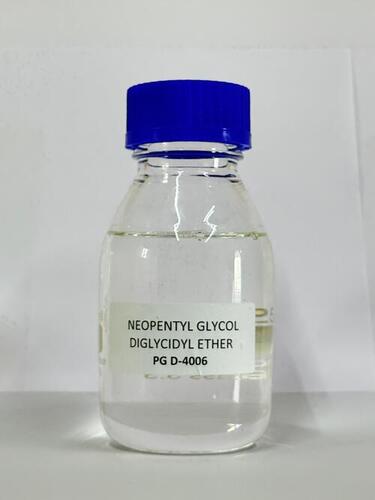
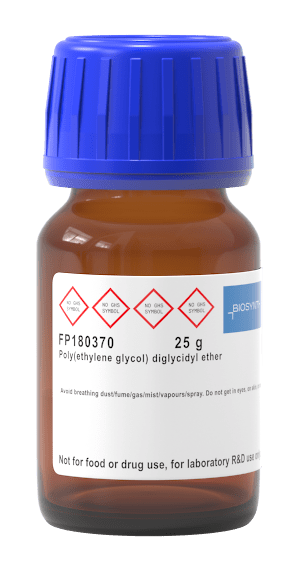
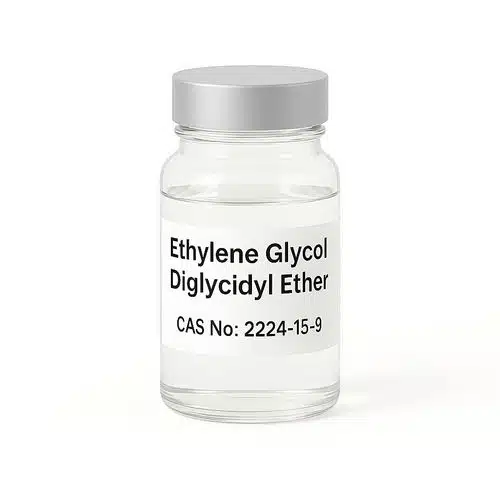
Description
1. Product Overview
Ethylene glycol diglycidyl ether (EGDGE) is a low-viscosity, difunctional aliphatic epoxy diluent and crosslinking agent, engineered to reduce system viscosity while enhancing flexibility and adhesion. Its primary industrial use is in high-performance epoxy formulations, including coatings, adhesives, encapsulants, and composite matrices, where precise reactivity and low volatility are critical. The key value proposition lies in its ability to significantly improve wetting, penetration, and impact resistance without compromising thermal or mechanical integrity. Strategically, EGDGE is increasingly vital as manufacturers seek lightweighting, durability, and solvent-free formulations to meet tightening global VOC regulations.
2. Key Specifications & Technical Characteristics
-
Chemical composition: Ethylene glycol diglycidyl ether (CAS No. 2224-15-9); difunctional aliphatic epoxy resin
-
Purity level: ≥99.0% (typical industrial grade; ≤0.5% hydrolysable chlorine)
-
Epoxy equivalent weight (EEW): 120–140 g/eq
-
Viscosity @ 25°C: 4–8 cP (lowest in its class)
-
Physical form: Clear, colorless to pale-yellow liquid
-
Density @ 25°C: ~1.10 g/cm³
-
Volatile organic content (VOC): Zero (reactive diluent)
-
Packaging options: 200 kg net steel drums, 20 kg pails, IBC totes (1,000 kg)
-
Shelf life: 24 months from date of manufacture when stored in original sealed containers at 5–35°C, away from moisture and strong oxidizers
3. Core Industrial Applications
-
Primary industries: Aerospace & defense, automotive lightweighting, wind energy (rotor blades), marine composites, industrial flooring, electronics encapsulation, and structural adhesives.
-
Specific use cases:
-
Low-viscosity epoxy impregnation: Enables vacuum-assisted resin transfer molding (VARTM) of large composite parts – penetrates fiber bundles faster than glycidyl ethers with higher chain length.
-
Flexible, impact-resistant coatings: Used as a reactive diluent in anti-corrosion pipe linings and bridge deck coatings; reduces brittleness without plasticizer migration.
-
High-filler-loading adhesives: Allows 30–40% higher filler content (e.g., alumina, silica) while maintaining pumpability – critical for thermal interface materials and potting compounds.
-
-
Why better than alternatives: Compared to non-reactive diluents (e.g., benzyl alcohol), EGDGE covalently bonds into the network – no outgassing, no exudation, and no loss of modulus at elevated temperature. Versus higher-glycol homologs (e.g., DEGDGE), EGDGE provides lower viscosity and faster cure response.
4. Competitive Advantages
-
Quality consistency: ISO 9001:2025 certified production; each batch tested for EEW, viscosity, color, and hydrolysable chlorine with COA delivered digitally.
-
Supply reliability: Dual-sourced raw material supply chain with minimum 18-month rolling capacity reservation; stock-keeping hubs in North America, Europe, and Southeast Asia.
-
Logistics capability: Temperature-controlled logistics partners (DOT/IMDG compliant); expedited lead times ≤10 business days for repeat orders.
-
Price competitiveness: Long-term take-or-pay agreements with upstream epichlorohydrin and ethylene glycol suppliers – pricing stability within ±5% per quarter.
-
Sustainability benefits: 100% reactive system (zero VOC); compatible with bio-based hardeners; no reproductive toxicity classification per GHS (unselect aromatic glycidyl ethers).
-
Technical support: Full rheology modeling, cure kinetics simulation, and compatibility testing documentation available on request via dedicated application engineers.
5. Commercial & Supply Information
-
Minimum order quantity (MOQ): 1,000 kg (one IBC tote) for spot orders; 20,000 kg (20 MT) for contract pricing.
-
Bulk 20 MT loading capacity: Standard 20-ft ISO container: 80 drums (200 kg each) = 16,000 kg net (16 MT); 20 MT requires flexitank or 100 drums in a 40-ft container. Preferred bulk configuration: 20 MT = 100 drums (200 kg) on pallets, loaded into one 40-ft high-cube container.


Reviews
There are no reviews yet.