
Description
-
Product Overview
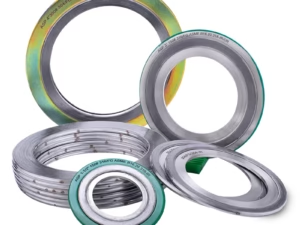
The Spiral Wound Gasket ASME B16.20 Inner + Outer Ring SS316/Graphite is a precision-engineered flange sealing solution designed for high-pressure, high-temperature piping and pressure-vessel applications. It combines a corrosion-resistant SS316 inner and outer ring with a high-grade graphite filler to deliver reliable metal-to-metal seating, exceptional sealing resilience, and chemical compatibility across aggressive process streams. The product’s key value lies in maintaining leak-tight integrity under thermal cycling, vibration, and corrosive environments, reducing unplanned shutdowns and maintenance costs. For industrial buyers, this gasket is strategically important because it supports compliance with ASME B16.20 standards while enabling safer, longer-lasting operations in critical fluid-handling systems.
-
Key Specifications & Technical Characteristics
-
Standard: ASME B16.20 compliant (spiral wound gasket with inner and outer ring)
-
Materials: Inner ring SS316 (ASTM A182/AISI 316), Outer ring SS316 (ASTM A182/AISI 316), Filler: flexible graphite (high-purity expanded graphite)
-
Filler density/grade: industry-standard flexible graphite, high compressibility, low cold-flow; graphitic purity typically > 98% carbon (confirm batch certs on request)
-
Metallic strip: Stainless steel 316 (thickness options available per specification and ASME guidance)
-
Surface finish: Controlled to ASME tolerances for concentricity and flatness; sealing surfaces compatible with raised-face and flat-face flanges
-
Size range: Full ASME flange range (custom sizes available; specify nominal pipe size and ASME class when ordering)
-
Temperature range: Typical service -200°C to +450°C for graphite-filled construction (application-dependent; confirm for extreme cases)
-
Pressure rating: Suitable across ASME pressure classes when specified per flange-rating and gasket seating calculations (verify with operating conditions)
-
Chemical compatibility: Resistant to most hydrocarbons, steam, acids and alkaline process streams; confirm specific media with technical data sheet and chemical compatibility table
-
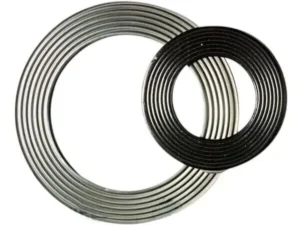
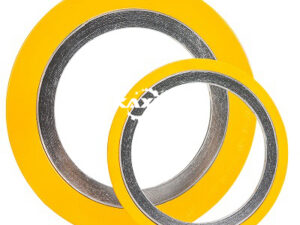
Form/appearance: Spiral-wound layered construction (alternating metal winding and graphite filler), metallic inner and outer rings continuous, color: metallic finish with dark graphite layers visible on cross-section
-
Tolerances: Manufactured to industrial tolerance bands for concentricity, thickness, and cross-sectional uniformity; batch QA and dimensional inspection reports available
-
Packaging options: Wooden crates, corrugated cartons with desiccant, palletized with stretch-wrap; export-ready packaging per Incoterm and carrier requirements
-
Shelf life: Indefinite under dry, non-corrosive storage; recommend storage in original packaging, away from direct moisture and contaminants
-
Documentation: Material Test Reports (MTRs for SS316), Certificate of Conformity to ASME B16.20, dimensional drawings, installation and torque guidance, and recommended seating stress data available on request
-
Core Industrial Applications
-
Primary industries: Oil & gas (upstream, midstream, downstream), petrochemical, chemical processing, power generation (including steam plants), LNG, refining, pulp & paper, water treatment, and industrial manufacturing.
-
Specific operational use cases: High-temperature steam lines and headers, heat exchangers, reactor and distillation column flanges, pipeline isolation and valve flanges, pressure vessel manways and nozzles, and cryogenic service where graphite selection is appropriate.
-
Why it performs better than alternatives: The combination of SS316 rings with flexible graphite filler provides superior mechanical confinement and centering (inner/outer rings) compared with plain spiral-wound gaskets, improving blowout resistance and flange alignment. Graphite filler offers excellent conformability to flange irregularities and superior thermal stability versus non-graphitic fillers. Compared with full-metal gaskets, spiral-wound SS316/graphite delivers better sealing across thermal cycles and vibration while maintaining chemical resistance.
-
Efficiency, durability, cost advantages: Reduced leak rates and extended mean time between maintenance lower lifecycle costs. Ease of installation and reusability for appropriate service conditions reduce downtime. The product balances initial purchase cost with long-term operational reliability for capital-intensive systems.
-
Competitive Advantages
-
Quality consistency: Manufactured under ISO-aligned quality systems with batch-level inspection; MTRs and dimensional QA reports supplied.
-
Supply reliability: Production capacity aligned for industrial procurement cycles with advanced lead-time planning, safety stock, and priority allocation for long-term contracts.
-
Logistics capability: Export-grade packing, bulk palletization, and coordination with FCL/LCL shipping; export documentation and customs support available for major trade corridors.
-
Price competitiveness: Volume pricing for bulk orders and contract pricing for repeat buyers; total-cost-of-ownership-oriented commercial proposals available.
-
Sustainability: Stainless steel 316 and graphite components are recyclable; manufacturing minimizes hazardous additives and follows environmental handling best practices.
-
Technical support: Application engineering support, installation best-practice guidance, torque/seating tables, compatibility checks, and on-request site consultation for critical projects.
-
Documentation availability: Full compliance documentation, certificates, and dimensional drawings provided to support procurement, QA, and regulatory audits.
-
Commercial & Supply Information
-
Minimum Order Quantity (MOQ) BULK: 20 MT
-
Loading capacity: Specify MT per container based on packaging and gasket sizes; typical guideline — up to 20 MT per standard 20-foot container for gasket bulk-pack configurations, subject to packing density and size mix. Confirm exact loading figures at order stage with packing list and containerization plan.
Reviews
There are no reviews yet.