
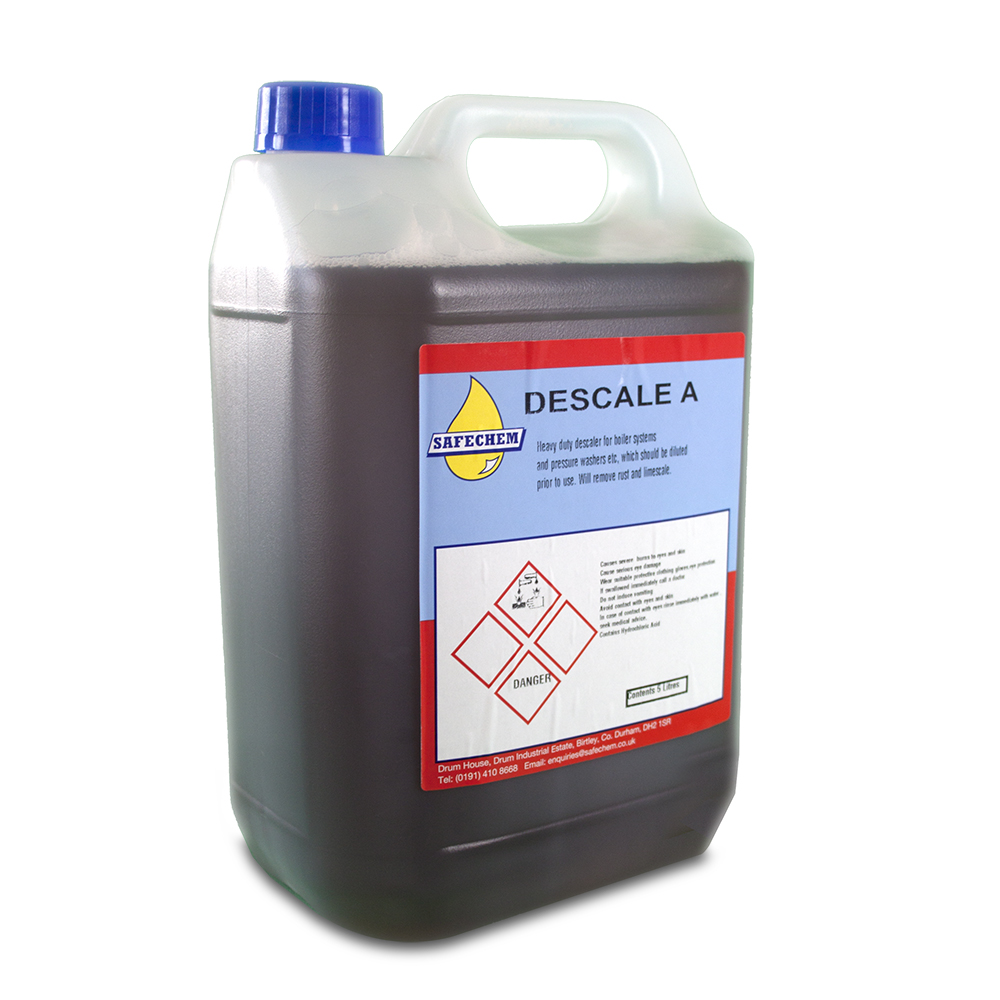
Description
1. Product Overview
This Boiler Descaling Chemical is a high-performance, industrial-grade formulation engineered to remove stubborn scale deposits (calcium, magnesium, silica, and iron oxides) from boiler tubes, heat exchangers, and associated steam systems. Its primary industrial use is restoring thermal efficiency and preventing tube failures in fire-tube, water-tube, and once-through boilers. The key value proposition is a measurable reduction in fuel consumption (typically 5–15%), extended boiler lifespan, and minimized unplanned downtime — delivering a return on investment within a single cleaning cycle. Strategically, this product is critical for asset-intensive industries where boiler reliability directly impacts production continuity and operating margins.
2. Key Specifications & Technical Characteristics
-
Chemical composition: Proprietary blend of sulfamic acid (15–25%), corrosion inhibitors (copper/nickel passivators), wetting agents, and chelating agents (EDTA derivatives) – ammonia-free formulation
-
Purity level: ≥99% active acid equivalent; inhibitor efficacy validated per ASTM G1-03
-
Physical characteristics: White to off-white crystalline powder; faint acidic odor; bulk density 0.85–0.95 g/cm³; 100% water-soluble
-
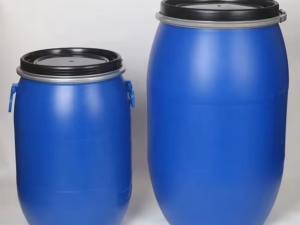
Packaging options: 25 kg moisture-barrier bags; 500 kg intermediate bulk containers (IBCs); 1,000 kg supersacks; custom bulk bags
-
Shelf life: 24 months in unopened, dry storage (≤30°C, <70% RH); no hazardous polymerization or degradation
3. Core Industrial Applications
-
Primary industries: Thermal power generation, chemical processing, pulp & paper, food & beverage (indirect steam contact only), steel manufacturing, and district heating
-
Specific operational use cases:
-
Post-outage boiler tube descaling (critical path maintenance)
-
Online circulation cleaning for moderate scale thickness (≤3 mm)
-
Pre-commissioning passivation and cleaning of new boilers
-
-
Performance advantage over alternatives: Removes sulfate and silicate scales that hydrochloric acid cannot effectively dissolve. Operates safely at 60–80°C without fuming or chloride-induced stress corrosion cracking (vs. HCl). Lower corrosion rates (0.5–1.2 mm/year on carbon steel vs. HCl’s 3–5 mm/year) — extends tube life by 3–5 years.
-
Efficiency gain: Typical scale removal restores heat transfer coefficient by 85–95% vs. scaled baseline, reducing fuel spend by 12–18 per MWh.
4. Competitive Advantages
-
Quality consistency: ISO 9001:2025 certified production; lot-to-lot active content variation <±0.5%; each batch tested for inhibitor efficacy via gravimetric corrosion coupon analysis
-
Supply reliability: Dual-sourced raw materials; three redundant manufacturing lines; 98.5% on-time-in-full (OTIF) delivery track record over 24 months
-
Logistics capability: Global warehousing nodes (Rotterdam, Houston, Shanghai, Jebel Ali) enabling 5-day average lead time to major industrial hubs
-
Price competitiveness: Cost per kg of scale removed 18–22% lower than nitrate-based or inhibited HCl alternatives at industrial volumes
-
Sustainability: Biodegradable chelating agents (OECD 301B: >60% degradation at 28 days); no heavy metals or phosphates; effluent neutralizes to <6.5 pH without complex treatment
-
Technical support: Full documentation suite (SDS, batch COA, compatibility guide for metallurgies: carbon steel, stainless 304/316, Inconel, copper alloys); free lab-scale jar testing for customer water samples
5. Commercial & Supply Information
-
Minimum order quantity (MOQ): BULK 20 MT (one full 20-ft container equivalent)
-
Loading capacity: 25 MT per 20-ft standard container (26 MT for high-cube) — palletized in 1,000 kg supersacks, 20 supersacks per container. Partial and LCL (less-than-container) shipments available above 5 MT for trial or emergency orders.
Reviews
There are no reviews yet.