


Description
1. Product Overview
This product is a macroporous carbon-based adsorbent with a sponge-like cellular structure, engineered for high-flow gas and liquid phase adsorption. It is primarily used in industrial emission control, solvent recovery, and wastewater treatment to remove volatile organic compounds (VOCs), odours, and dissolved organics. The key value proposition is its exceptionally low pressure drop combined with fast mass transfer, which reduces energy consumption and enhances system throughput. Strategically, it addresses tightening global air and water quality regulations, offering a scalable alternative to granular activated carbon (GAC) where resistance to fouling and regeneration efficiency are critical.
2. Key Specifications & Technical Characteristics
-
Chemical composition: Amorphous activated carbon with controlled surface oxygen groups; ≥95% fixed carbon
-
Purity level: High-purity, acid-washed grade available; ash content ≤8%
-
Physical characteristics:
-
Form: Rigid, open-cell sponge monolith or cut sheets/cylinders
-
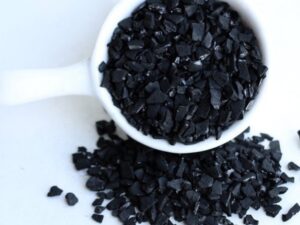
Colour: Matte black
-
Particle size: Available as 10×10×10 mm cubes or custom die-cut shapes
-
Bulk density: 0.35 – 0.45 g/cm³
-
Surface area (BET): 700 – 1,200 m²/g
-
Porosity: Macroporous (>50 nm) combined with microporosity
-
-
Packaging options: Sealed multi-ply kraft bags (25 kg), octabins (500 kg), or bulk FIBCs (1 MT)
-
Shelf life: 24 months in original unopened packaging, stored below 30°C and ≤60% RH
3. Core Industrial Applications
-
Primary industries: Chemical processing, pharmaceuticals, automotive painting, printing, semiconductor fabrication, and industrial wastewater treatment
-
Specific operational use cases:
-
Rotor concentrator systems for low-concentration VOC abatement
-
Pre-treatment for bioreactors by removing inhibitory organics
-
Solvent recovery in flexographic printing and coating lines
-
-
Performance advantage over alternatives: Compared to granular or powdered activated carbon, the carbon sponge allows 40–60% lower pressure drop at equivalent linear velocity, reducing fan energy by 15–25%. Its rigid structure eliminates channeling and attrition dust, while thermal regeneration cycles achieve >90% capacity recovery with minimal mass loss.
-
Cost advantage: Extended service life (3–5x longer between replacements in fouling-prone streams) lowers total cost of ownership despite higher upfront unit price.
4. Competitive Advantages
-
Quality consistency: Every batch undergoes ISO 17025-certified BET, iodine number, and hardness testing; certified statistical process control ensures ≤3% variation in key metrics
-
Supply reliability: Dual manufacturing facilities (Asia, EU) with 5,000 MT/month nameplate capacity; safety stock held in regional hubs (US, Germany, Singapore)
-
Logistics capability: Just-in-time delivery via contract carriers; expedited air freight options for critical breakdowns
-
Price competitiveness: Direct-from-producer pricing for orders ≥20 MT; volume-based discounts up to 18%
-
Sustainability: 100% steam reactivation service available for spent media; cradle-to-gate carbon footprint disclosure available upon request
-
Technical support: Dedicated process engineering team provides free adsorption modeling, pressure drop calculations, and on-site commissioning support
5. Commercial & Supply Information
-
Minimum order quantity (MOQ): 5 MT (standard grades); 20 MT for custom shapes or acid-washed grades
-
BULK 20MT loading capacity: 20 MT per 20-ft dry container (palletized, 16 pallets of 1,250 kg each) or 21.5 MT per 20-ft open-top container
-
Loading capacity (MT per container):
-
20-ft standard container: 20 MT (max gross weight limit)
-
40-ft HC container: 20 MT (restricted by weight, not volume)
-


Reviews
There are no reviews yet.