


Description
Tungsten Hexacarbonyl: A Versatile Player in the World of Organometallic Chemistry
In the vast and intricate realm of chemistry, certain compounds stand out for their unique properties and diverse applications. Among these is Tungsten Hexacarbonyl, W(CO)6, a fascinating organometallic compound that serves as a cornerstone in both fundamental research and industrial processes.
What is Tungsten Hexacarbonyl?
Tungsten hexacarbonyl is a coordination compound consisting of a central tungsten atom (W) bonded to six carbonyl (CO) ligands. It belongs to a class of compounds known as metal carbonyls, which are characterized by the presence of carbon monoxide molecules bonded to a metal center.
Its chemical formula, W(CO)6, belies a remarkably stable and symmetrical structure. The tungsten atom sits at the center of an octahedron, with the six carbonyl ligands positioned at each vertex. This highly symmetrical arrangement contributes to its distinctive properties.
Key Characteristics and Properties:
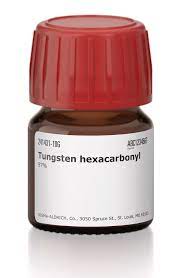
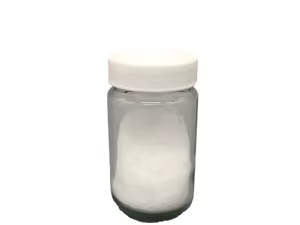
- Appearance: W(CO)6 typically appears as a white, crystalline solid.
- Volatility: Unlike many metal compounds, tungsten hexacarbonyl is remarkably volatile. It sublimes readily at room temperature, meaning it can transition directly from a solid to a gas without passing through a liquid phase, a property that is crucial for some of its applications.
- Stability: It is relatively stable in air and moisture at room temperature, unlike many other organometallic compounds which are highly reactive with oxygen or water.
- Solubility: It is sparingly soluble in nonpolar organic solvents like hydrocarbons but can dissolve in some more polar solvents.
- 18-Electron Rule: W(CO)6 is an excellent example of a complex that obeys the 18-electron rule, a guideline that predicts the stability of many organometallic compounds. Tungsten (Group 6) brings 6 valence electrons, and each CO ligand contributes 2 electrons, totaling 6 + (6 * 2) = 18 electrons, leading to its kinetic and thermodynamic stability.
Synthesis:
Tungsten hexacarbonyl is typically synthesized by the reductive carbonylation of a tungsten halide, such as tungsten hexachloride (WCl6), under high pressure of carbon monoxide, often with a reducing agent like aluminum powder.
Applications and Importance:
The unique combination of stability, volatility, and the “labile” nature of its carbonyl ligands (meaning they can be replaced by other molecules under specific conditions) makes W(CO)6 incredibly valuable:
- Chemical Vapor Deposition (CVD): This is one of its most significant industrial applications. Due to its volatility and thermal decomposition properties, W(CO)6 is used as a precursor to deposit thin films of pure tungsten metal. These films are essential in the semiconductor industry for creating interconnects, gate electrodes, and diffusion barriers in microelectronic devices, leveraging tungsten’s high melting point and electrical conductivity.
- Precursor in Organometallic Synthesis: Tungsten hexacarbonyl serves as a crucial starting material for synthesizing a vast array of other tungsten-containing organometallic compounds. The CO ligands can be selectively replaced by other ligands, allowing chemists to create compounds with tailored properties for various applications, including catalysis.
- Catalysis and Ligand Exchange Chemistry: While W(CO)6 itself is not a traditional catalyst for many reactions, its derivatives and complexes formed via ligand exchange can act as catalysts or pre-catalysts in organic synthesis, particularly in reactions involving carbon-carbon bond formation and hydrogenation. It is also a fundamental model compound for studying ligand exchange kinetics and mechanisms.
- Fundamental Research: Its well-defined structure and predictable reactivity make it an ideal compound for fundamental research in inorganic and organometallic chemistry, helping scientists understand metal-ligand bonding, electron transfer mechanisms, and the behavior of transition metals.
- Nanoscience: The controlled thermal decomposition of W(CO)6 can be used to synthesize tungsten nanoparticles and nanowires, which have potential applications in catalysis, sensors, and advanced materials.
Safety Considerations:
Like all metal carbonyls, tungsten hexacarbonyl must be handled with care. While relatively stable, it can decompose under certain conditions to release highly toxic carbon monoxide (CO) gas. Therefore, it should always be handled in a well-ventilated fume hood with appropriate personal protective equipment (PPE).
Conclusion:
Tungsten hexacarbonyl, W(CO)6, stands as a testament to the elegant simplicity and profound utility found within inorganic and organometallic chemistry. From enabling the fabrication of advanced microchips to serving as a versatile building block for new chemical compounds, its unique properties continue to make it an indispensable compound, driving innovation and expanding our understanding of chemical principles.


Reviews
There are no reviews yet.