

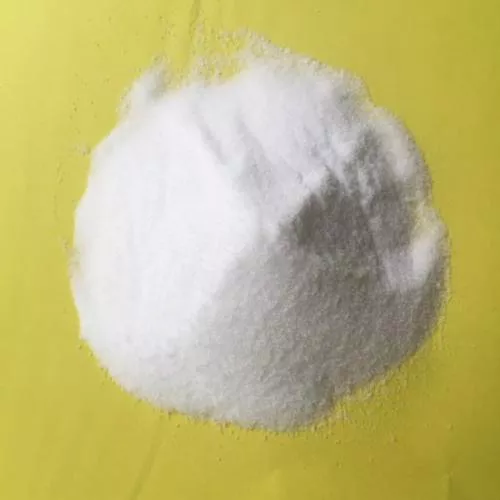


Description
Tantalum Pentachloride (TaCl₅): A Key Compound in High-Performance Materials
Tantalum pentachloride (TaCl₅) is an inorganic chemical compound and an important halide of the transition metal tantalum. With its distinct properties and versatile reactivity, TaCl₅ serves as a crucial precursor and intermediate in the synthesis of various tantalum-based materials, which are integral to modern high-tech industries.
Chemical Identity and Structure
- Formula: TaCl₅
- Appearance: Typically a pale yellow crystalline solid.
- Molar Mass: 358.19 g/mol
- Melting Point: Approximately 216-221 °C
- Boiling Point: Approximately 242 °C
In the gas phase, TaCl₅ exists as monomeric molecules with a trigonal bipyramidal geometry. However, in the solid and liquid states, it forms a dimeric structure, Ta₂Cl₁₀, where two tantalum atoms are bridged by two chlorine atoms, resulting in a pair of edge-sharing octahedra. This dimeric structure is common among many transition metal pentahalides.
Chemical Properties and Reactivity
Tantalum pentachloride is characterized by its high reactivity, particularly towards protic solvents and reducing agents:
- Hydrolysis: TaCl₅ is highly hygroscopic and reacts vigorously with water (hydrolysis), forming hydrochloric acid (HCl) and hydrated tantalum oxides or tantalic acid (H₅TaO₆): TaCl₅ + 5H₂O → H₅TaO₆ + 5HClThis reaction explains why TaCl₅ fumes in moist air and must be handled under anhydrous conditions.
- Lewis Acidity: As a metal halide, TaCl₅ is a strong Lewis acid, readily accepting electron pairs from Lewis bases. It forms adducts with various ligands, including ethers, nitriles, amines, and phosphines. This property makes it useful as a catalyst in certain organic reactions.
- Reactions with Organic Compounds: It reacts with alcohols to form alkoxides (e.g., Ta(OR)₅) and with various organic compounds to facilitate reactions such as Friedel-Crafts acylation and alkylation.
- Reduction: TaCl₅ can be reduced to lower oxidation states of tantalum, such as TaCl₄ or even tantalum metal, under appropriate conditions.
Synthesis
The primary industrial methods for synthesizing tantalum pentachloride include:
- Direct Chlorination of Tantalum Metal: High-purity tantalum metal reacts directly with chlorine gas at elevated temperatures (typically 200-400 °C): 2Ta (s) + 5Cl₂ (g) → 2TaCl₅ (g)The TaCl₅ product sublimes and can be collected, often as a solid.
- Carbochlorination of Tantalum Oxide: Tantalum pentoxide (Ta₂O₅) is reacted with chlorine gas in the presence of carbon (as a reducing agent) at high temperatures: Ta₂O₅ (s) + 5C (s) + 5Cl₂ (g) → 2TaCl₅ (g) + 5CO (g)This method is commonly used industrially due to the availability of tantalum oxide ores.
Applications
Tantalum pentachloride’s unique properties make it invaluable in several high-tech applications:
- Precursor for Tantalum Compounds: TaCl₅ is the primary starting material for the synthesis of a wide range of tantalum compounds, including:
- Tantalum Oxide (Ta₂O₅): Crucial for high-k dielectrics in advanced semiconductor devices (e.g., DRAM capacitors) due to its high dielectric constant.
- Tantalum Alkoxides (Ta(OR)₅): Used in sol-gel processes and as precursors for MOCVD (Metal-Organic Chemical Vapor Deposition) of tantalum oxide films.
- Tantalum Nitride (TaN) and Tantalum Carbide (TaC): Used in diffusion barriers, hard coatings, and wear-resistant applications.
- Chemical Vapor Deposition (CVD): TaCl₅ is a common precursor for the CVD of thin films of tantalum metal and tantalum oxide. These films find applications in:
- Semiconductor Manufacturing: As diffusion barriers, gate electrodes, and high-k dielectrics.
- Corrosion-Resistant Coatings: Protecting surfaces from harsh chemical environments.
- Protective Layers: On cutting tools and other high-wear components.
- Catalysis: Due to its strong Lewis acidity, TaCl₅ functions as a catalyst in various organic synthesis reactions, including:
- Friedel-Crafts reactions.
- Polymerization reactions.
- Purification of Tantalum: TaCl₅ can be used in the purification process of tantalum metal through chemical vapor transport techniques.
Handling and Safety
Tantalum pentachloride is a corrosive and moisture-sensitive substance. Proper handling precautions are essential:
- Corrosive: It reacts with moisture to release highly corrosive hydrochloric acid, causing severe burns to skin and eyes and irritation to the respiratory tract.
- Hygroscopic: Must be stored and handled under an inert, dry atmosphere (e.g., argon or nitrogen) in well-sealed containers to prevent hydrolysis.
- Safety Equipment: Always use appropriate personal protective equipment (PPE), including chemical-resistant gloves, safety goggles or face shield, and a lab coat.
- Ventilation: Work should be performed in a well-ventilated fume hood to prevent inhalation of vapors and hydrolysis products.
- Disposal: Waste TaCl₅ and its residues must be treated as hazardous waste and disposed of according to local regulations.
Conclusion
Tantalum pentachloride (TaCl₅) stands as a pivotal compound in the realm of high-performance materials. Its unique chemical properties, particularly its reactivity and ability to serve as a precursor, make it indispensable for the production of advanced tantalum-based materials critical to the semiconductor, electronics, and aerospace industries. As technology continues to demand ever higher performance and miniaturization, TaCl₅ will undoubtedly remain a cornerstone in the development of next-generation materials and devices.


Reviews
There are no reviews yet.