

Description
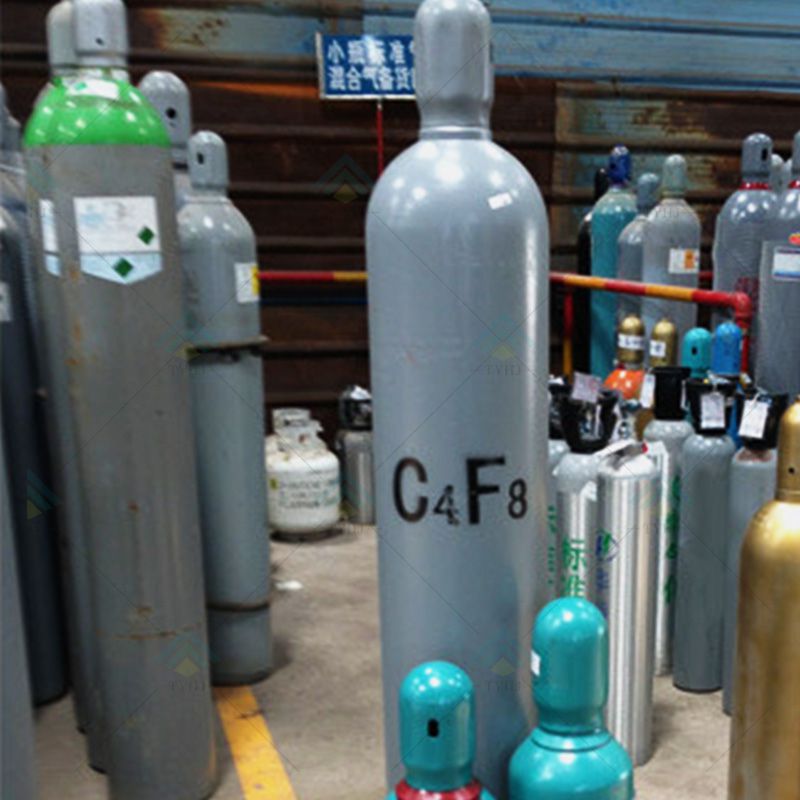
Octafluorocyclobutane (C₄F₈) – semiconductor etch gas
Octafluorocyclobutane (C₄F₈) is a fluorinated gas widely used in semiconductor plasma etching, particularly as a sidewall passivation agent in deep reactive ion etching (DRIE) processes such as the Bosch process. It works in tandem with etch gases to enable highly anisotropic etching of silicon and silicon-containing materials.
How C₄F₈ is used in DRIE
- In Bosch-type DRIE, the etch cycle typically uses a fluorine-containing gas (for example, SF₆) to remove material, while a polymerizing fluorocarbon gas (C₄F₈) deposits a protective polymer on sidewalls.
- The result is vertical or near-vertical sidewalls with minimal lateral etching, enabling high aspect ratio features.
- By alternating etch and passivation steps, the process achieves good anisotropy while maintaining acceptable etch rates.
Typical process picture (illustrative ranges)
- Gas roles:
- SF₆ or similar: etch step (fluorine radicals to remove silicon)
- C₄F₈: passivation step (polymer deposition on sidewalls)
- Operational ranges (illustrative only and tool dependent):
- Chamber pressure: ~10–60 mTorr
- Gas flows: SF₆ ~ 5–40 sccm; C₄F₈ ~ 5–50 sccm
- RF power: a few hundred watts to over 1 kW (source/bias configuration varies)
- Substrate temperature: near room temperature or slightly cooled
- Cycle times: etch steps a few seconds; passivation steps a few seconds
- Important note: exact parameters are highly tool- and material-dependent and require optimization for each process.
Advantages and limitations
- Pros
- Enables high aspect ratio, anisotropic etching with smooth sidewalls
- Protects sidewalls during the etch, reducing lateral etching
- Compatible with common semiconductor materials used in DRIE
- Cons
- Can cause polymer buildup that affects bottom etch rate or surface roughness if not tuned
- Requires careful process tuning of etch vs passivation cycles
- Environmental and safety considerations due to fluorinated gases
- Byproducts can be corrosive or reactive, necessitating proper exhaust scrubbing and handling
Safety, handling, and environmental impact
- C₄F₈ is a fluorinated gas with environmental considerations; many facilities treat fluorinated gases as greenhouse gases with high global warming potential.
- Use appropriate gas cabinets, leak detection, and scrubbers in the exhaust to remove fluorocarbons before release.
- In the event of exposure, follow standard industrial hygiene practices; ensure good ventilation and proper PPE when handling cylinders and plasma processes.
Quick comparison (C₄F₈ versus related gases)
| Gas | Primary role in DRIE | Pros | Cons |
|---|---|---|---|
| C₄F₈ | Sidewall passivation in Bosch-style DRIE | Enables high anisotropy and vertical sidewalls | Polymer buildup; requires careful tuning; environmental concerns |
| SF₆ | Etch component (fluorine radical generation) | High etch rate for silicon | Lateral etching if not balanced by passivation; toxicity/handling considerations |
| CHF₃ or CF₄ | Alternative fluorocarbon etch/passivation options | Different polymerization behavior; can be tuned with other gases | Similar environmental concerns; process sensitivity |
| C₅F₈ or other fluorocarbons | Passivation alternatives or process tweaks | Potential for different deposition characteristics | Similar handling and environmental considerations |
Practical tips for engineers (high level)
- Always balance etch rate with passivation: adjust C₄F₈ and SF₆ flows to achieve the desired sidewall protection without overly suppressing bottom etching.
- Monitor chamber pressure and temperature carefully; small changes can shift polymer deposition dramatically.
- Plan for post-etch cleaning or surface conditioning if polymer residues affect device performance.
- Implement proper gas handling and exhaust treatment to minimize environmental impact.
Summary
- C₄F₈ is used primarily to deposit a protective polymer on sidewalls during DRIE, enabling high aspect ratio, anisotropic silicon etching when paired with an etch gas like SF₆. Its use requires careful process optimization to balance etch rate, sidewall passivation, surface roughness, and environmental/safety considerations.


Reviews
There are no reviews yet.