
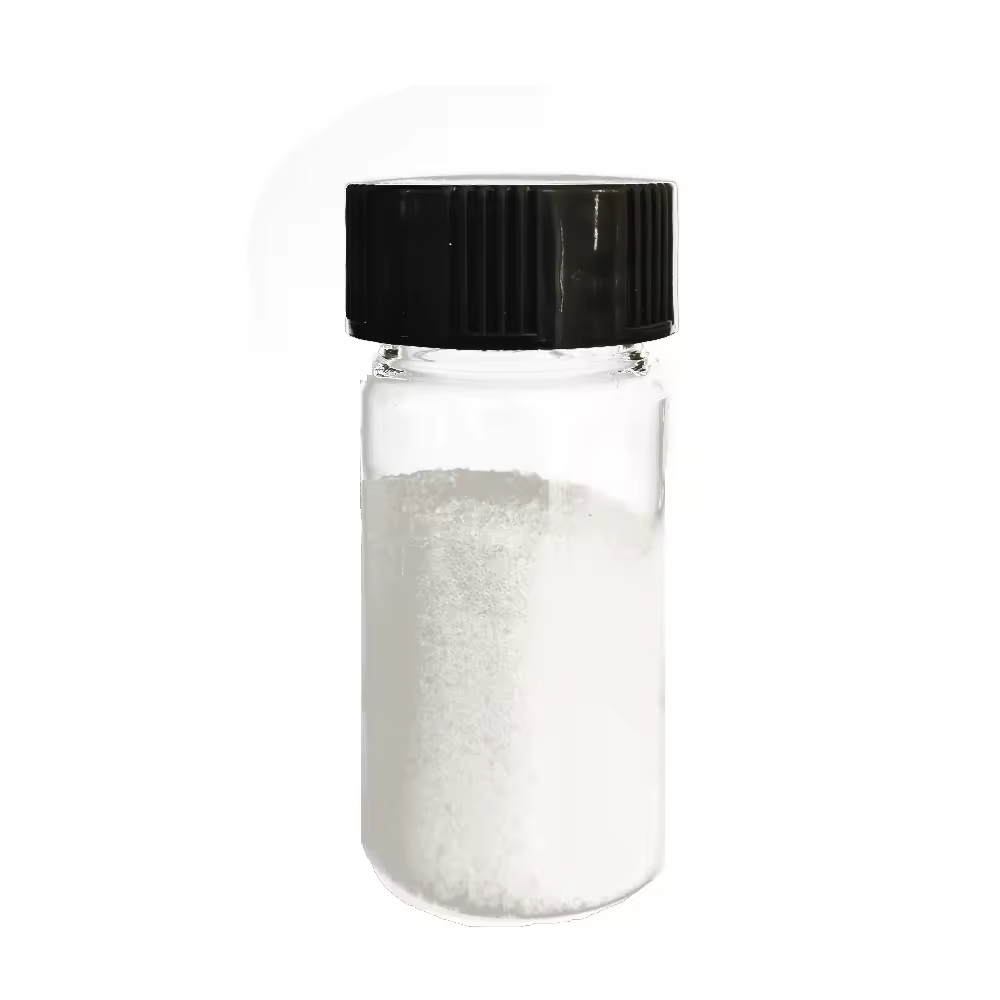
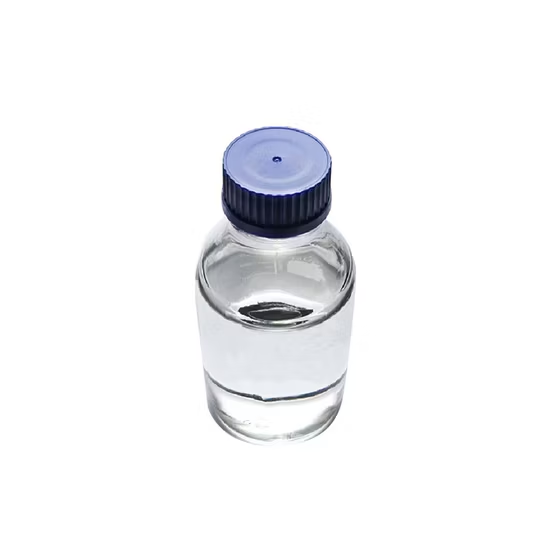
Tert-Butyl Carbamate

£15.18

Tert-Butyl Carbamate: A Versatile Reagent in Organic Synthesis Tert-butyl carbamate, also known as Boc-amine or (Boc)NH, is a widely used reagent in organic synthesis. Its unique properties and versatility have made it an essential tool in the synthesis of complex molecules, particularly in the fields of peptide chemistry, medicinal chemistry, and materials science. This essay will delve into the structure and properties of tert-butyl carbamate, its preparation methods, and its applications in various areas of organic synthesis. Structure and Properties Tert-butyl carbamate is a carbamate ester derived from tert-butanol and ammonia. Its molecular structure consists of a carbonyl group bonded to a tert-butyl group and an amino group. This unique structure confers upon it several important properties. Firstly, the tert-butyl group provides steric hindrance, making it difficult for nucleophiles to attack the carbonyl group, thereby increasing the stability of the molecule. Secondly, the amino group is highly reactive, allowing it to participate in various chemical reactions. Finally, the carbonyl group can be easily cleaved, making it a useful protecting group in organic synthesis. Preparation Methods Tert-butyl carbamate can be prepared through several methods. One common method involves the reaction of di-tert-butyl dicarbonate with an amine in the presence of a base such as triethylamine. This method is widely used due to its simplicity and high yield. Another method involves the reaction of tert-butyl chloroformate with an amine in the presence of a base. This method is often used when the amine is particularly sensitive to the reaction conditions. Applications in Organic Synthesis Tert-butyl carbamate has numerous applications in organic synthesis, including peptide synthesis, medicinal chemistry, and materials science. In peptide synthesis, tert-butyl carbamate is used as a protecting group to prevent unwanted reactions at the amino terminal of the peptide chain. The Boc group can be easily removed using a mild acid such as trifluoroacetic acid, allowing for the subsequent addition of amino acids to the growing peptide chain. In medicinal chemistry, tert-butyl carbamate is used as a precursor to various biologically active compounds. For example, it can be used to prepare protease inhibitors, which are used to treat diseases such as HIV and cancer. Additionally, tert-butyl carbamate can be used to prepare compounds with potential anti-inflammatory and antimicrobial activity. In materials science, tert-butyl carbamate is used as a monomer in the synthesis of polyurethanes and polyureas. These polymers have a wide range of applications, including coatings, adhesives, and biomedical materials. Conclusion In conclusion, tert-butyl carbamate is a versatile reagent with a wide range of applications in organic synthesis. Its unique structure and properties make it an essential tool in the synthesis of complex molecules. Its preparation methods are simple and efficient, and its applications in peptide synthesis, medicinal chemistry, and materials science are numerous and varied. As the demand for complex molecules continues to grow, the importance of tert-butyl carbamate in organic synthesis is likely to increase. References: Greene, T. W., & Wuts, P. G. (2012). Protective Groups in Organic Synthesis. John Wiley & Sons. Smith, M. B., & March, J. (2013). March’s Advanced Organic Chemistry: Reactions, Mechanisms, and Structure. John Wiley & Sons. * Carey, F. A., & Sundberg, R. J. (2007). Advanced Organic Chemistry: Part B: Reactions and Synthesis. Springer.

Description

Tert-Butyl Carbamate: A Versatile Protecting Group in Organic Synthesis

Tert-butyl carbamate, often referred to as Boc (t-Boc), is a widely used protecting group in organic chemistry, particularly for amines. Its chemical formula is (CH₃)₃C-O-CO-NH₂, and it is characterized by its bulky tert-butyl group attached to the carbamate functionality. Boc offers several advantages that make it a popular choice for protecting amines during complex syntheses.

Why Protect Amines?

Amines are highly reactive functional groups that can interfere with desired reactions in a molecule. This is especially true in peptide synthesis and other complex organic transformations. Protecting groups like Boc temporarily “mask” the amine, rendering it unreactive until it’s time to incorporate it into the final product.

Advantages of Boc Protection:

  • Ease of Installation: Boc protection is typically achieved by reacting the amine with di-tert-butyl dicarbonate (Boc₂O) in the presence of a base. This reaction is generally high-yielding and proceeds under mild conditions.
  • Stability: Boc-protected amines are stable to a wide range of reaction conditions, including basic, nucleophilic, and oxidative environments. This robust nature allows chemists to perform various transformations on other parts of the molecule without affecting the amine functionality.
  • Selective Deprotection: One of the most crucial features of Boc is its selective removal under acidic conditions, commonly using trifluoroacetic acid (TFA) or hydrochloric acid (HCl). This deprotection method is orthogonal to other commonly used protecting groups, such as Fmoc (9-fluorenylmethyloxycarbonyl), making it possible to selectively remove Boc while leaving other protecting groups intact.
  • Crystallinity: Boc-protected amines are often crystalline, which can be beneficial for purification and characterization.
  • Commercial Availability: Tert-butyl carbamate and Boc₂O are readily available commercially, making them easily accessible to researchers.

Applications in Synthesis:

Boc protection is extensively employed in various areas of organic chemistry, including:

  • Peptide Synthesis: Boc is widely used in solid-phase peptide synthesis (SPPS) to protect the N-terminus of amino acids. This allows for the sequential addition of amino acids to the growing peptide chain.
  • Pharmaceutical Chemistry: Boc is crucial in synthesizing complex pharmaceutical compounds, as it allows for the selective modification of amine-containing molecules.
  • Natural Product Synthesis: The protection and deprotection of amines are often necessary to synthesize complex natural products, and Boc plays a critical role in these processes.
  • Materials Science: Boc-protected monomers can be used to prepare polymers with specific properties, such as pH sensitivity.

Limitations and Considerations:

While Boc protection is highly effective, it’s important to consider its limitations:

  • Acidity: Boc deprotection requires acidic conditions, which may not be compatible with acid-sensitive functional groups in the molecule.
  • Bulky Nature: The bulky tert-butyl group can sometimes hinder reactions, especially in sterically hindered environments.
  • Alternative Protecting Groups: For acid-sensitive substrates or where steric hindrance is a concern, other protecting groups like Alloc (allyloxycarbonyl) or Cbz (benzyloxycarbonyl) might be more suitable.

Conclusion:

Tert-butyl carbamate (Boc) is a powerful and versatile protecting group in organic synthesis. Its ease of installation, stability, selective deprotection, and commercial availability make it an indispensable tool for chemists working on complex molecules. While it’s important to consider its limitations and alternative options, Boc remains a cornerstone of amine protection strategies in diverse fields, from peptide synthesis to pharmaceutical development.

Additional information

Availability

tert-Butyl carbamate is available from Sigma-Aldrich, tci america, BLD Pharm, and Thermo Scientific Chemicals.

Properties

Melting point: 107–109 °C
Boiling point: 196 °C
Density: 0.99 g cm−3
Refractive index: 1.428
Flash point: 82.4 °C
Solubility: Soluble in methylene chloride, chloroform, and alcohols; slightly soluble in petroleum ether and water

Synonyms Carbamic Acid tert-Butyl Ester.

CAS number 4248-19-5.

Safety

Safety and hazards information for tert-butyl carbamate is available on PubChem.

Uses

Used in the palladium-catalyzed synthesis of N-Boc-protected anilines
Used in the synthesis of tetrasubstituted pyrroles, functionalized with ester or ketone groups at C-3 position

Reviews

There are no reviews yet.

Be the first to review “Tert-Butyl Carbamate”

Your email address will not be published. Required fields are marked *

Add to cart