
Description
1. Product Overview
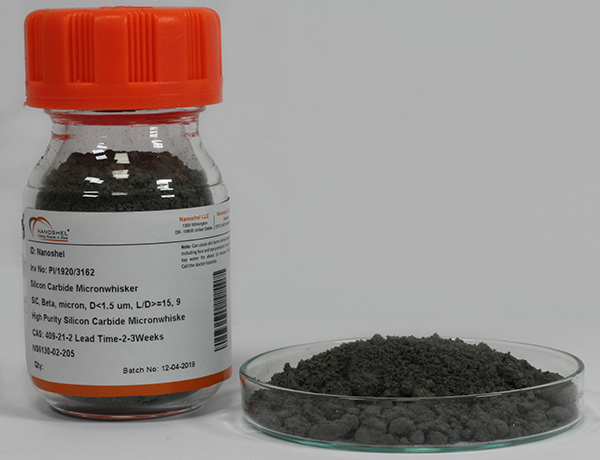
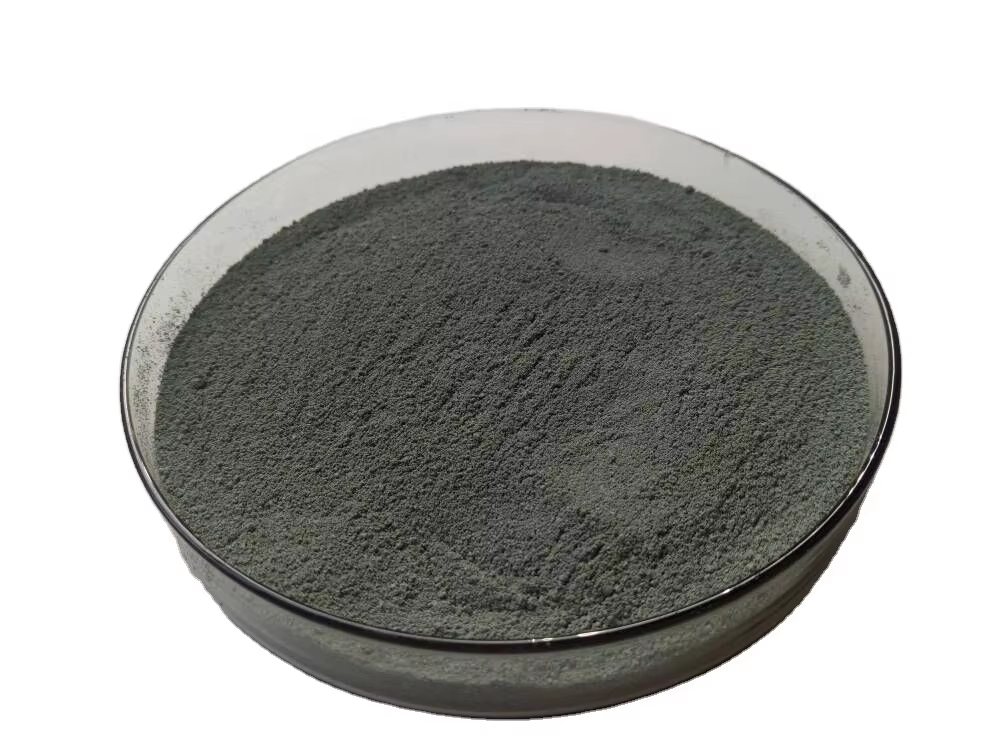
Silicon carbide (SiC) whiskers are single-crystal, high-aspect-ratio reinforcing filaments engineered for extreme thermal and mechanical performance. They are primarily used as a high-performance composite reinforcement in ceramic, metal, and polymer matrix systems to dramatically improve fracture toughness, creep resistance, and thermal stability. The key value proposition lies in their ability to deliver near-diamond hardness with oxidation resistance up to 1600°C, offering a strategic alternative to brittle ceramic solutions. In a market demanding lighter, hotter, and stronger materials for aerospace and energy sectors, SiC whiskers are a mission-critical enabler.
2. Key Specifications & Technical Characteristics
-
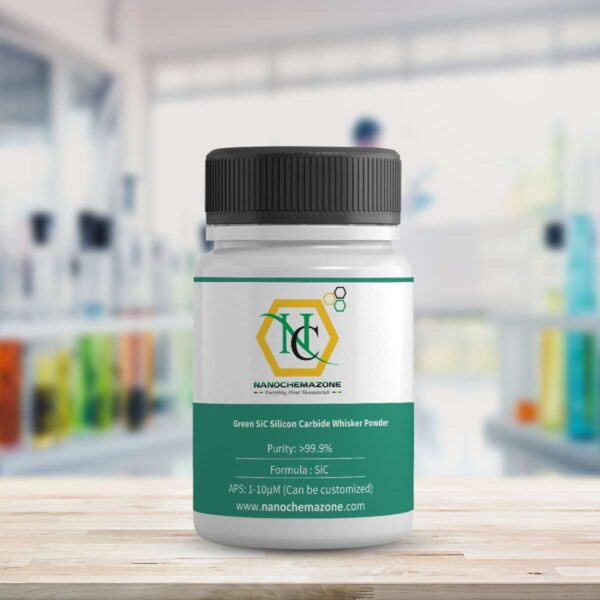
Chemical composition: β-SiC (cubic crystal structure), >99.5% purity
-
Purity level: 99.5% – 99.9% (trace Fe, Al, Ca <0.1%)
-
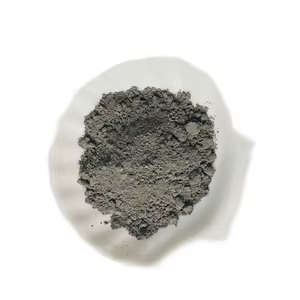
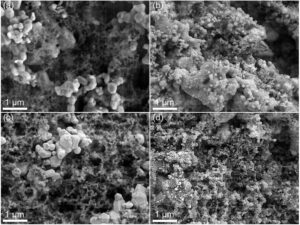
Physical form: Fine, needle-like monocrystalline whiskers
-
Color: Light green to gray-green
-
Diameter range: 0.1 – 1.0 µm (mean: 0.5 µm)
-
Length range: 10 – 80 µm (mean: 30 µm)
-
Aspect ratio: 20–80:1 (mean 60:1)
-
Density: 3.21 g/cm³
-
Melting point: 2,730°C (decomposes without melting)
-
Tensile strength: 8.4 GPa (typical)
-
Young’s modulus: 580 GPa
-
Thermal conductivity: 120 W/m·K
-
Packaging options: 1 kg, 5 kg, 10 kg vacuum-sealed aluminum-lined bags; 20 kg fiber drums; bulk FIBC (500 kg)
-
Shelf life: 36 months in sealed, dry, non-corrosive environment
3. Core Industrial Applications
-
Aerospace & defense: Used in ceramic matrix composites (CMCs) for turbine engine shrouds, nozzle flaps, and leading edges — outperforms continuous SiC fiber in complex geometries and isotropic reinforcement.
-
High-performance cutting tools: As a reinforcing phase in ceramic (Al₂O₃–SiCw) cutting inserts — increases tool life 3–5x vs. conventional ceramics by suppressing crack propagation.
-
Electronics thermal management: Embedded in Al or Cu matrix composites for IGBT and radar heat spreaders — delivers 180–220 W/m·K with coefficient of thermal expansion (CTE) tunable to 6–8 ppm/K, matching silicon.
-
Advanced armor systems: Added to boron carbide or alumina armor tiles — enhances multi-hit capability without adding weight, reducing spall failure by over 40% in ballistic tests.
4. Competitive Advantages
-
Quality consistency: Laser-diffraction and SEM-EDS batch-control reporting. Coefficient of variation (CV) for diameter <5% across production runs — critical for reproducible composite manufacturing.
-
Supply reliability: Dedicated production lines with 50 MT/month capacity; safety stock held in three regional hubs (North America, Europe, Asia).
-
Logistics capability: Export-worthy anti-static and moisture-barrier packaging. DG classification: non-hazardous for air/sea/land.
-
Price competitiveness: Direct-from-furnace pricing with no distributor markup; volume discounts from 5 MT upward.
-
Sustainability: Whiskers derived from rice hull-sourced silica and low-VOC binder systems; 100% recyclable production water loop; Scope 1 & 2 emissions data available on request.
-
Technical support: Full material safety data sheets (MSDS), processing guides (dispersion, hot-pressing, SPS parameters), and application engineering support included.
5. Commercial & Supply Information
-
Minimum order quantity (MOQ): 20 kg (industrial-grade); 5 kg for qualified R&D institutions
-
BULK 20MT loading capacity: 20 metric tons per 20-foot dry container (standardized FIBC layering)
-
Loading density per container (20’ DV): 20 MT net weight (palletized or loose FIBC)
-
Lead time: 15 days for <1 MT; 30 days for bulk 20 MT orders ex-warehouse
-
Incoterms supported: EXW, FOB (Ningbo / Rotterdam / Houston), CIF, DDP
-
Payment terms: Letter of credit at sight (L/C), 30% advance + 70% against B/L copy for qualified buyers

Reviews
There are no reviews yet.