
Description
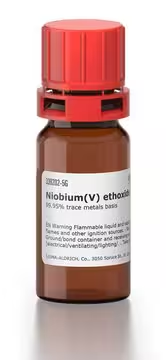
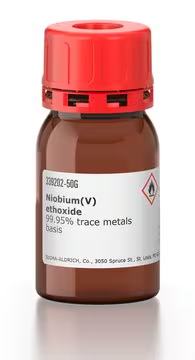
Niobium Ethoxide (Nb(OEt)5)
Niobium ethoxide is the niobium(V) alkoxide derived from ethanol, commonly used as a precursor for niobium oxide materials and as a catalyst/support precursor in sol–gel and related syntheses.
Chemical identity and structure
- Formula: Nb(OEt)5 (also written Nb(OC2H5)5)
- Oxidation state of Nb: +5
- Typical structure: In solid form, niobium alkoxides often form polymeric networks; in solution they can coordinate solvent molecules. The Nb–O bonds link to five ethoxide ligands.
Synthesis and preparation
Two common preparation approaches:
-
Salt metathesis (alkoxide exchange):
- NbCl5 + 5 NaOEt → Nb(OEt)5 + 5 NaCl
- This method uses sodium ethoxide as the ethoxide source to form the niobium ethoxide.
-
Transesterification or ester exchange (from other Nb–OR reagents):
- Nb(OiPr)5 + 5 EtOH → Nb(OEt)5 + 5 iPrOH
- This method swaps ester groups with ethanol when starting from another niobium alkoxide.
- Both routes require strictly dry, inert conditions because Nb(OEt)5 is moisture sensitive and hydrolyzes readily in air.
Physical properties (typical expectations)
- Appearance: Often a colorless to pale yellow solid or viscous liquid, depending on prevailing conditions and impurities.
- Stability: Reactive toward water and oxygen; handled under dry, inert atmosphere.
- Volatility: Not highly volatile; typically stored in sealed containers.
Reactivity and hydrolysis
- Moisture sensitivity: Reacts with water to form niobium oxide/hydroxide species and ethanol.
- Hydrolysis products: Under hydrolysis, Nb(OEt)5 tends to form Nb2O5-based networks (sol–gel derived) with release of ethanol.
- Coordination behavior: In solution, it can coordinate with solvent molecules and may form oligomeric species.
Applications and uses
- Sol–gel chemistry: Primary use as a Nb source to prepare Nb2O5-based materials, ceramics, or thin films.
- Catalysis: Used as a precursor for acidic Nb-containing catalysts and as a component in mixed oxide materials.
- Materials science: Helps in fabricating dielectric, optical, and catalytic Nb-containing materials via controlled hydrolysis and condensation.
Handling and safety
- Storage: Keep under strictly dry, inert atmosphere; store in a tightly closed container, away from moisture.
- Safety concerns: Corrosive and irritant; handle with appropriate PPE (gloves, eye protection, lab coat) and ensure good ventilation.
- Disposal: Follow local regulations for inorganic metal alkoxide waste; avoid releasing to the environment or moisture.
Reviews
There are no reviews yet.