
Description
Fluorosilicate gases and SiF6 derivatives
Fluorosilicate chemistry centers on silicon coordinated to fluoride, including volatile silicon fluorides and the hexafluorosilicate system. The most familiar and important species are:
- SiF4: silicon tetrafluoride, a volatile neutral molecule (gas at room temperature).
- [SiF6]2−: hexafluorosilicate anion found in salts (not a gas).
- H2SiF6: hexafluorosilicic acid, the aqueous form of hexafluorosilicate.
- SiF6 derivatives in salts: salts containing the hexafluorosilicate anion, e.g., Na2SiF6, K2SiF6, (NH4)2SiF6.
Below is a concise overview of these species, their properties, and common uses.
Key species and characteristics
-
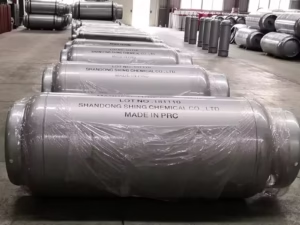
SiF4 (silicon tetrafluoride)
- Phase: gas at room temperature
- Reactions: hydrolyzes readily with water to form SiO2 and HF
- Uses: fluorinating agent, precursor for chemical vapor deposition (CVD) processes, silicon etching in microfabrication
-
[SiF6]2− (hexafluorosilicate ion)
- Phase: in salts (not a gas)
- Structure: silicon center coordinated to six fluoride ligands; octahedral coordination
- Salts: many metallates form Na2SiF6, K2SiF6, (NH4)2SiF6, etc.
- Uses: source of fluoride in water treatment and dental care products; heat-stable fluoridation additives
-
H2SiF6 (hexafluorosilicic acid)
- Phase: aqueous solution
- Behavior: strong acid; dissociates to release fluoride species in water
- Uses: widely used for water fluoridation and as a fluoridation reagent
Common SiF6 derivatives and salts
In practice, the SiF6 derivatives most commonly encountered are salts and acids built on the [SiF6]2− anion. Examples and typical applications:
-
Na2SiF6 (sodium hexafluorosilicate)
- Phase: solid salt
- Uses: water fluoridation and dental health products; also used in glass-etching and as a fluorinating source in some reactions
-
K2SiF6 (potassium hexafluorosilicate)
- Phase: solid salt
- Uses: similar to Na2SiF6; water fluoridation and industrial fluorination contexts
-
(NH4)2SiF6 (ammonium hexafluorosilicate)
- Phase: solid salt
- Uses: fluoride source in various chemical and industrial processes; can release HF slowly upon dissolution
-
H2SiF6 (hexafluorosilicic acid)
- Phase: aqueous solution
- Uses: primary reagent for adding fluoride to public water supplies; also used in some electrolyte formulations
Key reactions and properties
-
Hydrolysis and fluoride release:
- SiF4 + 2 H2O → SiO2 + 4 HF
- H2SiF6 in water can equilibrate to form [SiF6]2− and H+, enabling fluoride delivery
-
Stability considerations:
- SiF4 is a highly reactive fluorinating gas and reacts with moisture
- Hexafluorosilicate salts are relatively stable solids that release fluoride upon dissolution or hydrolysis
- Fluoride-containing species are typically corrosive and can generate HF, a highly hazardous acid, upon contact with water
Applications and practical context
- Water fluoridation and dental care: hexafluorosilicic acid and hexafluorosilicate salts are common fluoride sources to promote dental health.
- Industrial fluorination and materials processing: SiF4 is used as a fluorinating agent and as a precursor in semiconductor etching and deposition processes.
- Glass and ceramic processing: hexafluorosilicate salts can be used in specialized etching or coating workflows.
Safety and handling
- Fluoride compounds can be highly corrosive and toxic; HF formation presents serious inhalation and skin contact hazards.
- Handle SiF4 and fluoride-containing salts in well-ventilated fume hoods with appropriate PPE.
If you’d like, I can tailor this to a specific focus, such as:
- Detailed preparation and handling of Na2SiF6 or K2SiF6
- Industrial routes to SiF4 and its gas-phase chemistry
- Mechanisms of fluoride release from hexafluorosilicic acid in water treatment
- A comparison table of common SiF6 salts and their typical applications
Would you like a deeper dive into a particular derivative or application?
Reviews
There are no reviews yet.