
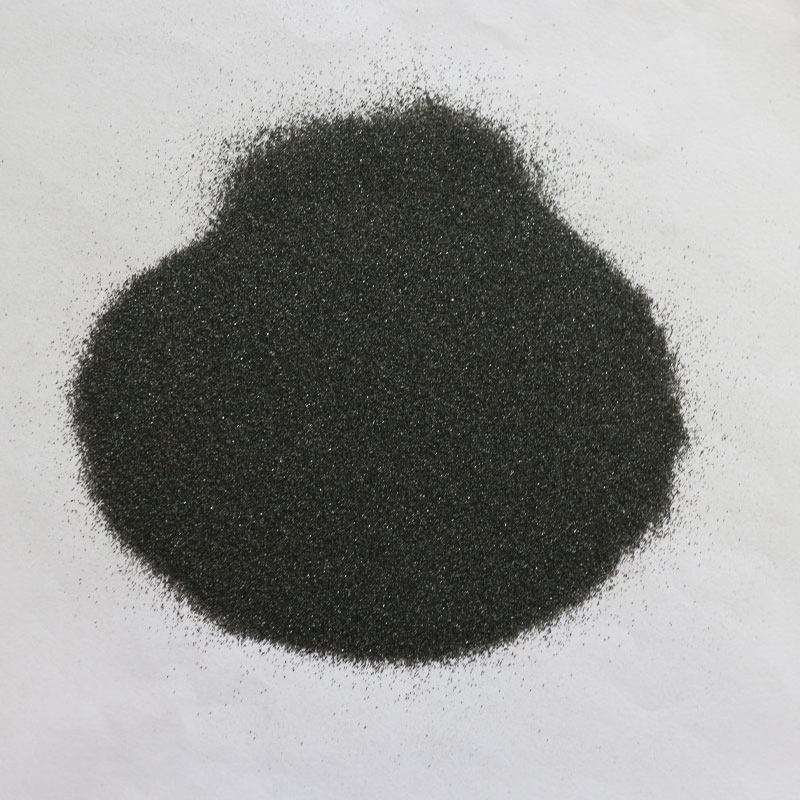
Description
Silicon Carbide (SiC) Whiskers: The Tiny Fibers Reinventing Materials Engineering
Introduction: Why “whiskers” matter
If you’ve ever watched a cat groom itself, you’ve seen a whisker in action: a slender, stiff filament that can sense the world with astonishing precision. In the world of materials science, the term whisker carries a very different, but equally impressive, meaning. A silicon carbide (SiC) whisker is a microscopic, needle‑like crystal—typically a few microns long and a few hundred nanometers in diameter—that possesses a remarkable combination of mechanical strength, chemical stability, and thermal endurance.
These tiny filaments have been around in research labs for more than four decades, but recent advances in synthesis, processing, and safety protocols are finally pushing SiC whiskers from the laboratory bench into mainstream commercial products. In this post we’ll explore what SiC whiskers are, how they’re made, why they’re so special, where they’re being used today, and what the future may hold.
1. What Exactly Is a SiC Whisker?
| Property | Typical Value (single crystal whisker) |
|---|---|
| Composition | Silicon carbide (SiC), often the 3C (cubic) polytype |
| Diameter | 0.1 – 0.5 µm (100 – 500 nm) |
| Length | 5 – 100 µm (sometimes up to several mm) |
| Aspect Ratio | 10 – 1 000 (length ÷ diameter) |
| Young’s Modulus | 420 – 450 GPa |
| Tensile Strength | 3 – 6 GPa (up to 7 GPa for defect‑free whiskers) |
| Thermal Conductivity | 120 – 200 W·m⁻¹·K⁻¹ |
| Oxidation Resistance | Stable up to ~1 200 °C in air (forming a protective SiO₂ layer) |
A SiC whisker is essentially a single‑crystal filament. Unlike polycrystalline SiC powders, the whisker’s lattice is continuous from tip to tip, meaning there are virtually no grain boundaries to act as weak points. This structural perfection explains the extraordinary strength‑to‑weight ratio that makes whiskers an attractive reinforcement for composites.
2. How Are SiC Whiskers Grown?
2.1 The Classic Vapor–Liquid–Solid (VLS) Route
The most widely used laboratory method is the Vapor–Liquid–Solid (VLS) technique, first demonstrated for silicon whiskers in the 1960s and adapted for SiC in the 1980s.
- Source gases – Typically a mixture of silicon‑containing vapors (e.g., SiCl₄, SiH₄) and carbon‑containing gases (e.g., CH₄, C₂H₄).
- Metal catalyst droplets – Tiny droplets of nickel, iron, or cobalt are deposited on a SiC seed substrate.
- Heating – At 1 200 – 1 500 °C the metal forms a liquid alloy with the vapor species.
- Supersaturation & precipitation – When the alloy becomes supersaturated with Si and C, SiC precipitates out as a solid filament, extending from the droplet.
The VLS method yields whiskers with excellent crystallinity and relatively uniform diameters, but it suffers from low throughput and the need for expensive metal catalysts.
2.2 Carbothermal Reduction (CR) – The “Industrial” Path
For large‑scale production, the carbothermal reduction route dominates:
- Raw materials: SiO₂ powder mixed with carbon (graphite or coke) in a 1:1 molar ratio.
- High‑temperature furnace: 1 500 – 1 700 °C in an inert atmosphere (Ar or N₂).
- Growth mechanism: SiO₂ reacts with carbon to form SiC gas (SiO + CO) that then nucleates and grows as whiskers on the surface of the solid mixture.
Key advantages:
- Scalability – Tens of kilograms per batch are feasible.
- Low catalyst contamination – No metal droplets are required, simplifying downstream purification.
A downside is that CR whiskers typically have a broader size distribution and more surface defects than VLS whiskers. However, post‑growth treatments (acid leaching, oxidation‑reduction cycles) can trim the defect population.
2.3 Emerging Low‑Temperature Methods
- Microwave‑plasma synthesis (≈ 800 °C) – Uses a plasma jet to activate Si–C precursors.
- Chemical vapor deposition (CVD) on patterned substrates – Enables controlled alignment, which is a game‑changer for additive‑manufacturing of SiC‑reinforced parts.
These techniques are still at the pilot‑scale stage but promise cheaper, greener production and better control over whisker orientation.
3. What Makes SiC Whiskers So Special?
3.1 Mechanical Superpowers
| Property | Typical Composite Enhancement |
|---|---|
| Tensile strength | +30 % to +200 % (depending on loading) |
| Young’s modulus | +20 % to +150 % |
| Fracture toughness | Up to 2 × that of unreinforced matrix |
Because whiskers are essentially “single‑crystal fibers,” they can bear loads far beyond conventional short SiC particles. Their high aspect ratio enables load transfer through shear at the whisker‑matrix interface, dramatically stiffening the host material.
3.2 Thermal Resilience
- High thermal conductivity helps dissipate heat in electronic packages.
- Low coefficient of thermal expansion (CTE) (≈ 4 × 10⁻⁶ K⁻¹) reduces thermal mismatch stresses when embedded in metal or polymer matrices.
- Oxidation resistance: A thin SiO₂ scale forms in air, protecting the underlying SiC even at > 1 200 °C.
3.3 Chemical Inertness
SiC whiskers are non‑reactive toward most acids, bases, and organic solvents. This makes them suitable for harsh chemical environments such as:
- Aerospace turbine coatings
- Industrial abrasives
- Catalyst supports in petrochemical reactors
3.4 Electrical Properties
Although bulk SiC is a wide‑bandgap semiconductor (3.2 eV for 3C‑SiC), whiskers retain semiconducting behavior. Doping during growth can tailor their conductivity, enabling niche applications like:
- High‑temperature sensors
- Nanoscale field‑effect transistors (research stage)
4. Real‑World Applications: Where Whiskers Meet the World
| Industry | Typical Product | Role of SiC Whiskers |
|---|---|---|
| Aerospace & Defense | Turbine‑blade coatings, heat‑shield tiles | Reinforce ceramic matrix composites (CMCs) for high‑temperature, high‑stress environments |
| Automotive | Brake pads, wear‑resistant inserts | Reduce wear rate while maintaining low weight |
| Electronics | Thermal interface materials (TIMs), substrate fillers | Enhance thermal conductivity of polymer or metal‑matrix composites |
| Energy | Nuclear fuel cladding, solar‑thermal receivers | Provide radiation‑hard, corrosion‑resistant reinforcement |
| Additive Manufacturing | SiC‑reinforced filament for FDM printers | Enable 3‑D‑printed parts with superior stiffness and heat tolerance |
| Medical | Dental prosthetics, bone‑implant coatings | Improve fracture toughness and biocompatibility (after surface functionalization) |
Case Study – Turbofan Engine CMCs (2024)
A leading engine manufacturer announced a 15 % fuel‑efficiency gain by replacing nickel‑based superalloy shrouds with SiC whisker‑reinforced SiC/SiC composites. The whiskers provided the necessary toughness to survive high‑cycle fatigue while allowing the component to operate at 1 300 °C—far hotter than traditional alloys.
5. Processing SiC Whiskers into Composites
5.1 Surface Treatment – The “Gotcha” Step
Raw whiskers have a hydrophobic, chemically inert surface that hinders bonding to most matrices. Conventional treatments include:
- Acid etching (H₂SO₄/HNO₃) – Introduces –OH groups.
- Silane coupling agents – e.g., γ‑aminopropyltriethoxysilane (APTES) to form covalent bridges with epoxy or polymer matrices.
- Carbon coating – Thin graphitic shells improve interfacial shear strength in metal matrices.
The goal is to strike a balance: enough functional groups for adhesion without compromising whisker strength through over‑etching.
5.2 Dispersion Techniques
Because whiskers tend to bundle (due to van der Waals attraction), achieving a homogeneous distribution is crucial:
| Technique | Typical Energy Input | Remarks |
|---|---|---|
| Ultrasonication (in solvent) | 20–40 kHz, 100–200 W | Works for low‑loading (< 5 wt %) systems |
| High‑shear mixing (planetary mixers) | > 5 000 rpm | Scales up to industrial batch sizes |
| Ball‑milling with surfactants | 200–500 rpm, 2–4 h | Risk of whisker breakage; use gentle media (e.g., ZrO₂ beads) |
5.3 Consolidation Methods
- Hot pressing / spark plasma sintering (SPS) – Densifies SiC whisker/SiC powder blends into monolithic CMCs.
- Polymer matrix casting – For epoxy, phenolic, or polyimide matrices; curing at 150–250 °C.
- Metal infiltration – SiC whiskers infiltrated with molten Al, Mg, or Ti alloys to form metal‑matrix composites (MMCs).
6. Safety & Environmental Considerations
The fibrous morphology of SiC whiskers raises concerns reminiscent of asbestos. While SiC is chemically inert and does not contain the silicate structure that makes asbestos hazardous, respirable fibers can cause mechanical irritation.
| Concern | Mitigation Strategy |
|---|---|
| Inhalation | Use local exhaust ventilation, HEPA filtration, and personal protective equipment (PPE) (N95 or higher) during powder handling. |
| Waste disposal | Treat waste with encapsulation (e.g., cementitious grout) before landfill; some jurisdictions classify SiC whiskers as “non‑hazardous but requires special handling.” |
| Environmental impact | CR synthesis consumes carbon and generates SiO₂ by‑products; recycling of off‑spec whisker slurry into SiC powders can reduce waste. |
Regulatory bodies (e.g., OSHA, EU REACH) have not classified SiC whiskers as carcinogenic, but best‑practice guidelines emphasize dust control and training.
7. The Road Ahead: Emerging Trends
7.1 Aligned‑Whisker Architectures
Researchers are leveraging magnetic fields, electric fields, and shear flow during processing to align whiskers preferentially. Aligned whisker composites exhibit anisotropic properties—up to 3× higher tensile strength along the alignment direction—opening doors for:
- High‑performance aerospace spars
- Directional thermal conductors for power electronics
7.2 Hybrid Reinforcements
Combining SiC whiskers with other nanoscale fillers—graphene, boron nitride nanosheets, or carbon nanotubes—creates multifunctional hybrids that can simultaneously improve:
- Mechanical strength (whiskers)
- Electrical conductivity (graphene)
- Thermal barrier performance (BN)
Early prototypes show fracture toughness improvements of 250 % over SiC‑whisker‑only composites.
7.3 Additive Manufacturing (AM)
The rise of direct ink writing (DIW) and laser‑based powder bed fusion (PBF) with SiC‑whisker‑laden inks/powders is a game‑changer. By printing complex geometries that would be impossible to forge, engineers can fully exploit whisker‑reinforced ceramics in lightweight lattice structures.
7.4 Sustainable Production
- Biomass‑derived carbon sources for carbothermal reduction.
- Closed‑loop gas recycling in VLS reactors to cut SiCl₄ usage.
- Life‑cycle analysis (LCA) indicating up to 30 % lower carbon footprint compared with traditional SiC powder production.
8. Bottom Line: Are SiC Whiskers Worth the Hype?
Short answer: Yes—if you need a material that can survive extreme heat, mechanical load, and hostile chemicals while staying lightweight.
Long answer: SiC whiskers sit at a sweet spot where mechanical excellence meets thermal resilience and chemical inertness. Their production has become more scalable, safety protocols are mature, and new processing routes (alignment, hybridization, AM) are expanding their design space. The remaining hurdles—cost, consistent quality control, and environmental handling—are being actively addressed by industry consortia such as the SiC Whisker Alliance (SWA) and by public‑private research initiatives.
Quick Takeaways
| ✔️ | Key Point |
|---|---|
| Strength | Single‑crystal whiskers deliver tensile strengths > 5 GPa. |
| Thermal | Conductivity up to 200 W·m⁻¹·K⁻¹ and oxidation resistance to > 1 200 °C. |
| Processing | Carbothermal reduction now produces > 50 kg batches; surface functionalization is essential for good matrix bonding. |
| Safety | Treat as respirable dust; use ventilation and PPE. |
| Future | Aligned architectures, hybrid fillers, and additive manufacturing will drive the next wave of applications. |
Want to Dive Deeper?
- Review article: “Silicon Carbide Whiskers: Synthesis, Properties, and Applications” – Advanced Materials (2023).
- Webinar series: “From Powder to Part – SiC Whisker Composite Manufacturing” – hosted by the Materials Research Society (2025).
- Open‑source data: The SiC‑Whisker Database (github.com/SWA/SiC-Whisker) contains composition, size distribution, and mechanical test results from over 30 labs.


Reviews
There are no reviews yet.