

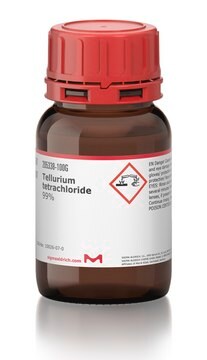
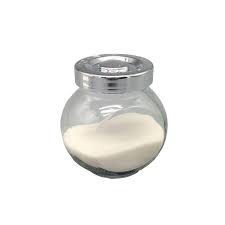
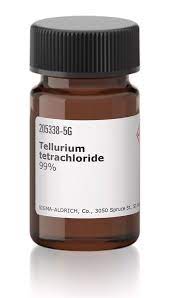

Description
Tellurium Tetrachloride (TeCl4): A Versatile Compound at the Heart of Tellurium Chemistry
Tellurium Tetrachloride (TeCl4) is an inorganic compound that plays a pivotal role in the synthetic chemistry of tellurium, a fascinating metalloid element. Often found as a white to pale yellow crystalline solid, TeCl4 is much more than just a simple halide; its unique structure, diverse reactivity, and utility as a synthetic intermediate make it an indispensable tool for chemists working with this intriguing element.
Chemical Identity and Structure
Formula: TeCl4 Appearance: Typically a white crystalline solid, though impurities can lend it a yellowish or grayish tint. Physical Properties: Tellurium tetrachloride has a relatively low melting point of around 225°C and boils at 390°C. Notably, it sublimes readily, meaning it can transition directly from a solid to a gas without passing through a liquid phase, a property often exploited for purification.
Fascinating Structure: One of the most intriguing aspects of TeCl4 is its varied structure depending on its state:
- Gas Phase: In the gas phase, TeCl4 molecules adopt a distorted trigonal bipyramidal geometry. This seemingly unusual shape is due to the presence of a lone pair of electrons on the central tellurium atom, which occupies one of the equatorial positions, pushing the other atoms into a seesaw-like arrangement.
- Solid State: In the solid state, TeCl4 forms a more complex, polymeric structure. It consists of tetrameric units, (TeCl4)4, where four TeCl4 molecules are linked together through bridging chlorine atoms, creating a network that contributes to its crystalline nature.
Synthesis
The most common method for synthesizing tellurium tetrachloride involves the direct chlorination of elemental tellurium. This reaction is straightforward and typically yields high purity TeCl4:
Te (s) + 2 Cl2 (g) → TeCl4 (s)
This process usually involves passing chlorine gas over heated tellurium metal in a controlled environment to ensure complete reaction and minimize impurities.
Chemical Properties and Reactivity
TeCl4 is a highly reactive compound, and its chemical behavior is dominated by several key characteristics:
- Hydrolysis: Tellurium tetrachloride reacts vigorously with water, undergoing hydrolysis. This reaction produces tellurous acid (H2TeO3) and highly corrosive hydrochloric acid (HCl): TeCl4 (s) + 3 H2O (l) → H2TeO3 (aq) + 4 HCl (aq) Due to this rapid hydrolysis, TeCl4 must be handled under anhydrous conditions and protected from atmospheric moisture.
- Lewis Acidity: Tellurium in TeCl4 is in the +4 oxidation state and possesses accessible vacant orbitals, allowing it to act as a strong Lewis acid. It readily accepts electron pairs from Lewis bases to form adducts. For instance, with chloride ions, it can form complex anionic species like [TeCl5]- or the octahedral [TeCl6]2-.
- Redox Chemistry: As tellurium is in an intermediate oxidation state (+4), TeCl4 can undergo both reduction and, less commonly, oxidation reactions. It can be reduced to lower oxidation states, including elemental tellurium (0) or tellurium dichloride (TeCl2), by various reducing agents.
- Organic Reactivity: TeCl4 is also employed in certain organic reactions, particularly in the telluration of alkenes and alkynes. It can add across double or triple bonds, introducing tellurium into organic molecules, which are then useful intermediates for further organic transformations.
Applications
The versatility of Tellurium Tetrachloride makes it a valuable compound in several areas, primarily as a precursor:
- Precursor in Inorganic Synthesis: Its most significant application is as a key starting material for synthesizing a wide array of other tellurium-containing compounds. This includes other tellurium halides, organotellurium compounds, and tellurium oxides.
- Semiconductor and Electronic Materials: Given tellurium’s importance in the electronics industry (e.g., in CdTe solar cells, thermoelectric devices, and phase-change memory), TeCl4 serves as a source for high-purity tellurium or its compounds, often obtained through chemical vapor deposition (CVD) processes.
- Catalysis: While less common than its role as a precursor, TeCl4 can sometimes act as a catalyst or co-catalyst in specific organic and inorganic reactions.
- Material Science Research: It is used in the synthesis of tellurium-based nanoparticles, thin films, and other advanced materials with tailored electronic and optical properties.
Safety and Handling
Tellurium tetrachloride is a hazardous chemical and must be handled with extreme care:
- Toxicity: Tellurium compounds are generally toxic, and exposure to TeCl4 can lead to symptoms consistent with tellurium poisoning, including a distinctive “garlic breath” odor.
- Corrosive: Its rapid hydrolysis releases hydrochloric acid, making it highly corrosive to skin, eyes, and respiratory tissues. It can cause severe burns and irritation.
- Irritant: Inhalation of its dust or vapors can cause severe irritation and damage to the respiratory tract.
Therefore, handling TeCl4 requires appropriate personal protective equipment (PPE), including gloves, eye protection, and protective clothing. All work should be conducted in a well-ventilated fume hood to prevent inhalation of dust or vapors. Disposal must adhere to strict hazardous waste regulations.
Conclusion
Tellurium Tetrachloride stands as a testament to the diverse and often complex chemistry of metalloid elements. Its unique structural forms, strong Lewis acidity, and crucial role as a precursor for a vast array of tellurium compounds underscore its importance in both fundamental chemical research and advanced materials science. As the demand for tellurium-based technologies continues to grow, TeCl4 will undoubtedly remain a vital compound at the forefront of chemical innovation.


Reviews
There are no reviews yet.