

Description
What Exactly is SMA Copolymer?
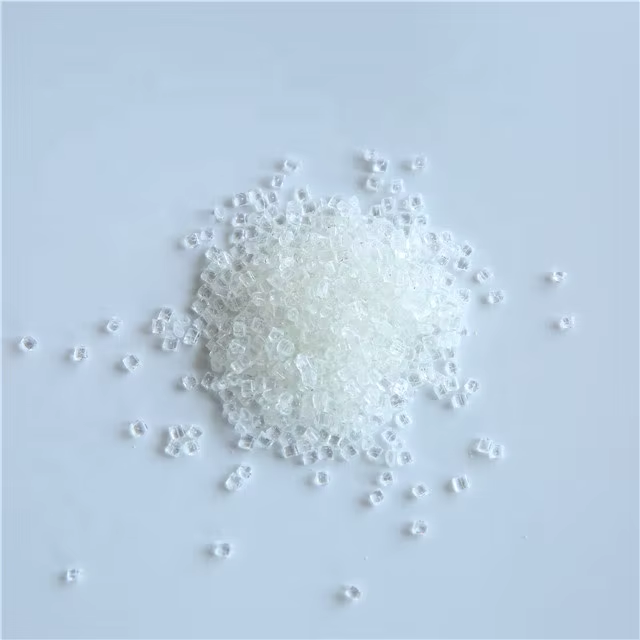
At its core, SMA is a synthetic copolymer made by polymerizing two monomers: styrene and maleic anhydride.
- Styrene provides rigidity, ease of processing, and a glossy finish.
- Maleic Anhydride is the real star of the show. It introduces highly polar reactive sites onto the polymer chain.
It’s this second component that gives SMA its superpowers. The anhydride groups are like chemical “hands” that can do two critical things:
- They dramatically increase the heat resistance of the plastic compared to pure polystyrene.
- They can be modified and reacted with other chemicals, making SMA a fantastic compatibility agent and a building block for more complex materials.
Why Choose SMA? The Key Properties
So, what makes a product designer specify SMA over another resin? The answer lies in its unique combination of properties:
- High Heat Resistance: This is SMA’s headline feature. It has a significantly higher Heat Deflection Temperature (HDT) than many other common thermoplastics like ABS or general-purpose polystyrene. This means parts made from SMA won’t warp or soften as easily when exposed to heat.
- Rigidity and Dimensional Stability: SMA is a stiff, strong polymer that holds its shape well, even under load and across a range of temperatures.
- Exceptional Adhesion and Compatibility: Thanks to those reactive anhydride groups, SMA bonds brilliantly to other materials, including glass fibers, minerals, and even other polymers. This makes it a phenomenal compatibilizer in polymer blends.
- Ease of Processing: It can be easily molded using standard techniques like injection molding and extrusion.
- Receptive to Modification: The anhydride can be hydrolyzed to form carboxylic acids, or reacted with alcohols and amines to create a whole family of SMA derivatives (like SMAnh imides) with tailored properties for specific applications.
SMA In Action: Where You’ll Find It
You may not see “Made with SMA” on a label, but it’s everywhere:
- Automotive Interiors: This is a major application. SMA’s heat resistance is crucial for parts that bake in the sun all day, like dashboard substrates, glove box doors, and interior trim. Its rigidity ensures these parts don’t creak or sag over time.
- Appliances: The housings for microwaves, blender bases, and coffee makers often use SMA-based blends to withstand operational heat while maintaining a high-gloss, aesthetically pleasing finish.
- Pipes and Fittings: Its strength and heat resistance make it suitable for certain hot-water pipe applications.
- Polymer Blending and Compatibilization: This is where SMA works its magic behind the curtain. It’s added to otherwise incompatible polymer blends (like nylon and polyolefins) to help them stick together, creating a stronger, more uniform, and higher-performing composite material.
- A More Niche but Revolutionary Application: Nanodiscs™. In biochemistry, special formulations of SMA copolymer are used to “cut out” patches of cell membranes, creating SMA Lipid Particles (SMALPs) or “nanodiscs.” This allows scientists to study membrane proteins in their native lipid environment—a groundbreaking tool for drug discovery.
The Bottom Line
Styrene Maleic Anhydride copolymer may not be a household name, but it is a textbook example of materials engineering at its finest. By combining two simple monomers, chemists created a polymer that fills critical performance gaps, enables new technologies, and improves the products we rely on every day.
It’s the reliable, high-performance problem-solver of the plastics world—the ultimate supporting actor that deserves a standing ovation.
What high-heat or high-performance applications are you designing? Could a material like SMA be the key? Share your thoughts in the comments below!
Tags: #MaterialsScience #Polymers #PlasticsEngineering #SMA #Manufacturing #Innovation #Chemistry #Automotive #Appliances


Reviews
There are no reviews yet.