
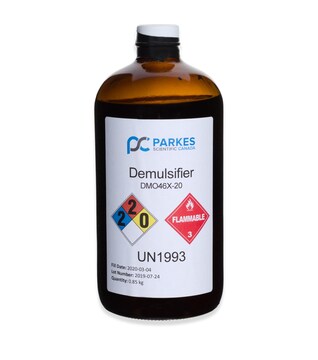
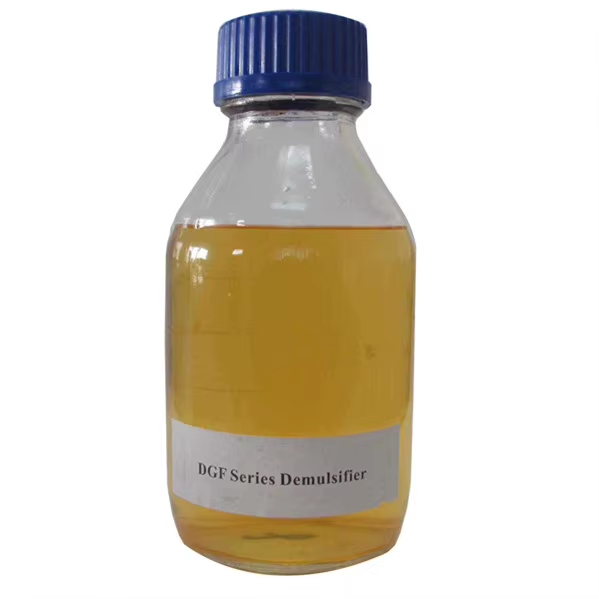
Description
Unlocking Efficiency: The Power of Specialty Demulsifier Blends
In myriad industrial processes, particularly within the oil and gas sector, refining, and industrial wastewater treatment, the separation of immiscible liquids is a critical step. Often, these liquids form stable emulsions – finely dispersed mixtures that resist natural separation, leading to significant operational challenges, reduced product quality, and increased costs. This is where the power of demulsifiers comes into play, and more specifically, the advanced capabilities of specialty demulsifier blends.
The Challenge of Emulsions
An emulsion is a stable mixture of two immiscible liquids, like oil and water, where one liquid is dispersed as tiny droplets within the other. These are often stabilized by various factors, including:
- Naturally occurring surfactants: Asphaltenes, resins, naphthenic acids in crude oil.
- Fine solids: Clays, silts, corrosion products.
- High viscosity: Making droplet coalescence difficult.
- High interfacial tension: Preventing droplets from merging.
If left untreated, emulsions can cause:
- Off-spec products: Excessive water in crude oil (BS&W), or oil in produced water.
- Increased energy consumption: More heating required to break emulsions.
- Equipment fouling and corrosion: Due to water and suspended solids.
- Reduced throughput and efficiency: Slower separation times.
- Environmental non-compliance: Failure to meet discharge limits for water.
Beyond Generic: The Rise of Specialty Demulsifier Blends
While generic demulsifiers exist, a “one-size-fits-all” approach rarely delivers optimal results. Crude oil properties vary vastly from well to well and even over time from the same well. Industrial wastewater streams are equally diverse. This variability necessitates highly customized solutions, leading to the development of specialty demulsifier blends.
Specialty demulsifier blends are not single chemicals but carefully formulated combinations of multiple chemical components, designed to work synergistically to address the specific characteristics of a given emulsion. They leverage a deep understanding of emulsion chemistry and fluid dynamics to provide targeted, efficient, and cost-effective solutions.
How Specialty Demulsifiers Work
The primary goal of a demulsifier is to destabilize the interfacial film that surrounds the dispersed droplets, allowing them to coalesce and separate by gravity. Specialty blends achieve this through a combination of mechanisms:
- Interfacial Film Weakening: Components in the blend adsorb at the oil-water interface, displacing or neutralizing the natural emulsifiers (like asphaltenes), weakening the film’s mechanical strength.
- Droplet Coalescence: They promote the merging of smaller droplets into larger ones, accelerating the separation process.
- Wetting and Flocculation: Some components may alter the wettability of suspended solids, causing them to settle, or act as flocculants to aggregate fine particles that contribute to emulsion stability.
- pH Adjustment & Solvent Action: Certain blends may include components to adjust pH or solvency to enhance the performance of other active ingredients by solubilizing stabilizing agents.
These blends typically incorporate a range of active chemical classes, including:
- Surfactants: Non-ionic, anionic, cationic, and amphoteric polymers and copolymers.
- Solvents: Alcohols, aromatics, or esters to improve miscibility and aid dispersion.
- Flocculants/Coagulants: To deal with solids-stabilized emulsions.
- Corrosion Inhibitors/Biocides: Often included to provide additional benefits.
Key Advantages of Specialty Demulsifier Blends
The tailored nature of specialty demulsifier blends offers a multitude of benefits:
- Optimized Performance: Maximized water/oil separation efficiency for specific emulsion types.
- Reduced Dosage Rates: Highly effective formulations mean less chemical is needed, leading to lower operational costs.
- Faster Separation Times: Accelerated phase separation translates to increased throughput and reduced tank residence times.
- Improved Product Quality: Achieves stringent specifications for water content in oil (BS&W) and oil content in water (for discharge).
- Lower Energy Consumption: Less reliance on heating and mechanical separation.
- Reduced Equipment Fouling: Prevents build-up of water and solids in process equipment.
- Environmental Compliance: Helps meet strict discharge regulations for produced water and industrial effluents.
- Operational Flexibility: Adaptable to changes in feedstock composition or operating conditions.
Applications Across Industries
Specialty demulsifier blends are indispensable in several sectors:
- Oil & Gas Production (Upstream):
- Separation of crude oil from produced water at the wellhead and processing facilities.
- Treating slop oil and tank bottoms.
- Dehydration of heavy crude oils and bitumen.
- Refining (Downstream):
- Desalter units to remove water and salts from crude oil prior to distillation, preventing corrosion and fouling.
- Treatment of spent caustic and oily wastewater streams.
- Separation of slop oil and interface cuts.
- Industrial Wastewater Treatment:
- Oil removal from industrial effluents in petrochemicals, manufacturing, food processing, and general industrial sites.
- Breaking emulsions to prepare water for further treatment or discharge.
The Customization Process
Developing a specialty demulsifier blend is a meticulous process involving:
- Emulsion Analysis: Comprehensive laboratory testing of the target emulsion (e.g., water cut, oil composition, viscosity, interfacial tension, solids content, pH, temperature).
- Chemical Screening: Extensive bottle testing and dynamic jar tests with a vast library of individual demulsifier components and pre-formulated blends.
- Formulation Development: Blending selected components in specific ratios to optimize performance.
- Field Trials and Optimization: Testing the most promising blends under actual operating conditions, fine-tuning dosages and injection points.
- Ongoing Monitoring: Continuous performance monitoring and adjustment as emulsion characteristics might change over time.
The Future of Emulsion Treatment
As energy sources become more challenging (e.g., ultra-heavy oils, tight emulsions) and environmental regulations tighten, the demand for advanced specialty demulsifier blends will only grow. Future innovations will likely focus on:
- Greener Chemistries: Developing more biodegradable and environmentally benign formulations.
- Smart Blends: Incorporating sensors and real-time data analytics for autonomous dosing and optimization.
- Nanotechnology: Utilizing nano-emulsions or materials for enhanced separation.
- Synergistic Technologies: Integrating demulsifiers with other separation technologies (e.g., membranes, electro-coalescence).
In conclusion, specialty demulsifier blends are more than just chemicals; they are highly engineered solutions critical to the efficiency, profitability, and environmental responsibility of industries dealing with complex liquid separations. Their customized nature ensures optimal performance, making them an indispensable tool in the modern industrial landscape.

Reviews
There are no reviews yet.