
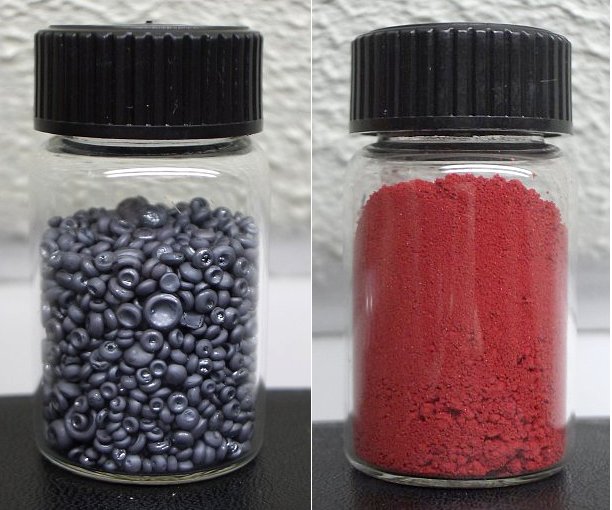
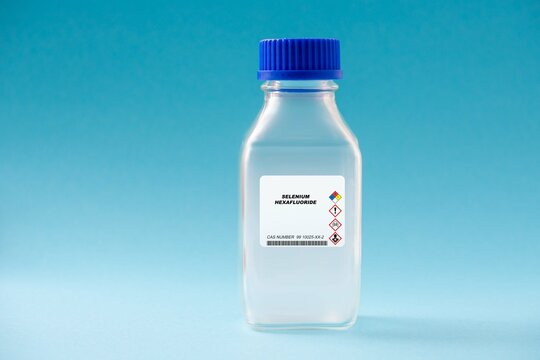
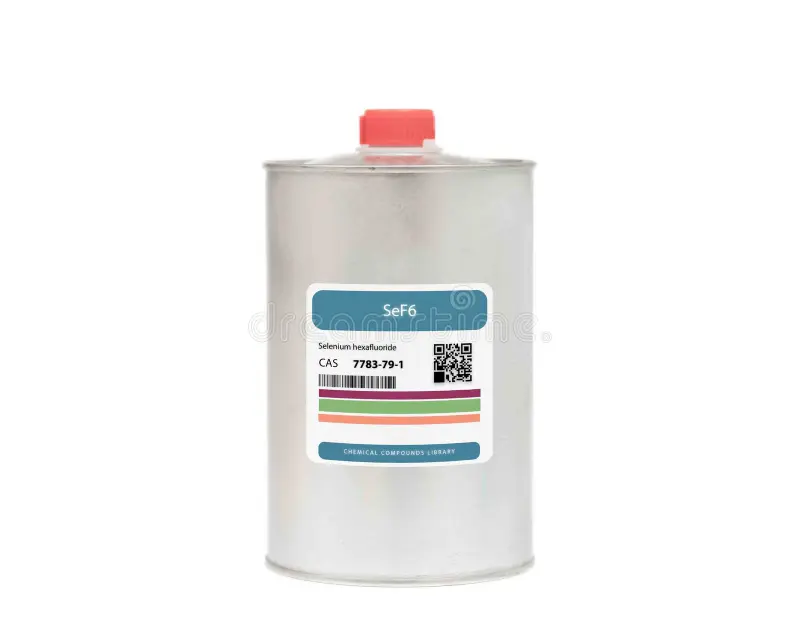
Description
Selenium Hexafluoride: An Inert Gas with Surprising Applications
Selenium hexafluoride (SeF₆) is a colorless, odorless, and surprisingly inert gas at room temperature. While less commonly known than its sulfur analog, sulfur hexafluoride (SF₆), SeF₆ shares similar properties and finds applications in various niche areas. Understanding its unique characteristics and handling is crucial for its safe and effective use.
Chemical Properties and Stability:
SeF₆ is a fluorinated inorganic compound where a central selenium atom is surrounded by six fluorine atoms in an octahedral geometry. This symmetrical structure and strong Se-F bonds contribute significantly to its inertness. Unlike some other selenium compounds, SeF₆ is remarkably unreactive and does not readily react with water, acids, or bases under normal conditions. This stability extends to relatively high temperatures, making it useful in specific applications.
The reason for its inertness is multifaceted. The fluorine atoms create a steric hindrance, physically blocking access to the central selenium atom. Furthermore, the strong Se-F bonds require significant energy to break, preventing the molecule from easily participating in chemical reactions.
Applications:
Despite its inertness, SeF₆ finds use in several specialized fields:
- Dielectric Gas: Similar to SF₆, SeF₆ is an excellent electrical insulator. It’s sometimes used in niche high-voltage applications and plasma etching processes where its non-reactivity is critical. However, its higher global warming potential (GWP) compared to SF₆ generally limits its widespread use as a dielectric gas.
- Tracer Gas: SeF₆ can be used as a tracer gas in atmospheric studies and leak detection. Its low concentration in the atmosphere and ease of detection make it suitable for tracking air movement and identifying leaks in closed systems.
- Semiconductor Manufacturing: In semiconductor manufacturing, SeF₆ can be used as an etchant for specific materials, particularly in the fabrication of micro- and nano-structures. Its well-controlled etching properties allow for precise pattern transfer in the creation of integrated circuits.
- Research and Development: SeF₆ finds applications in research laboratories, particularly in studies related to gas-phase chemistry, molecular spectroscopy, and the investigation of inert gas properties.
Safety and Handling:
While relatively inert, SeF₆ should still be handled with care due to its potential health hazards.
- Inhalation Hazard: As a heavy gas, SeF₆ can displace oxygen in enclosed spaces, leading to asphyxiation. Proper ventilation is essential when working with SeF₆.
- Decomposition Products: At elevated temperatures or under electrical discharge, SeF₆ can decompose, forming toxic and corrosive products such as selenium fluoride compounds and hydrogen fluoride (HF). Measures should be taken to prevent decomposition and to handle any resulting byproducts safely.
- Global Warming Potential: SeF₆ has a significant global warming potential, highlighting the need to minimize its release into the atmosphere. Responsible handling, leak prevention, and proper disposal are crucial for mitigating its environmental impact.
Future Outlook:
While SeF₆ may not be as widely used as SF₆, its unique properties continue to make it valuable in specific applications. Research into alternative dielectric gases with lower global warming potential may impact its future role in some areas. However, its unique combination of inertness and specific etching properties likely ensures its continued use in specialized semiconductor manufacturing and research applications.
In conclusion, selenium hexafluoride is a fascinating compound with a surprising combination of inertness and utility. Its unique properties have carved out niche applications across various fields, demonstrating the importance of understanding even the seemingly simple chemical compounds and their potential for technological advancement. However, careful handling and awareness of its potential environmental impact are crucial for its responsible use.


Reviews
There are no reviews yet.