

Description
Ruthenium acetylacetonate
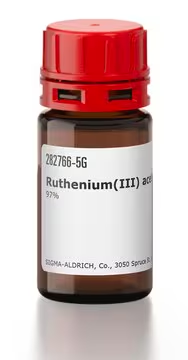
Ruthenium acetylacetonate typically refers to the tris(acetylacetonato) ruthenium complex, written as Ru(acac)3. This is a coordination compound where three acetylacetonate (acac) ligands bind to ruthenium in a common oxidation state for this complex.
Common forms and formulas
- Ru(acac)3 — tris(acetylacetonato) ruthenium(III) complex
- Chemical formula: Ru(C5H7O2)3
- Approximate molecular weight: ~398 g/mol (not accounting for any waters of crystallization)
- Related but distinct compounds you might encounter:
- Ru(acac)2Cl2 — a ruthenium(II) complex with two acac ligands and two chloride ligands
- There are other Ru(acac)n species depending on oxidation state and ligands
Structure and oxidation state
- Central metal: Ruthenium(III) in Ru(acac)3
- Geometry: Generally octahedral around the Ru(III) center
- Each acac ligand is a bidentate, σ-donor chelating ligand derived from acetylacetone
Properties (overview)
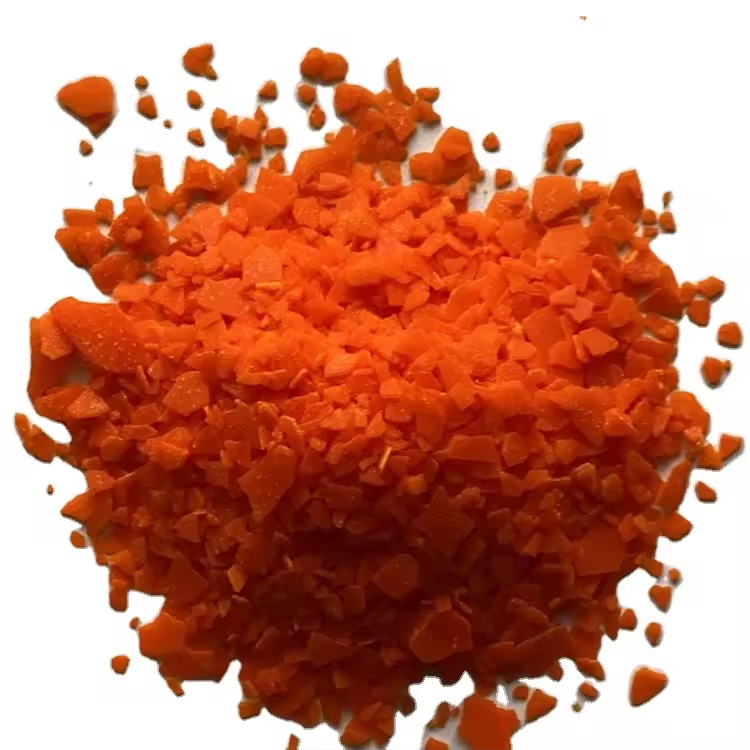
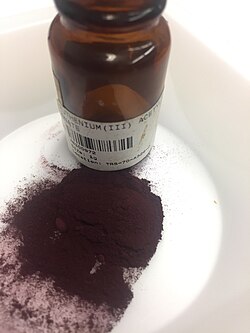
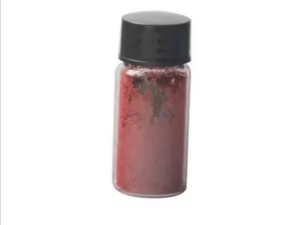
- Color: Typically an orange-brown to red-brown solid
- Stability: Relatively air-stable as a solid; moisture sensitivity can vary with formulation
- Magnetic/electronic: Ru(III) is d5, so the complex is paramagnetic; properties can be probed by spectroscopic methods (e.g., UV-Vis, EPR)
Synthesis (general outline)
Ruthenium acetylacetonate is commonly prepared by reacting a ruthenium source with acetylacetone in the presence of a base to deprotonate the ligand. A typical lab approach is:
- Start from a ruthenium(III) salt such as RuCl3·xH2O
- Add acetylacetone (Hacac) and a base (for example, sodium or potassium acetate, or another suitable base)
- Heat the mixture to reflux in an organic solvent (such as ethanol or isopropanol) to promote chelation and formation of Ru(acac)3
- Isolate the product by filtration, followed by washing and drying under appropriate conditions
Notes:
- The exact stoichiometry and conditions vary by procedure; the goal is to form three acetylacetonate ligands coordinated to Ru(III) and to remove byproducts (such as salts and water).
- Handling should follow appropriate inorganic synthesis safety practices.
Uses and applications
- Precursor in synthesis: Used as a starting material to prepare other ruthenium complexes and materials.
- Catalysis: Serves as a precursor for homogeneous catalytic systems and can be employed in synthesis and transformation reactions after suitable activation.
- Materials science: Used in the preparation of ruthenium-containing nanoparticles and thin films.
- Can also be used as a reference compound for spectroscopic studies of metal–acetylacetonate chemistry.
Safety and handling
- Contains a heavy metal; handle with appropriate PPE (gloves, eye protection) and work in a well-ventilated area or fume hood.
- Follow standard inorganic synthesis safety protocols for handling ruthenium compounds and organic solvents.
- Dispose of waste according to local regulations for inorganic hazardous waste.
Reviews
There are no reviews yet.