
Description
Overview
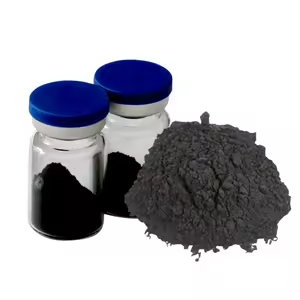
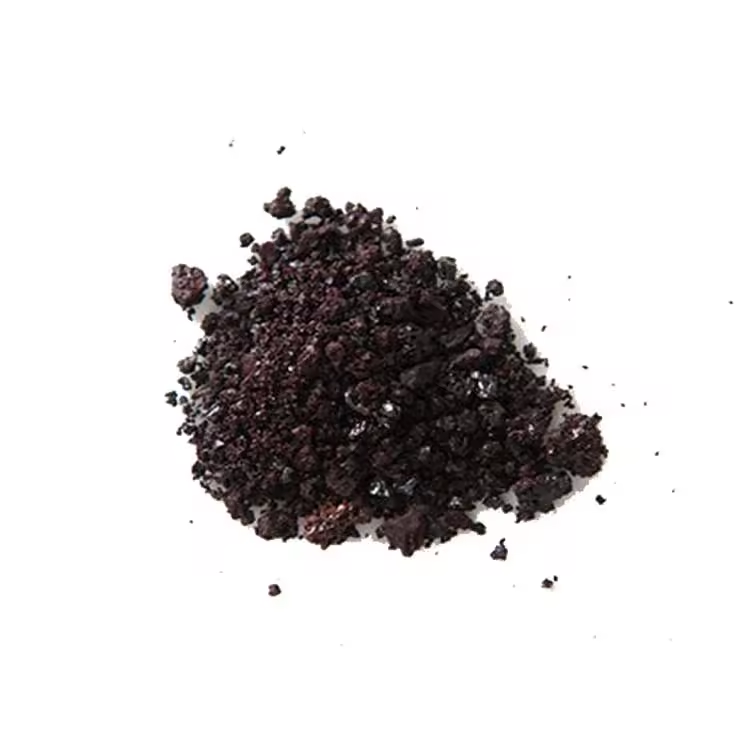
Rhodium is the key active metal for the NOx reduction step in automotive three-way catalysts (TWCs). In practice, rhodium is typically used as a supported catalyst on oxide carriers (like alumina, silica, ceria-zircia, etc.). Rhodium chloride (RhCl3, often as RhCl3·3H2O) is a common precursor used to introduce rhodium onto these supports. The chloride-containing precursor is impregnated into the support, followed by heat treatments that convert the chloride to oxide and finally to metallic rhodium particles active for NOx reduction.
Role of rhodium in automotive catalysts
- Primary function: Reduces nitrogen oxides (NOx) to nitrogen (N2) in the presence of reducing agents (CO, hydrocarbons) under lean-to-rich cycling.
- Synergy: Rh is typically the least abundant and most expensive precious metal in TWCs, but it provides unique NOx chemistry that Pt and Pd do not handle as effectively alone.
- Typical catalyst architecture: A washcoat containing Rh (plus Pt and Pd) dispersed on a porous oxide support, often with ceria (CeO2) for oxygen storage capacity to improve redox performance.
Rhodium chloride as a precursor
- Common form: RhCl3 or RhCl3·3H2O, highly soluble in water, enabling uniform impregnation of the support.
- Purpose: Delivers rhodium evenly to the washcoat so that small, well-dispersed Rh species are formed after calcination and reduction.
- Processing caveat: Chloride ligands must be effectively removed during heat treatment to avoid chloride-related site blocking and potential catalyst deactivation.
Processing steps (high level)
- Prepare the support (e.g., alumina, silica, or ceria-zirconia washcoat) and form the monolith or powder for impregnation.
- Impregnate with RhCl3 solution to distribute Rh across the support.
- Dry the coated support to remove solvent.
- Calcine in air at roughly 450–550 °C to convert Rh compounds to Rh2O3 and decompose/chloride removal as HCl or Cl-containing species.
- Reduce in hydrogen (or a reducing atmosphere) at temperatures around 300–500 °C to form metallic Rh nanoparticles or highly dispersed Rh on the support.
- Incorporate Pt and Pd (if part of a three-metal formulation) and complete the washcoat formulation.
- Shape and cure the finished catalyst, then apply to the monolith substrate.
Note: Exact temperatures and durations are proprietary and tuned for performance, durability, and the specific support material. The goal is to maximize dispersion of Rh while minimizing chloride residues.
Key considerations and challenges
- Chloride management: Residual chloride can poison active sites or alter redox behavior. Thorough calcination and, if needed, post-calcination washing or control of the exposure to chloride during processing are important.
- Dispersion and particle size: Rh is expensive, so high dispersion (small nanoparticles or highly dispersed species) is desired to maximize active surface area per unit mass.
- Thermal stability: TWCs operate at high temperatures with rapid thermal cycling; Rh-based sites must remain active and well-dispersed after aging.
- Poison resistance: Sulfur compounds and other contaminants can deactivate Rh sites; formulation often includes protective measures (e.g., sulfur tolerance strategies) and synergy with CeO2 for oxygen storage.
- Cost and supply: Rh is among the rarer and more expensive precious metals, so formulations aim to minimize Rh loading while preserving performance.
Alternatives and best practices
- Alternative precursors: Other Rh precursors include Rh nitrate or organometallic complexes, but RhCl3 remains common due to solubility and processing familiarity. The choice of precursor affects dispersion and chloride management.
- Supports and promoters: Using ceria-based supports and adding promoters that improve redox behavior can enhance NOx reduction efficiency and aging resistance.
- Loading strategies: Stepwise impregnation, high surface area supports, and controlled washcoat formulations help achieve better Rh dispersion and durability.
- Process controls: Strict control of drying, calcination, and reduction conditions minimizes chloride-related issues and optimizes rhodium particle size distribution.
Safety and environmental considerations
- Toxicity and handling: RhCl3 is hazardous. Handle in a fume hood with appropriate PPE (gloves, eye protection). Avoid inhalation or ingestion.
- Waste management: Properly treat and dispose of chemical wastes containing chlorides and heavy metals according to local regulations.
- Environmental impact: The automotive catalyst system is designed to reduce emissions; proper catalyst production minimizes environmental impact and maximizes life-cycle efficiency.
Quick reference: when to choose RhCl3 as a precursor
- You have an aqueous impregnation process and need good solubility for uniform distribution.
- You can implement effective chloride removal during calcination and reduction.
- You are optimizing for high NOx conversion efficiency while balancing cost.
Summary
- Rhodium chloride is a practical, common precursor for introducing rhodium into automotive catalyst washcoats.
- The key to performance is achieving high dispersion and removing chloride residues through controlled calcination and reduction.
- Rh is critical for NOx reduction in TWCs, but its high cost drives an emphasis on dispersion, durability, and efficient use.
- If you’re planning on designing or optimizing a rhodium-based TWC, focus on the impregnation protocol, chloride management, and the interaction with the chosen support and co-catalysts.

Reviews
There are no reviews yet.