
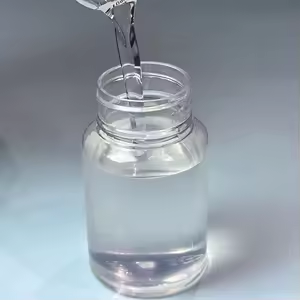
Description
1. Why Fluoroacrylates deserve a spotlight
If you’ve ever marveled at the oil‑repellent surface of a non‑stick pan, the low‑friction glide of a wind‑turbine blade, or the ultra‑clear protective coating on an optical fiber, chances are a fluoroacrylate‑based polymer was working behind the scenes.
Fluoroacrylates (FA) are a small family of monomers that combine the reactivity of an acrylate (or methacrylate) double bond with the chemical robustness of fluorine‑rich substituents. The result is a versatile building block that can be polymerised by free‑radical, anionic, or even controlled (RAFT, ATRP) methods, yielding polymers that are:
| Property | Typical Effect of Fluoroacrylate Incorporation |
|---|---|
| Hydrophobicity | Water contact angles > 110°; excellent oil repellency |
| Chemical resistance | Immune to acids, bases, organic solvents, and many oxidizers |
| Thermal stability | Decomposition temperatures > 350 °C (depending on fluorine load) |
| Low surface energy | 10–20 mN m⁻¹; perfect for anti‑sticking and release applications |
| Dielectric constant | 2.0–2.5 (much lower than conventional polyacrylates) |
| Mechanical toughness | High Young’s modulus when blended with high‑Tg backbones |
Because these traits are hard to achieve simultaneously with conventional acrylates, fluoroacrylates have become the “Swiss‑army knife” of high‑performance polymer chemistry.
2. The chemistry – what makes a fluoroacrylate tick?
2.1 Core structure
A generic fluoroacrylate looks like this:
   Rf
   |
CH2=C–COOR'
- Rf – a fluorinated alkyl or perfluoroalkyl group (e.g., CF₃, C₂F₅, –(CF₂)n–CF₃).
- R′ – an ester‑derived alcohol fragment (often n‑butyl, 2‑ethylhexyl, or a functionalized moiety such as hydroxy‑, epoxy‑, or azide‑containing alcohols).
The C=C double bond is the polymerisation handle, while Rf imparts the coveted fluorinated character.
2.2 Common members
| Monomer | Fluorinated group (Rf) | Typical R′ | Notable use |
|---|---|---|---|
| 2‑Trifluoromethyl‑acrylate (TFMA) | –CF₃ | –OCH₂CH₃ | UV‑curable coatings, high‑energy adhesives |
| Perfluorooctyl acrylate (PFOA) | –C₈F₁₇ | –OCH₂CH₂CH₂CH₃ | Low‑surface‑energy films for aerospace |
| 2‑Perfluoro‑propyl‑methacrylate (PFPM) | –C₃F₇ | –OCH₃ | Specialty inks, fluorinated photoresists |
| Fluoro‑hydroxy‑acrylate (FHA) | –CF₂CH₂– | –OCH₂CH₂OH | Reactive diluents, surface‑functional polymers |
| Azide‑functional fluoro‑acrylate | –CF₃ | –OCH₂CH₂N₃ | Click‑chemistry post‑modification for biosensors |
Tip: The more perfluorinated the Rf, the lower the surface energy and the higher the chemical inertness—but also the higher the cost and the greater the environmental scrutiny. Balancing performance vs. sustainability is a key design challenge today.
3. From monomer to material – polymerisation routes
| Method | Typical Conditions | Advantages | When to Choose |
|---|---|---|---|
| Free‑radical photopolymerisation (UV, LED) | 365 nm, 1–5 wt % photoinitiator, ambient temp | Fast, scalable, compatible with coatings & 3D printing | UV‑curable adhesives, anti‑icing films |
| Thermal free‑radical (peroxide initiators) | 80–130 °C, BPO or AIBN | Bulk polymerisation, good for thick parts | Composite matrices, injection molding |
| RAFT (Reversible‑Addition‑Fragmentation chain‑Transfer) | 60–90 °C, chain transfer agent | Precise molecular weight control, low dispersity | Block copolymers for nanostructured membranes |
| ATRP (Atom‑Transfer Radical Polymerisation) | 60–110 °C, CuBr/ligand | Enables “grafting‑to” or “grafting‑from” strategies | Surface‑grafted fluoropolymers on metals or glass |
| Anionic polymerisation (rare) | Low temp, strong bases (e.g., n‑BuLi) | Produces highly ordered, low‑defect polymers | Specialty optical fibers, high‑clarity lenses |
Practical note: Fluorinated monomers tend to lower the polymerisation rate because the electron‑withdrawing fluorine stabilises the double bond. Adding a small amount (5–10 mol %) of a more reactive non‑fluorinated acrylate can give a “speed‑boost” without compromising final properties.
4. Real‑world applications that rely on fluoroacrylates
| Sector | Product | Why Fluoroacrylate? |
|---|---|---|
| Aerospace & Defense | Low‑dielectric wiring insulation, radar‑absorbing coatings | Low permittivity + heat resistance |
| Automotive | Oil‑repellent interior trim, anti‑fog windshields | Surface energy < 15 mN m⁻¹ |
| Medical devices | Blood‑compatible catheters, anti‑bacterial coatings | Chemical inertness, reduced protein adsorption |
| Electronics | Flexible printed circuit (FPC) encapsulants, OLED encapsulation | Moisture barrier + UV stability |
| Oil & Gas | Downhole sealants, corrosion‑resistant pipe linings | Resistance to aggressive hydrocarbons & brines |
| Consumer goods | Non‑stick cookware, stain‑resistant textiles | Easy release, durability |
| 3D printing | High‑temperature, low‑shrinkage resins for aerospace prototypes | Combination of photopolymerisation speed and high Tg |
Case study: In 2024, a major aircraft manufacturer switched its interior wiring harnesses from polyimide to a fluoroacrylate‑based copolymer, cutting dielectric loss by 30 % and achieving a 15 % weight reduction thanks to thinner insulation layers.
5. Environmental and safety considerations
| Issue | Current status | Industry response |
|---|---|---|
| Persistence & bioaccumulation | Perfluoroalkyl chains (especially C₈ and above) are flagged for long‑term environmental impact | Shift toward short‑chain fluoroacrylates (C₁–C₄) and “fluorine‑alternatives” (e.g., silicone‑fluoro hybrids) |
| Manufacturing emissions | Volatile organic compounds (VOCs) + fluorinated by‑products | Closed‑loop reactors, scrubbers, and implementation of Green Chemistry metrics (E‑factor < 5) |
| End‑of‑life recycling | Fluoropolymers are notoriously difficult to depolymerise | Development of chemical recycling routes using supercritical CO₂ or HF‑free defluorination catalysts (e.g., Mg‑based systems) |
| Worker safety | Acrylates → skin sensitisation; fluorinated monomers → inhalation hazard if not handled under fume hood | Use of low‑vapour‑pressure monomers, PPE upgrades, and real‑time exposure monitoring |
Bottom line: The fluorine advantage does not come for free. Companies that adopt fluoroacrylates must pair them with robust life‑cycle management and regulatory compliance strategies.
6. Market snapshot – where the money is flowing
| Metric (2025) | Value |
|---|---|
| Global fluoroacrylate market size | ≈ USD 2.3 billion |
| ** CAGR (2021‑2026)** | 7.4 % |
| Top regions | North America (35 %), Europe (28 %), Asia‑Pacific (32 %) |
| Fast‑growing segments | UV‑curable coatings for automotive (12 % YoY), high‑temperature 3D‑printing resins (9 % YoY) |
| Key players | BASF, Dow, Arkema, 3M, Evonik, Daikin, and a rising cohort of specialty SMEs (e.g., FluoroTech Solutions, NanoFluor) |
What’s driving growth?
- Electrification of transport – demand for low‑dielectric, heat‑stable insulators.
- Regulatory push for water‑ and oil‑repellent surfaces – especially in food‑contact and medical applications.
- Additive manufacturing – need for resins that can survive post‑cure heat without warping.
7. Future trends – what’s on the horizon?
- Hybrid fluorinated‑siloxane monomers – marrying the low surface energy of fluorine with the flexibility of silicone.
- “Smart” fluoroacrylate polymers – incorporating thermally reversible Diels‑Alder linkages for self‑healing coatings.
- Bio‑derived fluoro‑acrylates – using renewable alcohols (e.g., from terpene feedstocks) to make the ester side chain, reducing carbon footprint.
- Digital design & AI‑guided monomer selection – platforms that predict the optimal Rf/R′ combo for a target property set, cutting R&D cycles from months to weeks.
- Regulatory‑forward design – pre‑emptive substitution of C₈+ chains with shorter fluorinated groups to stay ahead of future PFAS bans.
8. Quick‑start guide for formulators
| Goal | Suggested Fluoroacrylate | Typical Loading (wt %) | Co‑monomer (optional) | Additional tips |
|---|---|---|---|---|
| Ultra‑low surface energy (e.g., release films) | Perfluorooctyl acrylate (PFOA) | 15–30 % | Non‑fluorinated acrylic (e.g., n‑butyl acrylate) for flexibility | Add a small amount of silicone oil to enhance slip |
| High‑temperature coating (≥ 250 °C) | 2‑Trifluoromethyl‑acrylate (TFMA) | 20–40 % | Phenoxy‑acrylate for rigidity | Use a high‑temperature photoinitiator (TPO‑LT) |
| Water‑repellent biomedical device | Fluoro‑hydroxy‑acrylate (FHA) | 5–10 % | Hydroxyethyl methacrylate (HEMA) for hydrophilicity balance | Post‑cure plasma treatment to lock in micro‑roughness |
| Low‑dielectric encapsulant | Perfluoro‑propyl methacrylate (PFPM) | 25–35 % | Cyclo‑olefin copolymer (COC) oligomer | Cure under nitrogen to avoid oxygen inhibition |
| 3D‑printing resin | Azide‑functional fluoro‑acrylate | 10–20 % | Low‑viscosity acrylate monomer (e.g., isobornyl acrylate) | Use dual‑cure (UV + thermal) to improve interlayer bonding |
9. Take‑away
Fluoroacrylate monomers sit at the intersection of chemistry, engineering, and sustainability. Their unique ability to give polymers an ultra‑low surface energy, exceptional chemical resilience, and high thermal stability makes them indispensable for a host of next‑generation technologies—from clean‑energy power electronics to ultra‑clean medical devices.
Reviews
There are no reviews yet.