
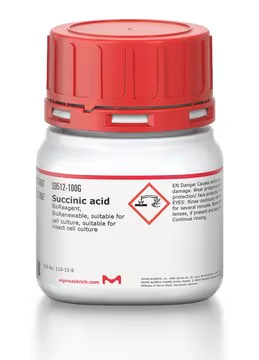
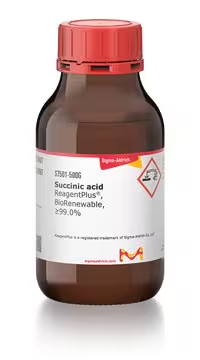
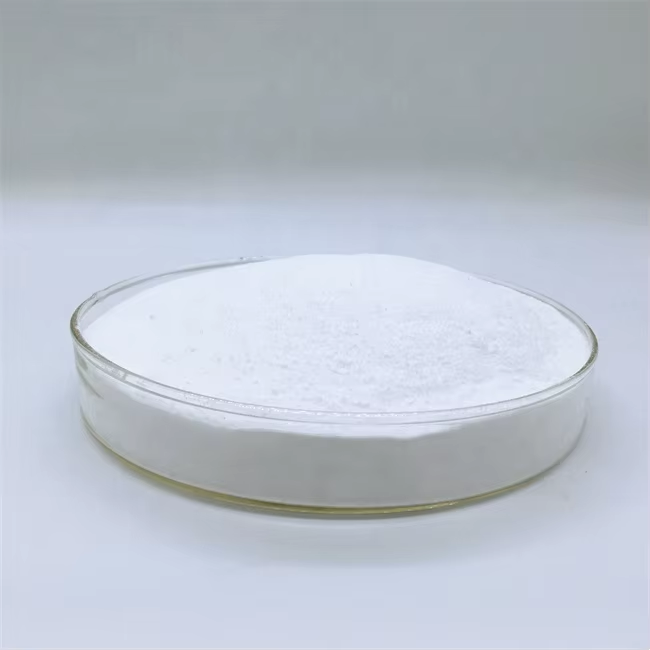
Description
1. From Sugar to Succinic Acid – The Bioprocess 101
1.1 The Chemistry in a nutshell
Succinic acid (HOOC‑CH₂‑CH₂‑COOH) is a four‑carbon dicarboxylic acid. In the traditional petrochemical route, it is obtained as a by‑product of the acetylene process or via hydrogenation of maleic anhydride. That route is energy‑intensive, generates a sizeable carbon footprint, and leaves a lot of value‑unlocked potential on the table.
1.2 The biological route – a “green” shortcut
The biological production of succinic acid leverages microorganisms that naturally ferment sugars (glucose, xylose, glycerol, etc.) into the dicarboxylic acid under anaerobic or micro‑aerobic conditions. The most common workhorses are:
| Microorganism | Key Traits | Typical Yield* |
|---|---|---|
| Actinobacillus succinogenes | High tolerance to low pH, natural succinate pathway | 85 g L⁻¹ |
| Mannheimia succiniciproducens | Fast growth, robust on mixed sugars | 70 g L⁻¹ |
| Engineered E. coli | Tailorable metabolism, easier downstream processing | 100 g L⁻¹ (lab‑scale) |
| Engineered C. glutamicum | GRAS status, high industrial scalability | 120 g L⁻¹ (pilot) |
*Yield is expressed as grams of succinic acid per liter of broth at the end of fermentation.
The process generally follows three steps:
- Feedstock preparation – Corn starch, sugarcane bagasse, wheat straw, or even food‑waste hydrolysates are converted into fermentable sugars.
- Microbial fermentation – The organism channels carbon flux toward the reverse TCA cycle or glyoxylate shunt, accumulating succinate while minimizing by‑products such as acetate or lactate.
- Downstream purification – Typically a combination of crystallization, ion‑exchange, and membrane filtration yields a > 99 % pure, food‑grade succinic acid.
Pro tip: The biggest cost driver is the feedstock. Using low‑value lignocellulosic waste can push the overall production cost below $1.5 kg⁻¹, making it competitive with petro‑derived succinic acid (~$2–$2.5 kg⁻¹ in 2025).
2. What Makes It a “Platform” Chemical?
A platform chemical is a building block that can be transformed into a family of downstream products, much like crude oil does for petrochemicals. Succinic acid’s versatility stems from its two carboxylic groups and a central hydrocarbon chain, enabling:
| Transformation | Resulting Product | Typical Use |
|---|---|---|
| Hydrogenation → 1,4‑butanediol (BDO) | Polyurethane (PU) foams, elastic fibers | Automotive interiors, mattresses |
| Esterification → Dimethyl succinate (DMS) | Solvent, plasticizer, fuel additive | Paints, coatings, diesel blends |
| Dehydration → Fumaric acid | Food additive, polymer precursor | Baking powders, latex |
| Oligomerization → Poly(succinic acid) | Biodegradable polymer | Packaging, agricultural films |
| Catalytic conversion → γ‑butyrolactone (GBL) | Solvent, precursor to pyrrolidone | Electronics cleaning, cosmetics |
| Electrochemical reduction → 1,4‑butanediol (via succinate) | Same as hydrogenation but powered by renewable electricity | Green manufacturing |
Because many of these downstream routes already exist in the petrochemical industry, bio‑succinic acid can be “drop‑in” substituted without re‑tooling the entire value chain—a massive advantage for fast market penetration.
3. Real‑World Applications – From Lab Bench to Factory Floor
3.1 Sustainable Plastics
- Bio‑based Polybutylene Succinate (PBS) – A semi‑crystalline polyester that mimics polypropylene’s mechanical properties but biodegrades in compost within 6–12 months.
- Polyurethane foams from BDO – Used in automotive seat cushions, reducing VOC emissions by 40 % compared with conventional PU.
3.2 Green Solvents & Additives
- Dimethyl succinate (DMS) replaces toxic solvents like toluene in paint formulations, delivering a VOC‑free alternative.
- γ‑Butyrolactone (GBL), derived from succinic acid, serves as a low‑toxicity solvent in the electronics industry.
3.3 Renewable Energy & Fuels
- Succinic acid‑based diesel blends improve cetane numbers and lower soot formation.
- 1,4‑Butanediol can be electrolytically converted to butanol, a next‑generation bio‑fuel with higher energy density than ethanol.
3.4 Specialty Chemicals & Pharmaceuticals
- Fumaric acid, a downstream product, is an active pharmaceutical ingredient (API) for treating psoriasis and multiple sclerosis.
- Succinate‑based metal chelates are used as catalysts in polymerization reactions, offering a greener alternative to phosphine ligands.
Case Study: Solvay launched a 100 % bio‑based succinate polymer for food‑packaging in 2024. The material achieved a 30 % reduction in carbon footprint compared with its petroleum counterpart and is now being used by a major European supermarket chain for fresh produce bags.
4. Market Landscape & Sustainability Metrics
| Metric (2025) | Bio‑Succinic Acid | Petro‑Succinic Acid |
|---|---|---|
| Production Capacity | ~ 2 M t yr⁻¹ (global) | ~ 1.5 M t yr⁻¹ |
| Average Cost | $1.3–$1.8 kg⁻¹ | $2.0–$2.5 kg⁻¹ |
| GWP (100‑yr) | 1.2 kg CO₂‑eq kg⁻¹ | 3.8 kg CO₂‑eq kg⁻¹ |
| Energy Input | 55 MJ kg⁻¹ (mostly renewable) | 85 MJ kg⁻¹ (fossil) |
| Key Players | BioAmber (now merged with BASF), DSM, Roquette, Myriant, Succinic Acid Inc., LanzaTech | Eastman, Dow, Shell (via downstream use) |
Growth trajectory: The market is projected to reach $12 bn by 2035, driven by rising regulatory pressure on petro‑derived plastics and a surge in consumer demand for “bio‑certified” products. The EU’s “Fit for 55” legislation (targeting a 55 % reduction in greenhouse‑gas emissions by 2030) is expected to accelerate adoption in packaging and automotive sectors.
Sustainability Scorecard (based on the United Nations Sustainable Development Goals):
| SDG | Contribution |
|---|---|
| SDG 7 – Affordable & Clean Energy | Enables renewable‑based fuel additives |
| SDG 9 – Industry, Innovation & Infrastructure | Provides a low‑carbon platform for new materials |
| SDG 12 – Responsible Consumption & Production | Supports circular economy via biodegradable polymers |
| SDG 13 – Climate Action | Cuts GWP by > 60 % vs. petro route |
| SDG 14/15 – Life‑on‑Land & Water | Reduces toxic solvent releases, lowers water contamination |
5. Roadblocks – What’s Still Holding Back Scale‑Up?
| Challenge | Details | Current Mitigation Strategies |
|---|---|---|
| Feedstock Variability | Lignocellulosic hydrolysates often contain inhibitors (furfural, HMF) that suppress microbial growth. | Adaptive strain engineering, detoxification via overliming, or using robust microbes like C. glutamicum. |
| Product Inhibition | Succinic acid at high concentrations drops pH, harming cells. | In‑situ product removal (ISPR) using ion‑exchange resins, pervaporation, or membrane electro‑lysis. |
| Downstream Cost | Crystallization of succinic acid is energy‑intensive. | Development of low‑temperature crystallization, anti‑solvent precipitation, and continuous reactive extraction. |
| Regulatory Hurdles | Food‑grade certification varies across regions (GRAS in US, Novel Food in EU). | Early engagement with authorities, leveraging existing GRAS status of microbial strains, and transparent safety dossiers. |
| Capital Expenditure (CAPEX) | Biorefineries require sizable upfront investment (often > $500 M for a 500 kt yr⁻¹ plant). | Modular “plug‑and‑play” bioreactors, public‑private partnerships, and financing through green bonds. |
Despite these obstacles, the economics are tightening. A 2025 techno‑economic analysis (TEA) from the National Renewable Energy Laboratory (NREL) showed that a 300 kt yr⁻¹ plant using corn stover could achieve a discounted cash flow IRR of 14 % without subsidies—just above the industry benchmark for new chemicals.
6. The Future Roadmap – Where Do We Go From Here?
6.1 Integrated Biorefineries
Imagine a “biorefinery 2.0” where the same feedstock stream simultaneously produces succinic acid, bio‑ethanol, lignin‑derived aromatics, and protein‑rich animal feed. This holistic approach spreads CAPEX across multiple revenue streams, dramatically improving profitability.
6.2 Synthetic Biology & CRISPR‑based Strain Design
Next‑generation strains will:
- Channel > 90 % of carbon flux to succinate.
- Resist inhibitors through over‑expression of detoxifying enzymes.
- Export succinate directly into the broth to reduce intracellular accumulation (e.g., using engineered succinate exporters like dcuA).
Companies such as Ginkgo Bioworks and Amyris are already filing patents on CRISPR‑mediated “succinic super‑bugs.”
6.3 Electrified Fermentation
Coupling renewable electricity to electro‑fermentation (using cathodic electrons as reducing power) can increase yields and eliminate the need for added hydrogen. Early pilots at the University of Michigan reported a 15 % increase in succinate titer when supplying electrons at 1 A L⁻¹.
6.4 New End‑Use Markets
- 3D‑Printing Resins: PBS‑based photopolymers that are biodegradable and exhibit low shrinkage.
- Smart Textiles: Succinic‑derived polyesters with built‑in antimicrobial properties for medical apparel.
- Carbon Capture Materials: Functionalized succinate polymers that can be regenerated to adsorb CO₂ from flue gas.
7. Quick Takeaways – A Cheat Sheet
| ✅ | Bio‑Succinic Acid Highlights |
|---|---|
| Renewable | Produced from sugars, agricultural waste, or CO₂‑derived feedstocks. |
| Low Carbon | 60–70 % lower GWP vs. petro route. |
| Platform | Converts to BDO, DMS, fumaric acid, GBL, PBS, etc. |
| Market Momentum | > 2 Mt yr⁻¹ capacity, $12 bn market forecast for 2035. |
| Economic Viability | Costs approaching parity with fossil‑derived succinate. |
| Key Challenge | Feedstock consistency and downstream purification cost. |
| Future Trend | Integrated biorefineries, synthetic biology, and electrified fermentation. |
8. How You Can Be Part of the Bio‑Succinic Revolution
- R&D Professionals: Explore CRISPR strategies for succinate exporters or test ISPR membranes in pilot reactors.
- Supply‑Chain Managers: Source lignocellulosic residues (e.g., corn stover, wheat straw) and negotiate long‑term contracts for stable pricing.
- Product Designers: Replace petroleum‑based BDO or PBS in your formulations with bio‑derived equivalents; highlight the sustainability claim in your packaging.
- Investors: Look for green‑bond issuances from companies scaling up succinic acid biorefineries.
- Consumers: Choose products labeled “bio‑based succinate” or “certified biodegradable PBS” – a small choice that drives market demand.
9. Final Thoughts
Bio‑succinic acid exemplifies what circular chemistry can achieve: a single, renewable molecule that unlocks a cascade of sustainable materials, fuels, and specialty chemicals while delivering a tangible climate benefit. The technology is no longer a laboratory curiosity; it’s an emerging cornerstone of the global bio‑economy.
If you’re as excited as I am about turning sugar into the next generation of plastics, solvents, and fuels, stay tuned to this blog. I’ll be tracking the latest breakthroughs—from pilot‑scale electrified fermenters to commercial launches of succinate‑based packaging—so you won’t miss a beat.
Reviews
There are no reviews yet.