
Description
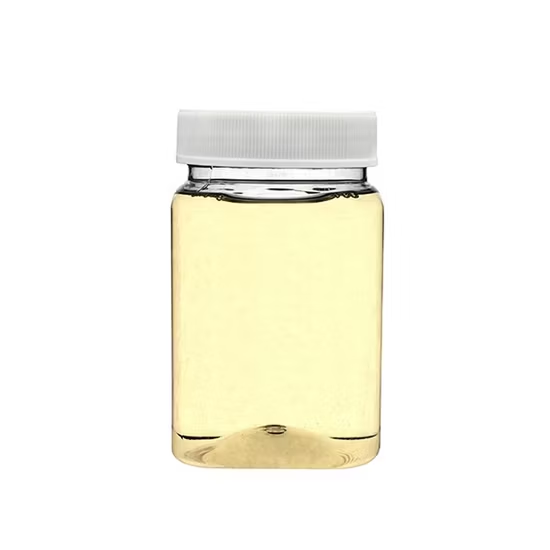
Alkylaryl Sulfonates: Versatile Surfactants Shaping Industries
Alkylaryl sulfonates are a class of synthetic anionic surfactants widely used in a variety of applications, from household detergents to industrial cleaners. Their effectiveness in reducing surface tension and emulsifying oils, combined with their relatively low cost, has made them indispensable ingredients in countless formulations.
What are Alkylaryl Sulfonates?
The name itself provides a clue to their structure. They consist of an alkyl group (a saturated hydrocarbon chain), an aryl group (a benzene ring), and a sulfonate group (SO3-). The alkyl chain provides the hydrophobic (water-repelling) portion, while the sulfonate group provides the hydrophilic (water-attracting) portion. This amphiphilic (having both hydrophobic and hydrophilic properties) nature is crucial to their surfactant behavior.
The general formula for alkylaryl sulfonates is R-C6H4-SO3-, where R represents the alkyl group, which can vary in chain length and branching. The length and structure of the alkyl chain significantly impact the surfactant’s properties, such as solubility, foaming ability, and detergency.
How They Work: The Science of Surface Activity
Alkylaryl sulfonates function as surfactants by accumulating at interfaces between water and other phases, such as oil or air. Their hydrophobic alkyl chain is attracted to non-polar substances like oil, while their hydrophilic sulfonate group is attracted to water. This allows them to:
- Reduce Surface Tension: By positioning themselves at the interface, they effectively lower the surface tension of water, allowing it to spread more easily and wet surfaces more effectively.
- Emulsify Oils: They can stabilize mixtures of oil and water by encapsulating oil droplets within micelles, structures where the hydrophobic chains point inwards and the hydrophilic sulfonate groups point outwards, interacting with the surrounding water. This prevents the oil droplets from coalescing and allows them to be dispersed in the water.
- Disperse Soils: They can detach dirt and grease from surfaces by interacting with both the soil and the surface, then suspending the soil in the water for easy removal.
Uses and Applications: A Broad Spectrum
Alkylaryl sulfonates are found in a wide range of products:
- Household Detergents: They are key ingredients in laundry detergents, providing cleaning power by breaking down grease and dirt.
- Dish Soaps: Their ability to emulsify fats and oils makes them essential for removing food residue from dishes.
- Industrial Cleaners: They are used in industrial settings for degreasing machinery, cleaning floors, and other heavy-duty cleaning applications.
- Textile Processing: They are used as wetting agents and detergents in textile manufacturing, improving the penetration of dyes and assisting in the removal of impurities.
- Emulsion Polymerization: They are used to stabilize emulsions during the polymerization process, ensuring the formation of stable and uniform polymer particles.
- Agricultural Formulations: They can be used as wetting agents and dispersants in pesticide and herbicide formulations, improving their effectiveness.
Environmental Considerations:
Historically, branched alkylaryl sulfonates, particularly tetrapropylene benzene sulfonate (TPBS), were widely used. However, these compounds were found to be poorly biodegradable, leading to environmental concerns such as foaming in sewage treatment plants and rivers.
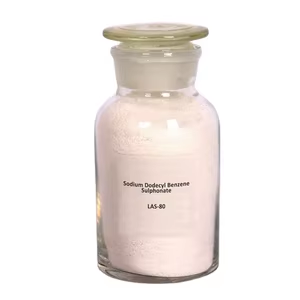
Today, linear alkylbenzene sulfonates (LAS) are the predominant type of alkylaryl sulfonate used. These are more readily biodegradable, posing less of an environmental risk. However, their use still necessitates careful environmental management, and ongoing research focuses on developing even more sustainable alternatives.
Future Trends:
The future of alkylaryl sulfonates will likely focus on:
- Improved Biodegradability: Research is ongoing to develop even more readily biodegradable versions.
- Bio-based Alternatives: Exploration of surfactants derived from renewable resources, offering a more sustainable option.
- Optimized Formulations: Tailoring the alkyl chain structure to specific applications to maximize performance and minimize environmental impact.
Conclusion:
Alkylaryl sulfonates are highly versatile surfactants with a wide range of applications. While environmental concerns related to older, less biodegradable versions have been addressed with the adoption of LAS, ongoing research is focused on developing even more sustainable and environmentally friendly surfactant technologies. As industries continue to seek effective and responsible cleaning and emulsifying agents, alkylaryl sulfonates, and their evolving alternatives, will continue to play a crucial role in shaping formulations across diverse sectors.


Reviews
There are no reviews yet.