
Description
Boosting Your Diesel’s Brain: A Deep Dive into 2-Ethylhexyl Nitrate (2-EHN)
If you work in the automotive industry, manage a fleet of heavy-duty trucks, or are simply a diesel enthusiast, you’ve likely heard of “Cetane improvers.” But behind that generic term lies a specific chemical powerhouse that does most of the heavy lifting: 2-Ethylhexyl nitrate (2-EHN).
Often referred to as the “Vitamin C” of diesel fuel, 2-EHN is the most widely used additive in the world for improving combustion quality. But what exactly is it, and why is it so vital for modern engines? Let’s break it down.
What is 2-Ethylhexyl Nitrate?
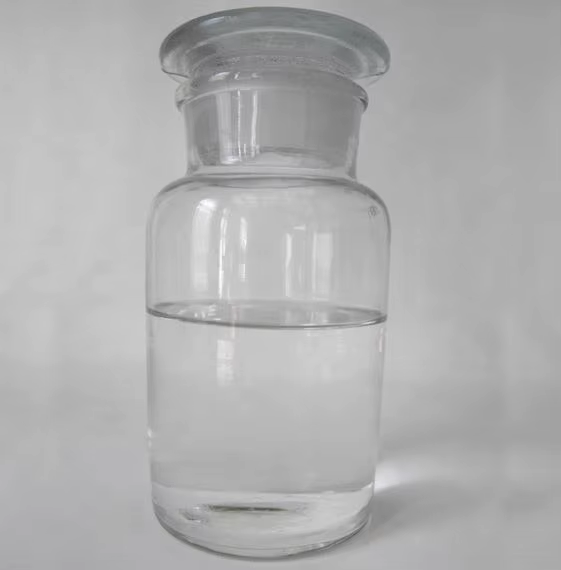
At its core, 2-Ethylhexyl nitrate ($C_8H_{17}NO_3$) is an organic compound—specifically an ester of 2-ethylhexanol and nitric acid. It’s a pale, straw-colored liquid with a characteristic odor.
While that sounds like high-school chemistry jargon, its function is simple: It acts as an ignition improver. When added to diesel fuel in relatively small concentrations (measured in parts per million), it significantly raises the fuel’s Cetane Number.
The Cetane Connection
To understand 2-EHN, you have to understand the Cetane Number. In a gasoline engine, we talk about Octane, which measures the fuel’s resistance to pre-ignition. In a diesel engine, we talk about Cetane, which measures the ignition delay.
A higher Cetane Number means the fuel ignites more quickly once injected into the combustion chamber. This leads to:
- Smoother combustion.
- More complete burning of the fuel.
- Better engine timing.
How Does 2-EHN Work?
Diesel engines rely on compression ignition. As the piston rises, it compresses air until it’s hot enough to ignite the fuel.
2-EHN is chemically unstable at high temperatures. As it is injected into the hot, compressed air of the cylinder, it decomposes rapidly, releasing free radicals. These radicals act as “chemical matches,” lowering the auto-ignition temperature of the diesel fuel and kickstarting the combustion process sooner than it would have started on its own.
The Real-World Benefits of 2-EHN
Why do fuel refiners and performance-seekers use 2-EHN? The benefits are multi-faceted:
1. Reduced “Diesel Knock”
That metallic clattering sound associated with older diesel engines is often caused by a long ignition delay. When fuel builds up in the chamber before igniting all at once, it creates a pressure spike. 2-EHN shortens that delay, leading to a quieter, smoother-running engine.
2. Improved Cold Starts
On a cold morning, diesel engines struggle because the air doesn’t get hot enough under compression to ignite the fuel easily. By lowering the ignition threshold, 2-EHN allows for faster, more reliable starts in freezing temperatures.
3. Lower Emissions
Because 2-EHN ensures more complete combustion, it reduces the amount of unburned fuel exiting the tailpipe. This leads to a significant reduction in:
- Particulate Matter (Soot/Black Smoke)
- Carbon Monoxide (CO)
- Total Hydrocarbons (HC)
4. Better Fuel Economy
When fuel burns more efficiently and at the optimal point in the piston’s stroke, the engine extracts more energy from every drop. While 2-EHN isn’t a “magic fuel saver,” it optimizes the engine’s thermal efficiency.
Is It Safe?
As with any concentrated chemical, 2-EHN requires careful handling. It is a combustible liquid and an organic nitrate, meaning it can be sensitive to high heat and should be stored in a cool, ventilated area.
For the average user, however, 2-EHN is most commonly encountered already pre-mixed in premium diesel fuels or sold in diluted amounts in retail fuel treatment bottles (like those from Liqui Moly, Hot Shot’s Secret, or Millers Oils).
The Bottom Line
2-Ethylhexyl nitrate is the invisible hero of the diesel world. As emissions regulations become stricter and engine designs become more sophisticated, the need for high-quality, high-cetane fuel has never been greater.
Whether you’re looking to protect your engine’s longevity, reduce your environmental footprint, or just enjoy a quieter ride, 2-EHN is the chemical component making it happen. Next time you fill up with “Premium Diesel,” you can bet that a little bit of 2-EHN is in the tank, making sure your engine stays sharp.
Disclaimer: This post is for informational purposes. Always consult your vehicle’s manual and follow local environmental regulations before using fuel additives.



Reviews
There are no reviews yet.