
Description
1. Product Overview
Polysaccharides are high-molecular-weight carbohydrate polymers derived from renewable biomass sources, including cellulose, starch, alginate, and microbial fermentation. Their primary industrial use spans rheology modification, emulsification, binding, and controlled-release matrices across chemical processing, food ingredients, pharmaceuticals, and oilfield operations. The key value proposition lies in delivering consistent molecular weight distribution and functional purity at scale—enabling process stability and formulation efficiency. With global supply chains under pressure for bio-based alternatives, this product is strategically critical for companies transitioning from synthetic polymers to sustainable, high-performance hydrocolloids.
2. Key Specifications & Technical Characteristics
-
Chemical composition: β-D-glucose, mannuronic/guluronic acid, or galactomannan units depending on grade (e.g., cellulose, alginate, guar, xanthan)
-
Purity level: ≥92% – 98% (industrial vs. food/pharma grade); ash content <5%; protein <1% for high-purity lines
-
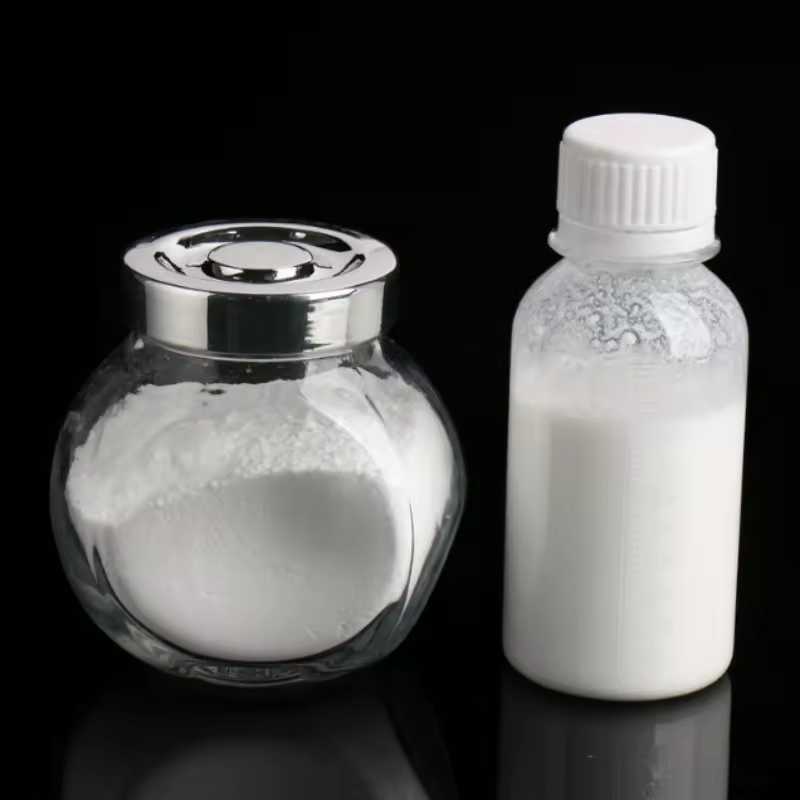
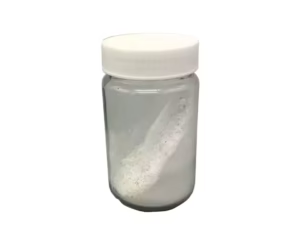
Physical characteristics: Off-white to light tan fine powder; particle size D90 ≤ 150 µm (customizable 50–250 µm); bulk density 0.4–0.7 g/cm³; viscosity 500–8,000 cP (1% solution, 25°C)
-
Packaging options: 25 kg multi-layer kraft-alu bags; 500–1,000 kg FIBC totes; heat-sealed moisture-barrier liners
-
Shelf life: 24 months from production date when stored in dry, ventilated conditions (RH <65%, temp 5–35°C)
3. Core Industrial Applications
-
Oil & gas drilling fluids: Used as viscosifier and fluid-loss control agent in water-based muds. Outperforms modified starches through superior salt tolerance and thermal stability up to 120°C, reducing additive consumption by 15–20%.
-
Food & beverage processing: Functions as stabilizer in sauces, dressings, and plant-based dairy. Provides clean label compliance and better freeze-thaw stability compared to synthetic gums, lowering rework rates.
-
Pharmaceutical excipients: Controlled-release tablet matrices and binder for wet granulation. Achieves more reproducible dissolution profiles than PVP or HPMC due to narrower polydispersity index (PDI <1.5).
-
Textile sizing & papermaking: Surface sizing agent and dry-strength additive. Increases burst strength by 12–18% versus native starch, enabling lower grammage and material cost reduction.
-
Water treatment coagulant aids: Flocculation enhancer for suspended solids. Reduces inorganic coagulant demand by up to 30%, lowering sludge volume and disposal cost.
4. Competitive Advantages
-
Quality consistency: Batch-to-batch viscosity variation <5% (ISO 9001:2025 certified); each shipment includes CoA with FTIR, molecular weight profile, and heavy metals analysis.
-
Supply reliability: Dual-sourced raw material from SE Asia and South America; three geographically redundant blending facilities; 98.5% on-time-in-full (OTIF) track record over 24 months.
-
Logistics capability: Dedicated bulk and LCL consolidation hubs in Rotterdam, Houston, and Shanghai; average lead time 10–14 days to major industrial zones.
-
Price competitiveness: Direct long-term contracts with upstream refiners remove two intermediary layers—priced 8–12% below market average for equivalent viscosity grades.
-
Sustainability: 100% plant-based, fully biodegradable (OECD 301B), and available with ISCC PLUS mass-balance certification for bio-circular content.
-
Technical support: In-house application lab providing formulation optimization, stability testing, and troubleshooting within 48-hour response window.
5. Commercial & Supply Information
-
Minimum order quantity (MOQ): 20 MT per product grade (mixed loads allowed across two adjacent viscosities)
-
BULK loading capacity: 20 MT per 20′ dry container (palletized or loose-filled depending on packaging)
-
Loading capacity per 40′ HC container: Up to 24 MT with FIBC totes; 20 MT with 25 kg bags (maximizes weight vs. volume)


Reviews
There are no reviews yet.