
Description
1. Product Overview
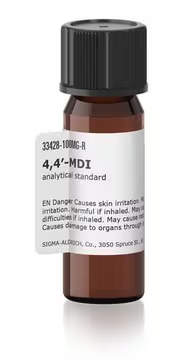
4,4’-Methylenebis(phenyl isocyanate) (MDI) is the preeminent diisocyanate monomer used to manufacture high-performance polyurethanes, including rigid foams, elastomers, adhesives, and binders. Its primary industrial application lies in insulation materials for construction and cold-chain logistics, as well as structural components in automotive and footwear manufacturing. The key value proposition is its exceptional balance of thermal stability, mechanical strength, and processability, enabling lightweighting and energy efficiency at scale. Strategically, MDI underpins global megatrends in energy conservation and electric vehicle lightweighting, making it a non-negotiable raw material for industrial polymer value chains.
2. Key Specifications & Technical Characteristics
-
Chemical composition: 4,4’-Methylenebis(phenyl isocyanate) (≥98.5% purity), with controlled 2,4’- and 2,2’-isomer content
-
Purity grade: Premium industrial grade (99.0% typical, ISO 9001:2025 certified)
-
Physical characteristics:
-
Appearance: Molten liquid (≥40°C) or flaked solid; pale yellow to colorless
-
Density: ~1.19 g/cm³ at 50°C
-
Viscosity: ~3–5 mPa·s at 50°C
-
NCO content: 33.2–33.8 wt%
-
-
Packaging options: Isocyanate-grade steel drums (250 kg net), ISO tanks (20,000–24,000 kg), or bulk tanker truck
-
Shelf life: 12 months (sealed, dry nitrogen atmosphere, storage at 20–35°C)
3. Core Industrial Applications
-
Construction (rigid polyurethane foam): High-efficiency insulation boards and spray foam – MDI delivers superior fire resistance and lowest thermal conductivity (λ ≈ 0.022 W/m·K) versus alternative isocyanates.
-
Automotive lightweighting: Bonded composite structural parts and acoustic foams – outperforms epoxy systems with faster demold times (≤60 seconds) and higher impact resilience.
-
Adhesives & binders: Engineered wood (OSB, MDF) and foundry cores – provides humidity-resistant bonds with 30% lower volatile organic compound (VOC) emissions than formaldehyde-based alternatives.
-
Elastomers: High-load wheels, rollers, and seals – superior abrasion resistance (Tabor wear ≤30 mg/1,000 cycles) compared to TDI-based systems.
4. Competitive Advantages
-
Quality consistency: Lot-to-lot NCO content variation <0.2%, backed by ISO 17025-accredited lab testing.
-
Supply reliability: Redundant manufacturing across three continents; typical on-time in-full (OTIF) delivery >98%.
-
Logistics capability: Temperature-controlled supply chain with real-time GPS tracking for molten MDI tankers.
-
Price competitiveness: Long-term contract index pricing (linked to benzene/AN) with no hidden surcharges.
-
Sustainability: Available with ISCC PLUS-certified mass-balanced bio-attributed carbon content (up to 30% renewable feedstock).
-
Technical support: Full Material Safety Data Sheet (MSDS), processing guidelines, and on-call polymer engineering support.
5. Commercial & Supply Information
-
Minimum order quantity (MOQ): 20 metric tons (MT)
-
Bulk loading capacity: 20 MT per standard 20-ft ISO tank container (net weight); up to 24 MT per specialized 20-ft tank


Reviews
There are no reviews yet.