
Description
Polyphosphoric Acid: The Versatile Workhorse of Organic Chemistry
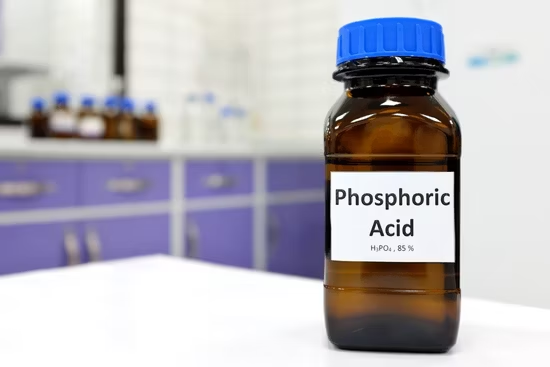
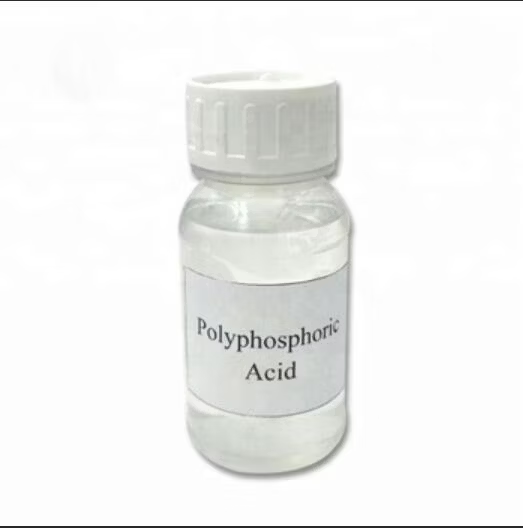
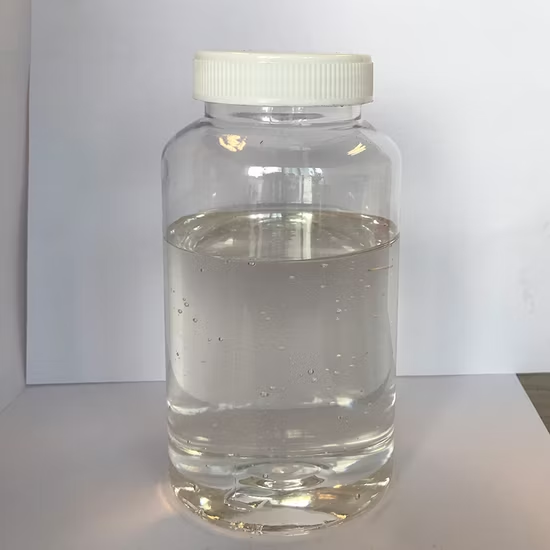
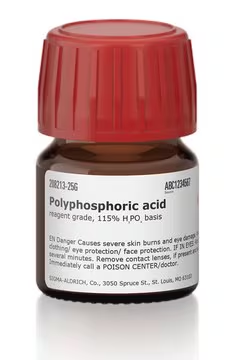
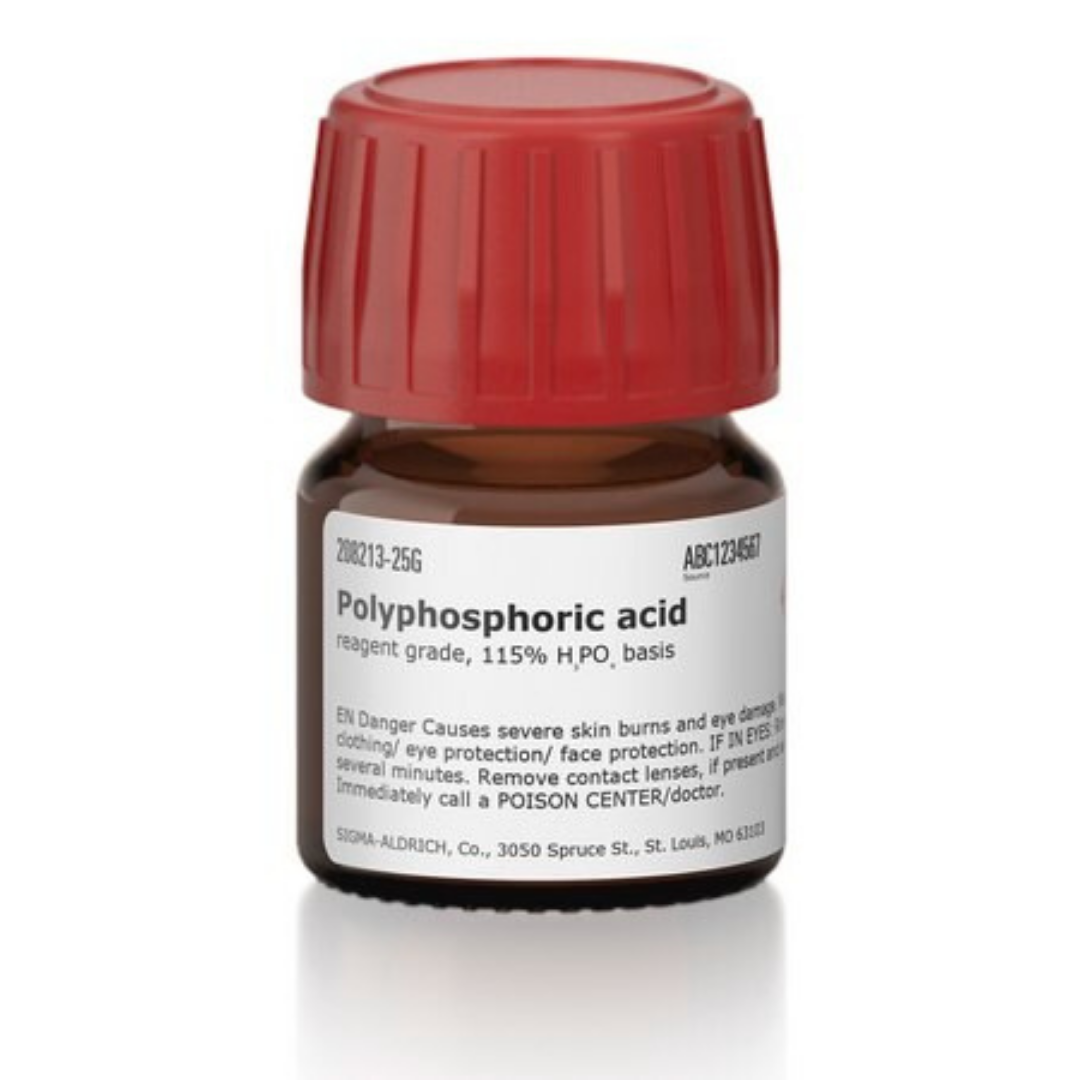
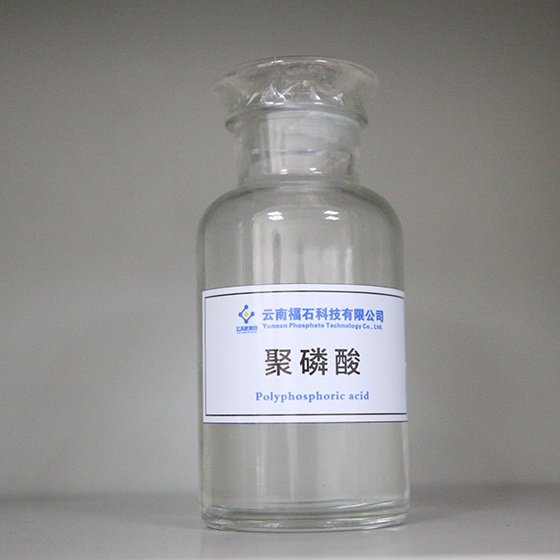
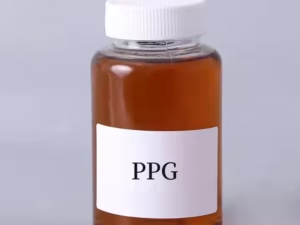
Polyphosphoric acid (PPA), often described as a viscous, colorless, and highly hygroscopic liquid, is more than just a chemical curiosity. It’s a powerful and versatile tool in organic chemistry, finding applications in various fields from pharmaceuticals to polymers. Understanding its properties and applications unlocks a deeper appreciation for its significance in synthesis and industrial processes.
What is Polyphosphoric Acid?
Unlike its name suggests, PPA isn’t a single acid, but rather a complex mixture of linear and branched chains of phosphoric acid (H₃PO₄) molecules. These chains are linked by anhydride bonds, meaning a water molecule has been removed between two phosphate groups. The general formula can be represented as H(HPO₃)ₓOH, where ‘x’ indicates the average number of phosphoric acid units in the polymer chain. Different grades of PPA exist, characterized by the H₃PO₄ content, which typically ranges from 82% to 85%. A higher H₃PO₄ content indicates a lower degree of polymerization.
Key Properties and Advantages:
PPA’s unique properties make it a desirable reagent:
- Strong Acid Catalyst: PPA is a strong acid, making it an effective catalyst for various organic reactions. Its strength lies in its ability to protonate reactants, initiating reactions that would otherwise require harsh conditions.
- Dehydrating Agent: The presence of anhydride bonds gives PPA excellent dehydrating properties. It can effectively remove water molecules from substrates, driving equilibrium towards the desired product.
- Non-Volatile: Unlike some common acids like hydrochloric acid or sulfuric acid, PPA is virtually non-volatile. This characteristic is advantageous in high-temperature reactions as it minimizes reagent loss and facilitates easier product isolation.
- Solvent and Reagent: In many reactions, PPA acts as both the solvent and the reagent, simplifying the reaction setup and minimizing waste.
- Ease of Handling: Despite its strong acidity, PPA is relatively easy to handle compared to other corrosive acids. However, proper safety precautions, including wearing protective gear, are still essential.
Applications in Organic Synthesis:
PPA’s versatility shines through in its diverse applications:
- Cyclizations: PPA is widely used in intramolecular cyclizations, forming cyclic molecules from open-chain precursors. This is crucial in the synthesis of pharmaceuticals, alkaloids, and other complex organic molecules. The Bischler-Napieralski reaction, used to synthesize dihydroisoquinolines, is a prime example of PPA’s effectiveness in ring formation.
- Acylations: PPA catalyzes acylation reactions, where an acyl group (R-C=O) is attached to a molecule. This is used in the synthesis of ketones, amides, and esters. The Friedel-Crafts acylation reaction, crucial for introducing acyl side chains onto aromatic rings, can be effectively catalyzed by PPA.
- Esterifications and Etherifications: PPA can catalyze the formation of esters from carboxylic acids and alcohols, and ethers from alcohols. Its dehydrating ability helps to shift the equilibrium towards product formation.
- Isomerizations: PPA can catalyze the isomerization of organic compounds, rearranging their structure without changing their composition.
- Polymerization: The “poly-” in polyphosphoric acid hints at its role in polymerization reactions. It’s used as a catalyst and dehydrating agent in the synthesis of various polymers, including polyketones and polyamides.
Beyond the Lab: Industrial Applications:
While prominent in laboratory synthesis, PPA also plays a significant role in industrial processes:
- Fertilizers: PPA is used in the production of fertilizers, particularly superphosphate fertilizers, improving their nutrient content and availability.
- Metal Treatment: PPA is used in metal surface treatment, providing corrosion resistance and improving adhesion for coatings.
- Aromatic Sulfonation: PPA is used as a catalyst in sulfonation reactions, crucial for the production of detergents and dyes.
Conclusion:
Polyphosphoric acid is a powerful and versatile reagent that continues to be indispensable in organic chemistry and various industrial applications. Its ability to act as a strong acid catalyst, dehydrating agent, and solvent makes it a valuable tool for chemists. From synthesizing complex pharmaceuticals to producing essential industrial materials, PPA’s contribution to modern chemistry is undeniable, solidifying its place as a significant and well-regarded chemical workhorse. As research continues, new applications and refinements to its use will undoubtedly emerge, further enhancing its importance in the future.



Reviews
There are no reviews yet.