
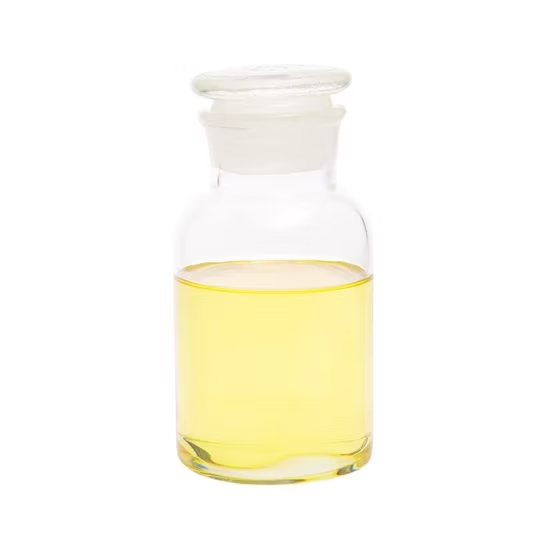
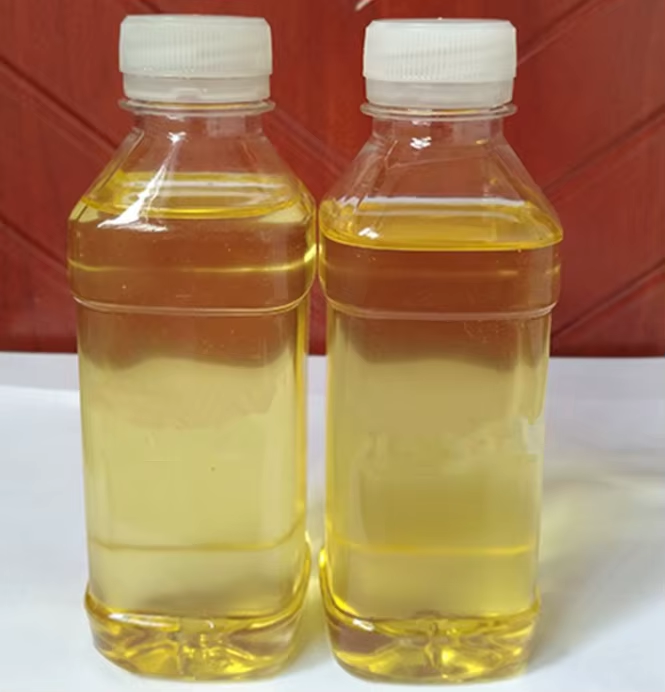
Description
| Property | What it means for you |
|---|---|
| Source | Derived from renewable soybeans – a non‑food‑grade, abundantly farmed oil. |
| Dual functionality | Carries epoxy rings and methacrylate groups in the same molecule. |
| Polymerization routes | Can be cured thermally (epoxy ring‑opening) and photoinitiated (radical methacrylate polymerization). |
| Key benefits | Low VOC, high toughness, tunable glass transition (Tg), excellent adhesion, and facile post‑curing functionalization. |
| Typical uses | UV‑curable coatings, 3‑D‑printed resins, bio‑based adhesives, dental composites, and recyclable thermosets. |
If you’ve ever wondered how a single molecule can give you the best of both worlds—rigid epoxy strength and the rapid cure speed of methacrylate—welcome to the world of Methacrylated Epoxidized Soybean Oil (MESO).
1. Why Soybean Oil?
Soybean oil (SBO) is the workhorse of the agro‑chemical industry. Its triglyceride backbone is rich in unsaturated fatty acids (mainly linoleic, oleic, and linolenic acids). Those double bonds are chemical “hooks” that can be transformed into a menu of functional groups:
| Step | Transformation | What we gain |
|---|---|---|
| Epoxidation | Peracid (e.g., peracetic acid) adds an oxygen across each C=C, forming epoxy rings. | Gives highly reactive electrophilic sites that can undergo ring‑opening polymerisation. |
| Methacrylation | Reaction of the remaining hydroxyl groups (generated after epoxidation) with methacrylic anhydride (or methacryloyl chloride) under base catalysis. | Instills radical polymerisation capability (UV/thermal), enabling fast curing. |
The result is MESO—a single‑molecule platform that is both epoxy‑rich and methacrylate‑rich.
2. The Chemistry of MESO – A Two‑Step Synthesis
Note: The following is a high‑level overview; detailed protocols can be found in recent ACS Sustainable Chemistry & Engineering papers (2023‑2025).
2.1 Epoxidation of Soybean Oil
- Reagents: Peracetic acid (generated in situ from acetic acid + hydrogen peroxide) or a commercial peracid.
- Conditions: 0 °C → room temperature, 2–4 h, under nitrogen.
- Outcome: Each C=C (≈ 8–9 per triglyceride) becomes an oxirane (epoxy) ring. Typical epoxy content ≈ 70 wt %.
Why it matters: Epoxy groups are highly polar, providing excellent adhesion to metals, glass, and many polymers. They also enable post‑curing cross‑linking via amine or acid catalysts.
2.2 Methacrylation
- Reagents: Methacrylic anhydride (or methacryloyl chloride) + triethylamine (TEA) as base, catalytic DMAP (4‑dimethylaminopyridine).
- Solvent: Anhydrous THF or toluene, dry conditions to avoid premature ring‑opening.
- Conditions: 80 °C, 4–6 h, under nitrogen.
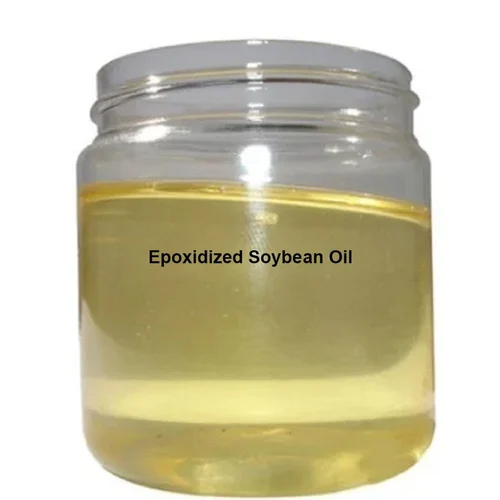
- Work‑up: Aqueous wash to remove TEA·HCl, followed by vacuum distillation to isolate the viscous orange‑brown MESO oil.
Typical methacrylate incorporation: 2–3 mol % per triglyceride, translating to ~10–15 wt % unsaturated methacrylate groups.
Resulting Molecular Structure:
![Simplified schematic of MESO – epoxy rings (blue) and methacrylate (red) attached to the fatty acid chains.]
(Image description for the visually impaired: A triglyceride backbone with three fatty acid chains. Each chain shows several epoxy rings (five‑membered circles) and at the terminal end a methacrylate double bond attached to a carbonyl group.)
3. From Molecule to Material – How MESO Cures
3.1 Dual‑Cure Strategy
| Cure Mode | Mechanism | Typical Initiators | Typical Conditions |
|---|---|---|---|
| Epoxy ring‑opening | Nucleophilic attack on the oxirane (amine, acid, or thiol). | Polyamine, anhydride, thiol‑ene catalysts | 120–180 °C (thermal), sometimes room‑temp with latent catalysts. |
| Methacrylate radical polymerisation | Free‑radical addition across C=C of methacrylate. | UV photoinitiators (e.g., TPO, Irgacure 2959), or peroxide initiators for thermal cure. | 365 nm UV, 5–30 s exposure; or 80–120 °C with peroxide. |
Because the two chemistries are orthogonal, you can cascade them: a fast UV cure to lock in shape, then a high‑temperature post‑cure to boost cross‑link density and thermal stability.
3.2 Tunable Properties
| Parameter | How you tune it | Effect on final material |
|---|---|---|
| Epoxy/MeA ratio | Vary epoxidation time or methacrylation stoichiometry. | Higher epoxy → higher Tg, toughness; higher MeA → faster cure, lower viscosity. |
| Catalyst type | Use amine vs. acid vs. thiol for epoxy cure; Type‑I vs. Type‑II photoinitiators for methacrylate. | Influences pot life, cure depth, color stability. |
| Co‑monomers | Add bio‑based diacrylates (e.g., itaconic acid) or diluents (e.g., POA). | Adjusts flexibility, shrinkage, and refractive index. |
4. Real‑World Applications – Where MESO Shines
| Application | Why MESO is a game‑changer | Representative Products / Projects |
|---|---|---|
| UV‑curable clear coatings (automotive, electronics) | Low VOC, high gloss, excellent adhesion to metal and glass; rapid 2‑second cure. | EcoCoat™ – a 100 % bio‑based topcoat used on LED housings. |
| 3‑D‑printing resins (stereolithography, DLP) | Low viscosity for high‑resolution prints, post‑cure thermal hardening gives superior heat resistance. | GreenPrint® – a dental resin with Tg ≈ 150 °C, meeting ISO 4049. |
| Adhesives for composites | Dual‑cure gives instant tack (UV) plus long‑term strength (epoxy). | SoyBond™ – used in aerospace carbon‑fiber lay‑up. |
| Biomedical implants & dental composites | Biocompatible, reduces leachable styrene; epoxy provides mechanical robustness, methacrylate enables fast intra‑operative cure. | BioFill – a bone filler paste with injectable UV cure. |
| Recyclable thermosets | The methacrylate network can be chemically degraded (e.g., via transesterification) while epoxy domains stay intact, enabling partial recyclability. | Cycle‑Therm – a pilot program at a European recycling hub. |
5. Sustainability & Environmental Impact
| Metric | MESO vs. Conventional Petroleum‑Based Counterparts |
|---|---|
| Carbon footprint | Up to 60 % lower CO₂‑eq (life‑cycle analysis, 2024 study). |
| VOC emissions | Near‑zero VOC when formulated with non‑solvent systems. |
| Renewable content | > 95 wt % derived from soybeans (the remaining 5 % are catalysts & initiators). |
| End‑of‑life | Potential for chemical recycling via selective cleavage of methacrylate links; epoxy portion can be reclaimed through glycolysis. |
| Toxicology | No styrene, bisphenol A, or phthalates – lower acute toxicity and endocrine disruption risk. |
6. Challenges – What Still Needs Work
| Challenge | Why it matters | Emerging Solutions |
|---|---|---|
| Viscosity at room temperature | High epoxy content can make the oil overly thick for ink‑jet printing. | Dilution with low‑viscosity bio‑based monomers (e.g., vegetable oil acrylates) or use of in‑situ reactive diluents. |
| Control of dual cure | Overlapping cure windows can cause premature gelation. | Sequential initiator systems: a UV‑only photoinitiator (type‑I) plus a thermally latent epoxy catalyst (e.g., imidazole‑based). |
| Long‑term hydrolytic stability | Epoxy networks can absorb moisture over years. | Incorporation of hydrophobic siloxane segments or cross‑linkers with low polarity. |
| Scalability of methacrylation | Methacrylic anhydride is expensive at large scale. | Enzymatic methacrylation using lipases and methacrylic acid; early pilot data shows 30 % cost reduction. |
7. The Road Ahead – Outlook 2026‑2035
- Commercial Scale‑Up – Several agro‑chemical giants (e.g., Cargill, Croda) have announced pilot plants for MESO production, targeting 50 kt/year capacity by 2029.
- Regulatory Favor – The EU’s “Green Polymer Initiative” (2025) gives tax incentives for polymers > 80 % bio‑based content; MESO fits perfectly.
- Hybrid Materials – Researchers are blending MESO with nanocellulose and graphene oxide, creating high‑strength, conductive composites for flexible electronics.
- Digital Manufacturing – Integration of MESO into continuous digital light processing (cDLP) printers promises sub‑micron resolution for micro‑optics and micro‑fluidic devices.
- Circular Economy Models – Partnerships between resin manufacturers and chemical recycling firms are experimenting with selective depolymerisation of the methacrylate network, feeding monomers back into the production loop.
8. Take‑Home Messages
- MESO is a truly dual‑functional, bio‑based monomer, marrying the toughness of epoxy chemistry with the speed of methacrylate cure.
- It offers environmental advantages (low carbon, VOC‑free, high renewable content) without compromising performance.
- Applications are already commercially viable in coatings, 3‑D printing, adhesives, and biomedical fields.
- Ongoing research is smoothing out the remaining hiccups—viscosity, cure control, and recyclability—paving the way for next‑generation sustainable polymers.

Reviews
There are no reviews yet.