
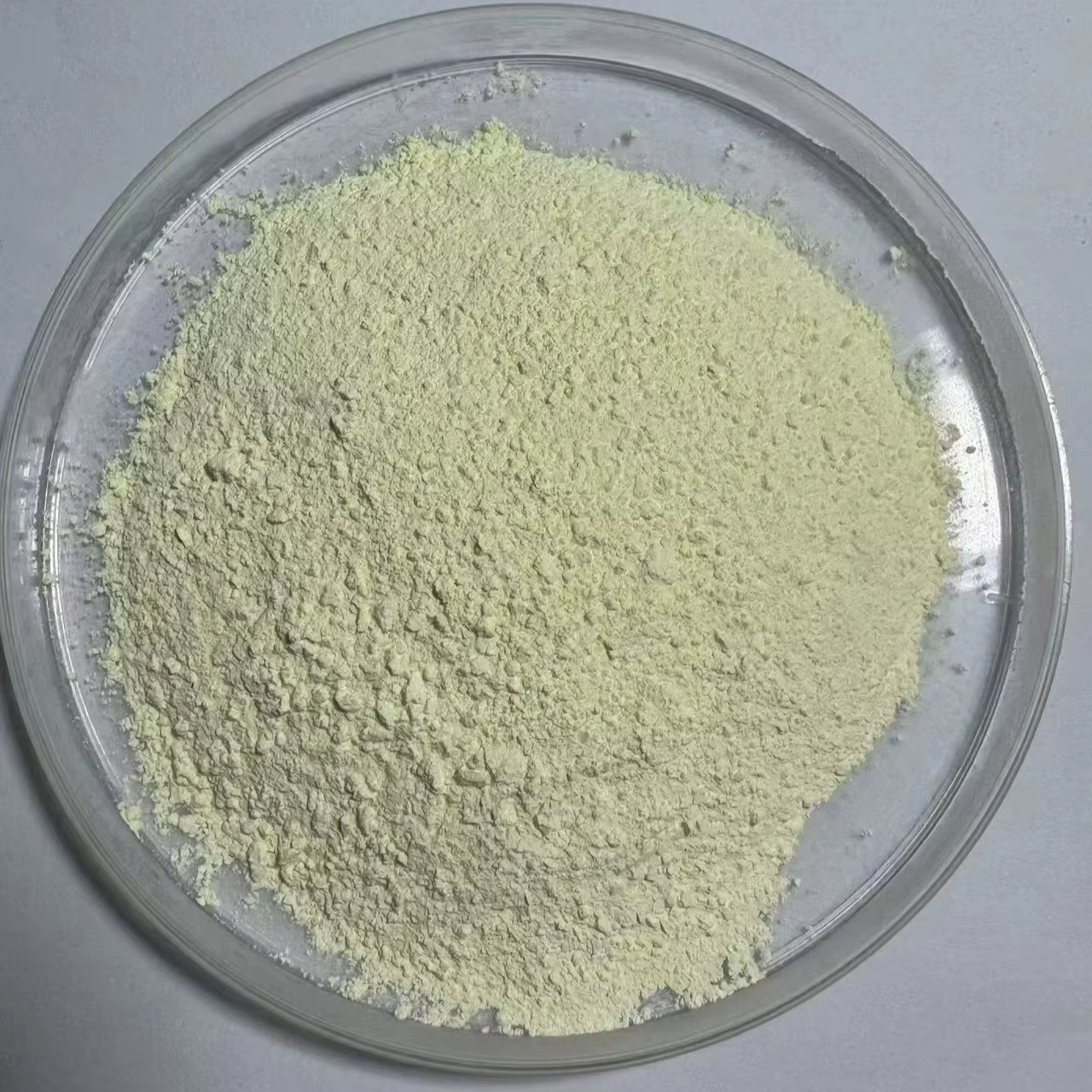
Description
Cerium oxide (CeO2): roles in catalysis and polishing
Cerium oxide is a versatile material used both as a catalyst component and as a polishing abrasive. Its unique redox chemistry and high oxygen mobility drive its effectiveness in catalytic processes, while its abrasive properties enable efficient surface finishing, especially for glass and optics. Below is a concise guide to its roles, mechanisms, and practical considerations in both areas.
Key properties that matter
- Nonstoichiometric redox couple: Ce4+ ⇄ Ce3+ with readily formed oxygen vacancies.
- Oxygen storage capacity (OSC): Ability to absorb and release oxygen, buffering redox reactions.
- Fluorite crystal structure: Supports high surface area and facile diffusion of oxygen species.
- Tunable properties: Doping (eg, Zr, Pr, Gd) and nanoscale particle size improve activity, stability, and OSC.
- Versatile supports: Often used as a catalyst support for noble metals (Pt, Pd, Rh) and as a promoter in various oxide catalysts.
Ceria in catalysis
Why ceria is useful for catalytic applications
- Oxygen buffering: CeO2 supplies oxygen to oxidize CO, hydrocarbons, and VOCs, and replenishes oxygen by drawing it from O2 in the gas phase.
- Redox flexibility: The Ce4+/Ce3+ cycle enables rapid turnover at moderate temperatures.
- Stability and dispersion: High surface area forms well-dispersed active sites and is often paired with noble metals to enhance activity and durability.
- Doping and synergy: Doping ceria with zirconia (Ce1−xZrxO2) or other dopants improves oxygen mobility, thermal stability, and OSC.
Typical applications
- Automotive exhaust aftertreatment: Three-way catalysts (TWC) and lean-NOx systems using CeO2 as an OSC promoter and support for Pt, Pd, Rh.
- CO and hydrocarbon oxidation: CeO2 promotes oxidation of CO and light hydrocarbons, often in combination with noble metals.
- Water-gas shift and reforming: CeO2-based catalysts support Cu, Ni, or other active phases for WGS and reforming reactions.
- VOC oxidation and dye degradation: CeO2’s redox chemistry aids oxidation of volatile organics and some environmental pollutants.
- Solid oxide fuel cells and electrochemistry: Ceria-based materials (eg, doped ceria) serve as electrolytes or electrode supports in intermediate-temperature SOFCs; CeO2 can act as a catalyst/promoter in reforming chemistry.
- Photocatalysis (with limitations): Pure CeO2 absorbs UV light and can catalyze some photoredox reactions; doping or coupling with other semiconductors can extend activity into visible light.
How it works (mechanistic highlights)
- Oxygen vacancy formation: Removal of lattice oxygen creates vacancies that activate O2 and reactants at the surface.
- Ce4+/Ce3+ cycling: Redox cycling supplies oxygen to reacting species and then re-oxidizes, refreshing active sites.
- Supports and promoters: Noble metals on CeO2 or CeO2-ZrO2 supports enhance low-temperature activity and resistance to sintering.
- Particle size and surface structure: Smaller, well-dispersed nanoparticles with high area boost catalytic performance; surface facets influence adsorption and turnover rates.
Practical guidelines for catalysis
- Choice of form: Use nanoscale CeO2 or high-surface-area CeO2 supports; consider Ce1−xZrxO2 for improved OSC and thermal stability.
- Metal loading: When decorating with Pt, Pd, or Rh, optimize metal loading and dispersion to maximize oxygen storage benefits without excessive cost.
- Doping strategy: Zr doping enhances OSC and thermal tolerance; other dopants (Pr, Gd) can tailor conductivity and redox behavior.
- Preparation methods: Impregnation, co-precipitation, hydrothermal synthesis, or sol-gel routes to achieve desired morphology and dispersion.
- Characterization to guide optimization: Use BET surface area, XRD for phase, CO-chemisorption or TEM for dispersion, and XPS for Ce3+/Ce4+ ratio and oxygen vacancy concentration.
- Operating conditions: Leverage CeO2’s OSC by ensuring redox cycling phases (oxidizing and reducing environments) align with process windows to prevent catalyst deactivation (sintering, oxygen vacancy blocking).
Quick comparison snapshot (catalysis)
- Pros: High OSC, good redox cycling, strong promoter effects for noble metals, good thermal stability with proper doping.
- Cons/limits: Cost when using noble metals; performance can depend on oxygen partial pressure and temperature; CeO2 can undergo sintering at very high temperatures if not stabilized.
Ceria in polishing
Why ceria is effective for polishing
- Chemical-mechanical polishing action: Ceria slurry combines gentle chemical action with abrasive removal, enabling smooth, mirror-like finishes on glass and related materials.
- Selective interaction with iron impurities: On glass, Ce4+ can oxidize iron-containing inclusions, aiding their removal and reducing staining.
- Controlled particle size: Fine colloids (often sub-micron to a few hundred nanometers) provide a balance between material removal rate and surface finish.
Typical polishing formulations and parameters
- Particle size: Commonly in the range of 0.05 to 0.5 micrometers for glass polishing; finer slurries yield smoother finishes.
- Slurry pH: Typically mildly basic, around pH 9–10, to stabilize CeO2 colloids and optimize polishing mechanics.
- Vehicle and additives: Water-based slurries with stabilizers or surfactants; sometimes additives to control surface chemistry or dispersion stability.
- Substrates: Soda-lime glass, borosilicate glass, fused silica, and certain ceramics; optical lenses and precision glass surfaces are common targets.
- Polishing mechanisms: A combination of chemical action (surface oxidation and complexation) and mechanical abrasion from CeO2 particles, aided by the polishing pad or belt.
Practical guidelines for polishing with ceria
- Substrate compatibility: Verify that the substrate can tolerate chemical interactions with CeO2 without causing unwanted surface chemistry changes.
- Particle control: Use appropriately sized particles for the desired finish; coarser slurries remove material faster but roughen the surface, while finer slurries yield smoother finishes.
- pH and stabilization: Maintain slurry stability to prevent sedimentation and agglomeration; follow vendor recommendations for stabilizers if mixing custom slurries.
- Process variables: Adjust polishing pressure, rotation speed, and slurry flow rate to balance material removal rate with surface quality.
- Safety and disposal: Handle slurries with standard lab or shop hygiene; dispose of waste according to local environmental regulations.
Quick comparison snapshot (polishing)
- Pros: Produces high-quality glass and optic finishes, effective stain removal on iron-containing inclusions, compatible with many polishing pads.
- Cons/limits: Slurry handling requires care to avoid dust and skin/eye exposure; performance depends on substrate chemistry and polishing setup.
Side-by-side comparison: catalysis vs polishing (at a glance)
- Primary role
- Catalysis: Redox active catalyst component and promoter for chemical reactions.
- Polishing: Abrasive/chemical helper in surface finishing.
- Key mechanism
- Catalysis: Oxygen storage/release and Ce4+/Ce3+ redox cycling.
- Polishing: Chemical-assisted mechanical removal of material.
- Typical particle form
- Catalysis: Nanoscale CeO2 on supports; doped oxides.
- Polishing: Stable colloidal CeO2 slurries with controlled particle size.
- Operating environment
- Catalysis: High-temperature, reactive gas environments; dynamic redox conditions.
- Polishing: Mild aqueous environments at room to moderate temperatures.
- Common substrates
- Catalysis: Metal oxides, noble metal catalysts, mixed oxides.
- Polishing: Glass, fused silica, ceramics, lenses.
Safety, handling, and environmental notes
- CeO2 powders and slurries can be irritants if inhaled; use appropriate PPE and ventilation.
- Fine oxide nanoparticles may pose inhalation hazards; handle with care in well-ventilated areas.
- Waste slurry should be disposed of according to local regulations for inorganic oxides and any additives present.
- Always consult material safety data sheets (MSDS) from suppliers for specific product formulations.
Summary / key takeaways
- Cerium oxide is a versatile material thanks to its oxygen storage capacity and Ce4+/Ce3+ redox chemistry.
- In catalysis, CeO2 acts as an oxygen buffer and promoter, enhancing oxidation reactions and stabilizing noble metal catalysts; doping and nanoparticle dispersion are important levers for performance.
- In polishing, CeO2 slurry provides a favorable chemical-mechanical balance for high-quality glass and optic surfaces, with process parameters tuned to substrate type and desired finish.
- When selecting ceria for either application, consider particle size, surface area, doping, and compatibility with the rest of the system (catalysts or polishing setup) to achieve the best performance.
If you’d like, I can tailor this to a specific substrate (eg, automotive exhaust catalyst, fused silica polishing, or a particular dopant system) and suggest a concrete formulation or experimental setup.

Reviews
There are no reviews yet.